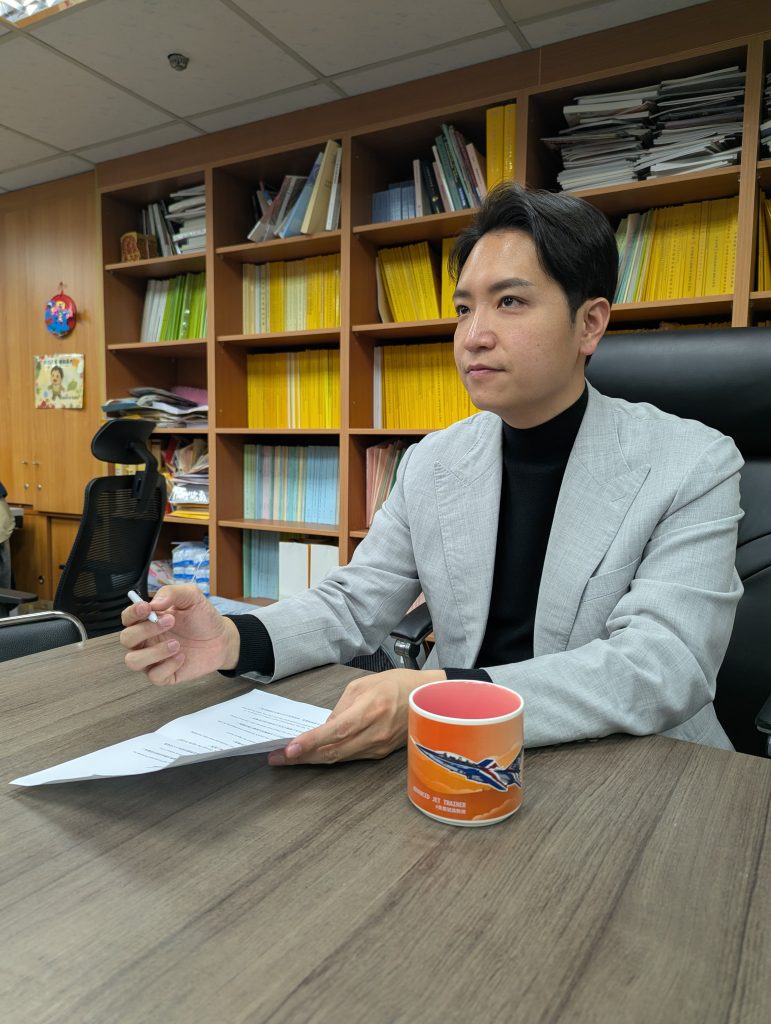
The Chinese Nationalist Party (KMT) could support the Taiwan People’s Party (TPP) special defense budget, a KMT lawmaker told Domino Theory.
The TPP’s proposal is “pretty much the same as ours,” said Lo Ting-wei (羅廷瑋), the legislator for Taichung’s sixth electoral district. “Whether it’s 380 billion or 400 billion, they are fundamentally similar,” he added.
Lo, who was speaking Mandarin, said that the two proposals could end up being bundled together as a single “blue-white” special budget (blue and white are the colors of the KMT and TPP respectively). But if it came down to it, “there’s definitely room” for the KMT to simply support the TPP version.
Taiwan is in the middle of a long and ugly battle over different special defense budgets proposed by the three main parties. But if Lo is correct, that battle might be brought to an end, at least at the legislative level.
Taiwan’s ruling party, the Democratic Progressive Party (DPP), proposed a 1.25 trillion New Taiwan dollar (roughly $40 billion) special defense budget in November. The opposition parties have opposed that ever since, saying that they want more legislative oversight over government spending and that the government’s proposal is not transparent enough. Critics say that the opposition is seeking to hamper Taiwan’s ability to defend itself from Chinese aggression.
The issue gained urgency in December when the U.S. announced an $11 billion arms sale. After subsequent pressure from U.S. lawmakers and officials, the TPP announced an NTD 400 billion (roughly $12.7 billion) special budget that would fund this purchase in January. The KMT revealed its own NTD 380 billion (roughly $12 billion) proposal last week.
The differences between the KMT and TPP proposals can partly be identified by the fact that the KMT’s version requires official Letters of Acceptance from Washington for each arms sale before funding is released, and that weapons be delivered by the end of 2028. The KMT also says it will provide the funds for future arms sales after they are announced by the U.S.
But another difference is that of the eight items in the U.S. arms sale, the TPP only proposed to fund five using the special budget, whereas the KMT committed to funding all eight. It was assumed at first that the TPP was cutting the other three items, but Taiwan’s defense ministry stated on March 5 that it would be covered by regular defense spending and budgeting extra for them was unnecessary.
Somehow, it seems the TPP knew this in January, and the KMT didn’t know it in March.
Emphasizing that he was speculating, Lo said that he believed there is “a huge gap in information communication.” He suggested that the defense ministry “intentionally concealed [information] or failed to inform us.” He added that much of the detail of the DPP’s NTD 1.25 trillion special budget was only revealed to the other parties in a highly classified briefing to the foreign and national defense committee on January 19, two months after it was announced.
“In the past, the executive branch was willing to simultaneously provide explanations on the content of the special budget when the [special defense budget] was sent to the Legislative Yuan,” Chieh Chung (揭仲), an adjunct associate research fellow at the Institute for National Defense and Security Research, Taiwan’s government-affiliated defense think tank, told Domino Theory last week. However, he said the current government has been very reserved in this regard.
The opposition parties also didn’t get any indication from Washington that the special budget would be so large, or what would be in it, according to Kevin Sun (孫廷禎), a policy advisor in the office of Chen Ching-hui (陳菁徽), another KMT lawmaker.
The TPP’s current proposal is too specific, which could “increase the difficulty of procurement and limit the flexibility needed for execution,” Sun cautioned via direct message. He gave the example of naming the HIMARS rocket system directly instead of using a broader category like “long-range precision fires.”
One analyst Domino Theory spoke to said that opposition parties should not be making defense budget proposals at all, calling the current situation “ridiculous.”
The TPP is the party in the driver’s seat now. If the DPP-led government is more transparent about the budget and meets TPP demands, “What happens if the TPP breaks away to have enough votes to pass the budget without the KMT?” said Bryce Barros, an associate fellow at GLOBSEC, a Slovakia-based think tank.
The TPP has indeed made noises to that effect, saying it could support the NTD 1.25 trillion special budget if the U.S. announces a second rumored arms sale package. Domino Theory asked Lo if he thought the TPP was trying to pressure the KMT.
“I would be lying if I said no,” he replied, with a curious expression somewhere between a smile and a grimace.



Leave a Reply