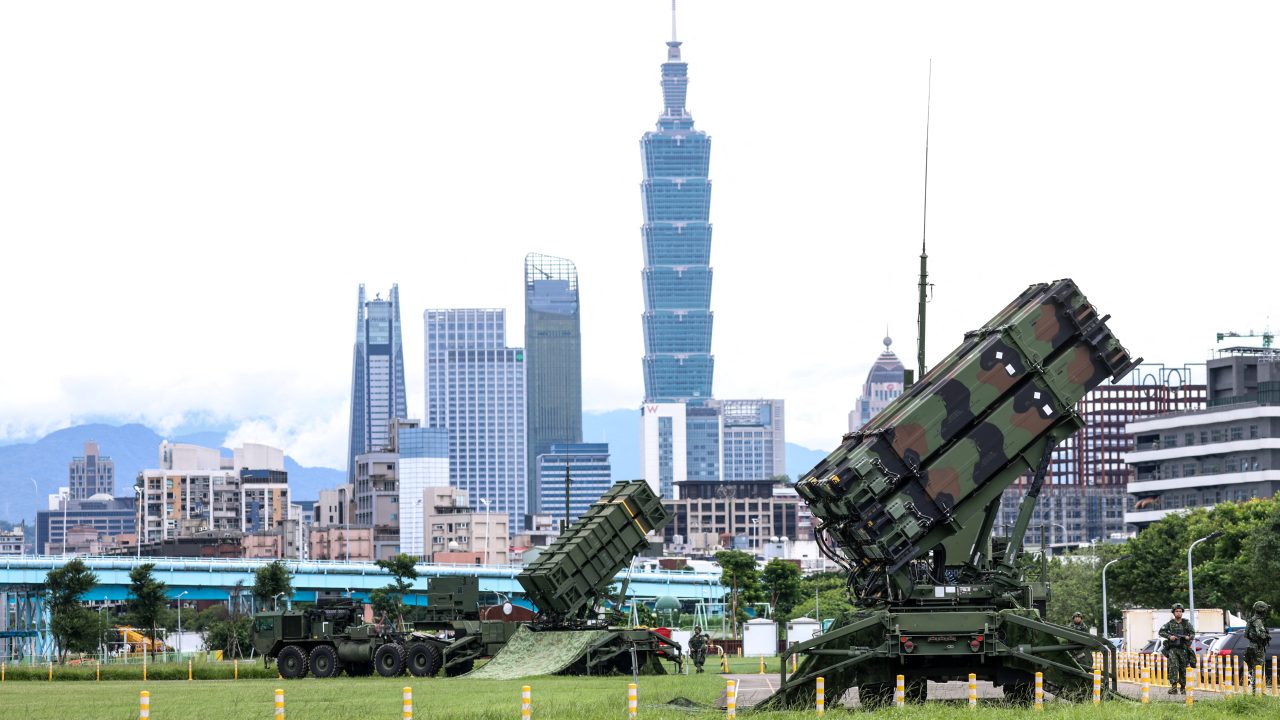
Taiwan’s defense budget woes are probably coming to a middle, not an end.
Taiwan needs to pass at least one special budget to fund its purchases of U.S. weapons. Each of the three main parties seems determined to propose their own special budget, leading to confusion and chaos.
The Democratic Progressive Party (DPP) has proposed 1.25 trillion New Taiwan dollar ($40 billion) special budget. The Taiwan People’s Party (TPP) has proposed a 400 billion NTD ($12.7 billion) special budget. And the Chinese Nationalist Party (KMT) hasn’t formally proposed a special budget yet, but says it will be 380 billion New Taiwan dollars ($12 billion) plus N, an unspecified amount for a future special budget for future U.S. sales.
A special budget is an act of legislation passed by Taiwan’s parliament and signed by the president. It provides funding for specific purposes which can be spent over a number of years. Notably, Taiwan’s president, Lai Ching-te (賴清德), is a member of the DPP, while its legislature is controlled by a coalition of the KMT and TPP.
“The number on the front of the arms package, whether that’s 11 billion, 20 billion, 40 billion, is what Washington is going to see, and think Taiwan is buying X billion,” said Seamus Boyle, a senior analyst at Garnaut Global, a risk strategy firm focused on China.
In terms of sending a signal to the U.S. that Taiwan is serious about its defense, and is also buying American weapons, the headline figure is important. Boyle said that opposition parties are being “asked to sign a blank check” with Lai’s $40 billion. But he pointed out that if they obstruct it, then they “risk arousing criticism” from Washington.
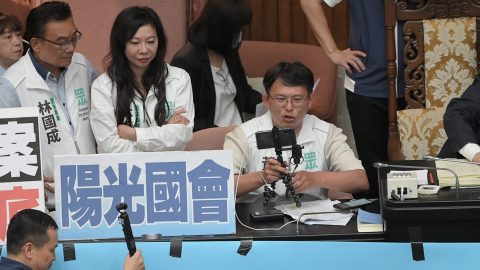
All parties say they support some form of increased defense spending, but nonetheless DPP and the coalition of the KMT and TPP have so far refused to support or compromise on the other’s spending plan.
In February, a bipartisan group of 37 U.S. senators and members of Congress signed a letter addressed to the speaker of Taiwan’s legislature and the heads of the three parties, calling for support for a “robust, multi-year special defense budget.” In December, the U.S. representative to Taiwan Raymond Greene, said in an interview that the U.S. welcomes “President Lai’s “commitment to increasing its defense budget to 5 percent of GDP, including through the 1.25 trillion New Taiwan dollar special defense budget.”
The DPP’s $40 billion special budget is an act that would legislate for Taiwan to spend $40 billion across the next eight years. Since it was announced in November, the opposition-run legislature has refused to consider it for discussion, let alone pass it into law. The special budget is intended to procure precision artillery; long-range precision strike missiles; air defense, anti-ballistic, and anti-armor missiles; unmanned vehicles and their counter systems; equipment to bolster sustained operational capacity; AI-assisted systems and Command, Control, Communications, Computer, Cyber, Intelligence, Surveillance, and Reconnaissance platforms; and equipment and systems co-developed and procured through Taiwan-U.S. collaboration.
The U.S. approved an $11 billion arms sale for Taiwan in December. The arms sale contains eight different items: HIMARS rocket artillery systems, Paladin gun artillery systems, ALTIUS loitering munitions, Javelin anti-tank missiles, TOW anti-tank systems, tactical mission software, Cobra helicopter repair support and Harpoon anti-ship missile repair support.
The DPP’s $40 billion special budget covers the $11 billion, as well as assumed future arms sales, because it already specifies in broad strokes the systems that are in them.
The TPP announced its own $12.7 billion special budget in January, which passed its first reading in the legislature with KMT support. It explicitly funds five of the eight items in the $11 billion sale, but doesn’t mention the tactical mission software and Cobra and Harpoon repair support. Domino Theory’s interpretation was that it also implicitly funded these remaining three items through a clause referring to “other items that have already received foreign approval for sale.”
That is probably not the case, according to Joe O’Connor from Taiwan Security Monitor, an organization at George Mason University that is tracking the budgets. Taiwan Security Monitor recently published a comparison of the DPP and TPP’s special budgets.
O’Connor’s main concern with the TPP proposal is that it doesn’t provide funds for Taiwan’s indigenous production of weapons, including domestic production lines for 105 millimeter ammunition, 120 millimeter ammunition and autocannon rounds, which Taiwan Security Monitor considers to be extremely important.
The fact that it doesn’t cover maintenance and logistics for what it buys is a “fair concern,” but O’Connor also said the TPP’s request is “somewhat logical” in that it just wants to procure concrete systems.
If the TPP special budget ended up on Lai’s desk and he was a U.S. policymaker he would still support Lai signing it, O’Connor said, as it funds “the five more important procurement cases.”
Interestingly, on March 3, TPP Chair Huang Kuo-chang (黃國昌) told the The Japan Times his party would agree to pass the $40 billion special budget if the U.S. formally announces a rumored second arms sale. That sale is reportedly being held up ahead of U.S. President Donald Trump’s visit to China in April.
For its part, the KMT announced details of its own special budget today, March 5. The dollar amount will be approximately $12 billion, and will cover the eight items in the recent arms sale from the U.S., according to United Daily News. But once the U.S. formally submits a new arms sales offer, a second special bill should be drafted and submitted to Taiwan’s legislature.
Liberty Times previously reported KMT leaders around Chairwoman Cheng Li-wun (鄭麗文), including legislator and caucus whip Fu Kun-chi (傅崐萁), apparently favored an $11 billion sum, but some KMT legislators instead supported a much larger 810 billion New Taiwan dollars, ($25.5 billion). “There are signs of a bit of an internal struggle in the KMT,” Boyle from Garnaut Global said. He pointed to quotes from the KMT’s speaker in the legislature, Han Kuo-yu (韓國瑜), who said that the party had been suffocating itself with its opposition to the special defense budget.
The legislature will review all three special proposals tomorrow, Liberty Times reported.
Ko Yong-sen (柯永森), a researcher at the Institute for National Defense and Security Research, commonly known as INDSR, Taiwan’s government-affiliated defense think tank, predicted to Domino Theory via email that the budget is likely to be handled through a compromise method of “reducing the budget scale, phased appropriations, and year-by-year (or biennial) review.”
In theory, passing multiple smaller special budgets over the next four years would be perfectly reasonable. But it would require a certain amount of trust from other interested parties that the subsequent budgets will be forthcoming.
And these days in Taipei, that trust is hard to come by.
Update: The KMT has updated the amount this afternoon from NTD 350 billion to NTD 380 billion, roughly $12 billion in today’s exchange rate (1 NTD = 0.0315 USD)



Leave a Reply