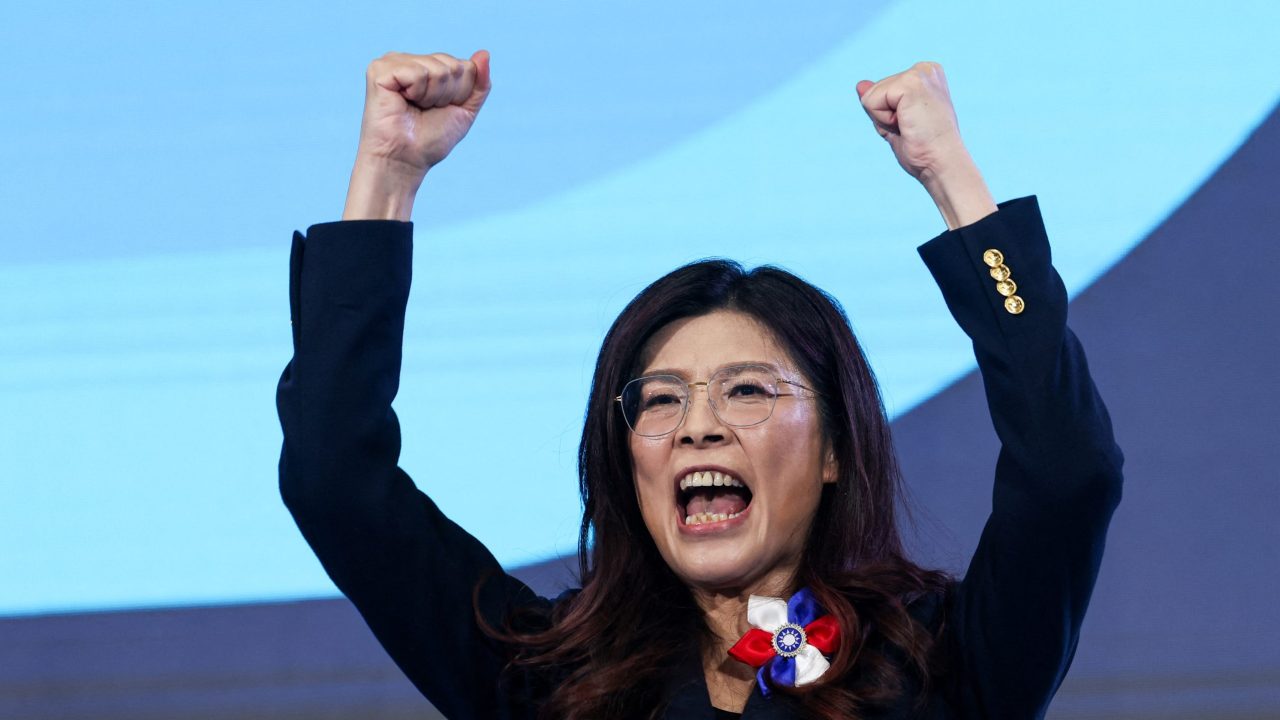
Russian President Vladimir Putin is democratically elected, Chinese Nationalist Party (KMT) Chairperson Cheng Li-wun (鄭麗文) said on Monday, doubling down on previous comments. She then asked, in stark contrast, whether Taiwanese President Lai Ching-te (賴清德) was undermining Taiwan’s own democracy.
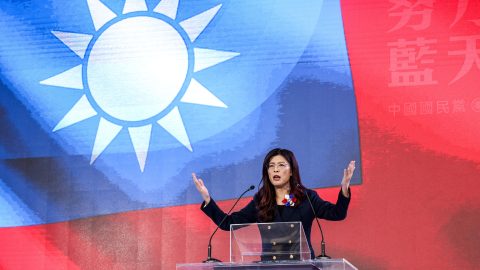
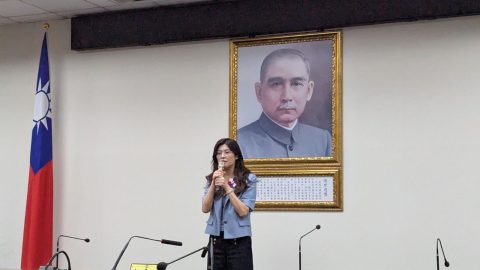
Cheng was speaking with students in an at-times heated question-and-answer session at Soochow University (東吳大學) on Monday.
At the event, titled “The KMT’s Reforms and the Path to Youth Participation in Politics,” Cheng talked about the hardship and changes the KMT is going through, and how international media like The New York Times and Deutsche Welle have misinterpreted her and her party. She and her colleagues are working hard to overcome these obstacles, Cheng said.
Cheng listed off historic events: the Republic of China government relocating from China to Taiwan, the severance of ties with the United States, the “withdrawal” from the United Nations. Through these obstacles, she said the country was able to transition into the “first democracy in Asia” (亞洲第一個民主共和國). This statement is hard to understand. In context it’s clear she is referring to the 1980s, but many democracies in Asia predate this.
The KMT, Cheng said, is a party that “creates miracles.”
Much other ground was covered.
Who Gets to Call Whom a Dictator?
Cheng caused a stir in October when she said Putin is not a dictator. Asked about those comments on Monday, Cheng repeated: “Putin is a president who was democratically elected. I am the chairperson of the KMT, so I wouldn’t say Putin is a dictator.”
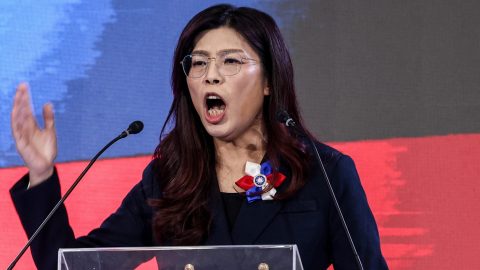
She added that she “wouldn’t use such harsh words to describe foreign leaders.” Cheng was immediately asked why then she had used the term “dictator” to describe Lai. She responded by asking “Is Lai Ching-te trying to undermine Taiwan’s democratic mechanisms, its democratic foundations, its democratic rules, and aspiring to become a dictator?”
The student who raised the point fired back, saying Cheng didn’t answer his question. Cheng shut him down: “If you are not satisfied with my answer, there is nothing I can do about it.”
Cross-Strait Defense
The KMT “has always been the strongest supporter of Taiwan’s military and defense,” Cheng said, adding that “we’re not against arms purchases or adequate capability, but Taiwan’s security isn’t decided by a price tag or a blank check.”
Real defense resilience comes from cross-strait peace, Cheng said, not “an arms race to see who has the bigger fist.”
She elaborated: “The real key to lasting cross-strait peace lies right here in Taiwan. It’s simple: KMT-CCP reconciliation first, then cross-strait reconciliation. The basis is the 1992 Consensus and opposing Taiwan independence.” Cheng argued that former President Ma Ying-jeou (馬英九) proved this with eight years of “peace and prosperity.”
Cheng defended Ma’s decision to downsize the military and reduce military spending during those eight years, saying he wanted to switch to an all-volunteer, professional force. “The U.S. also has an all-volunteer force, and mainland China also has an all-volunteer force. Does switching to an all-volunteer force mean no defense for Taiwan? That’s silly.”
Cheng clarified she is not against conscription per se. However, she asked: “Has extending it from four months to one year strengthened Taiwan’s defense? Are we that easy to fool ourselves? Is it really that easy to stop the People’s Liberation Army from coming?”
The real problem with the military, according to Cheng, is not conscription at all. It is recruitment. “Why is there no one willing to join the military professionally?” she asked.
Taiwan’s Constitutional Crisis
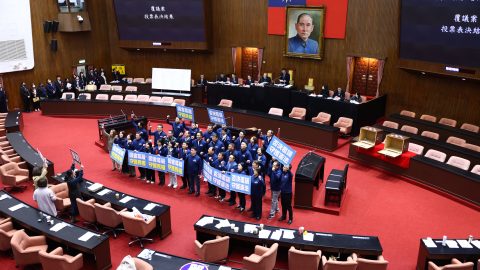
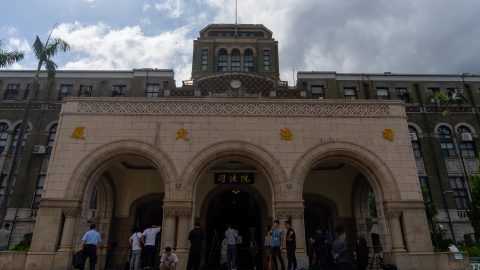
Taiwan is in the middle of a constitutional crisis after the premier refused to sign a new law and the KMT threatened to impeach him and the president. The terrain of the crisis shifted dramatically last Friday when the Constitutional Court, which had effectively been paralyzed by KMT legislation, suddenly ruled that said legislation was unconstitutional and effectively reactivated itself. Now, the KMT is suing the majority of five justices who made that ruling.
“The problem starts and ends with Lai Ching-te,” Cheng said. “Democracy means dialogue, communication, compromise. In a divided government, you nominate justices that the majority in the legislature can accept, that’s democracy. Lai would rather let the Constitutional Court grind to a halt than appoint anyone who doesn’t share his views. That’s the core reason we’re in a constitutional deadlock.”
Taiwan and the Republic of China’s Sovereignty
On whether the Republic of China is a sovereign state, Cheng said “Of course it is. There’s no need to ask such a provocative question. Today, although the Republic of China and the People’s Republic of China are not subordinate to each other, they belong to ‘one China.’ This is stipulated in black and white in the Constitution of the Republic of China.”
“The KMT opposes Taiwanese independence because it is realistically impossible,” Cheng said, continuing: “No country in the world supports Taiwanese independence.”
“When I say I’m Chinese, it’s a completely natural thing. Why has it become politically incorrect in Taiwan?” Cheng reflected. “‘Chinese’ shouldn’t be narrowly defined as just the PRC or ROC. For most people it means a 5,000-year civilization.”
Is the KMT Anti-Communist?
Cheng was asked about the KMT’s party charter including “opposition to Communism” and the contradiction between this and cross-strait reconciliation. She replied: “We oppose Communism. The KMT follows the ‘Three Principles of the People.’ This has no conflict with reconciliation between the KMT and CCP. We want no more fighting and killing, but we’re not joining the Communist Party, so there’s no need to change the charter.”
The Three Principles of the People (三民主義) are the ideological basis of the political program of KMT founder Sun Yat-sen (孫中山), championing the principles of nationalism, democracy and socialism.


Leave a Reply