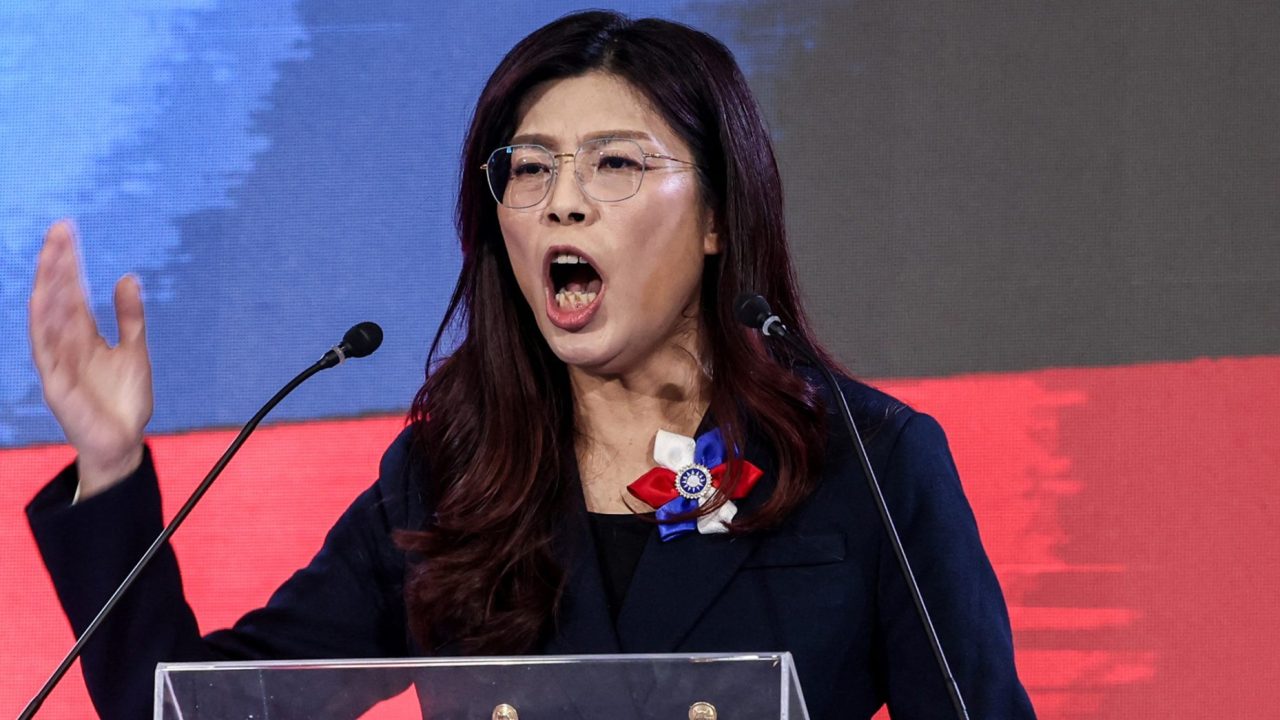
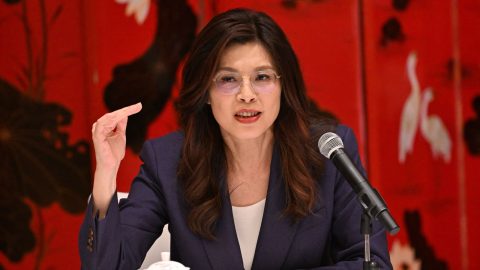
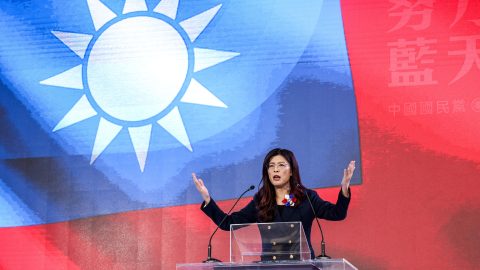
New Chinese Nationalist Party (KMT) chairperson Cheng Li-wun (鄭麗文) caused controversy last week when she told German public media Deutsche Welle that Russian President Vladimir Putin was not a dictator and that NATO caused the war in Ukraine.
After the interview aired on Friday, Cheng was immediately asked to justify her remarks, and said that after the collapse of the Soviet Union, Russia quickly transitioned to democracy.
“Those follow-up attacks only rally the loyal supporters, but they won’t convince light-blue voters, let alone centrists,” said Niu Tse-hsun (鈕則勳), a Chinese Culture University marketing professor who frequently offers commentary on Taiwanese political programs.
What Did She Say?
Cheng told Deutsche Welle’s Tsou Tzung Han (鄒宗翰): “Putin became president because he was elected via a democratic vote, you can’t call him a dictator. Labeling him that way is unreasonable and unfair.”
On Russia’s invasion of Ukraine, Cheng said “the core reason the war broke out and continues today is NATO’s repeated eastward expansion,” and “none of this would have happened” if Ukraine and allied countries had abandoned plans to let Ukraine join NATO.
Why Would Cheng Say That?
Cheng “lacks the relevant knowledge about the Russian political situation,” according to Chen Ping-Kuei (陳秉逵) from the Department of Diplomacy at National Chengchi University. He said she simply doesn’t know that in Russia, “there’s no legitimate opposition party.”
While it might be alarming that one of Taiwan’s leaders would be so uniformed on a geopolitical topic that matters a lot to a Western audience, Chen said that even many politicians don’t understand what happens in foreign countries. He also suggested that Cheng may be receiving Chinese narratives about Russia and Ukraine from Taiwanese sources that are close to China: “I think she has heard so many people talking about ‘it was the U.S. to blame in this war,’ so she took it for granted.”
How Has This Impacted Cheng’s Domestic Standing?
One way to understand the resounding failure of the recall votes this summer is to say that Taiwanese voters are looking for a more moderate politics.
If the KMT is going to perform well in the presidential election in 2028, the party needs to appeal to a median voter that has returned three Democratic Progressive Party (DPP) presidencies in a row. Chen said the median voter and even KMT members don’t really know who Cheng is yet. But there is no sign yet that Cheng is really courting a voter more centrist than her base. “It doesn’t seem that Cheng Li-wun is trying to claim to be a median voter party,” Chen said, and hammered home the point that this will concern median voters.
Everything Cheng says for the next three years will be parsed through the context of her trying to persuade the Taiwanese people that the party she now leads can be trusted to engage with China without hurting Taiwan’s interests. Views that centrist voters associate more with pro-China media in Taiwan, or with Chinese media itself, are likely to be a problem for the KMT.
Addressing the Cheng and the KMT’s relationship with China, Thomas Ching-wei Tu (凃京威), a doctoral fellow at National Chengchi University’s College of International Affairs, said that “China has very high expectations for Cheng Li-wun.” These expectations “could even shift the narrative on the party’s cross-strait policy, because the ‘1992 Consensus’ just isn’t usable anymore for all sorts of reasons — it’s no longer a viable term.” He asked if the KMT might come up with a new framework in the Cheng era.
The Taiwanese public doesn’t care much about Russia and its politics, Tu said. “If Cheng said Xi Jinping was democratically elected, that would really hit home for Taiwanese voters, but Putin feels distant, so the impact is milder.”
Cheng appears unalert to any risk associated with being too close to China. Tomorrow, she plans to attend an event in Taipei honoring a Chinese Communist Party spy who was executed by the KMT in 1950 and who is the subject of a current Chinese TV drama that Chen Binhua (陳斌華), a spokesperson for China’s Taiwan Affairs Office, said will “undoubtedly inspire compatriots on both sides of the Taiwan Straits to achieve the great cause of national reunification.”
How Will the U.S. View These Comments?
Under the previous Biden administration, Cheng’s views would have probably landed like a lead balloon. However, with the new MAGA Trump team, there will have been pockets of sympathy, at least for the NATO portion of her comments. It’s worth emphasizing that none of the experts featured in this article thought Cheng was adopting a deliberate stance for any reason, let alone because she thought there was some appetite for it in Washington.
Even though her views on Ukraine might cause less of a stir, Cheng still has choppy waters to navigate in the KMT’s relationship with the U.S. This year, outgoing chairman Eric Chu (朱立倫) seemingly managed to persuade the Americans that the KMT supported the defense budget increase the new administration has planned. Cheng has already said she opposes them.
Voters want more of a balance between Taiwan’s relations with the U.S. and China, Chen from National Chengchi University believes. The KMT needs to show it has “more courage to stand up to the U.S.,” he said. However, he doesn’t see “any sign” that Cheng is trying not to alienate U.S. “At this moment, I’m still a bit worried about the KMT — U.S. relations. I think, so far, it’s not going well, and it is not looking good.”
And the Europeans?
Ukraine cuts closer to Europeans than many Americans these days. However, European representative offices won’t want to be seen to be inserting themselves into a domestic political argument, said Marc Cheng (鄭家慶), Executive Director of the EU Centre in Taiwan, so their reaction will be muted. It will be “an issue that foreign representatives will want to clarify when it comes to [a] good opportunity or proper time,” Cheng said. Regardless, “it will, in some sense, have some impact over the perception of the foreign representatives in Taiwan, for the new KMT chairperson or chairwoman.”
The Scorecard
There seems to be widespread agreement that Cheng needs to tighten up her communication style and avoid these kinds of mistakes, given that everyone Domino Theory spoke to believes that she didn’t deliberately introduce the ideas.
Maybe she hasn’t realized that she is no longer a freelancer or political administrator when she faces the media, Cheng said. “Now she’s chairman of the KMT, the biggest political party in Taiwan.” He wondered if she forgot that everything she says carries policy weight. Tu spoke in a similar vein: “I think it’s probably that she hasn’t fully adjusted to the new role yet. Being the leader of a major party means she’s a reserve candidate for national-level office — that’s a basic fact.”
And the overall verdict? Let’s give Niu of Chinese Culture University the last word: “On this issue, for Cheng Li-wun, it was clearly a loss on points — a significant one.”

Leave a Reply