
Zero. Not even one.
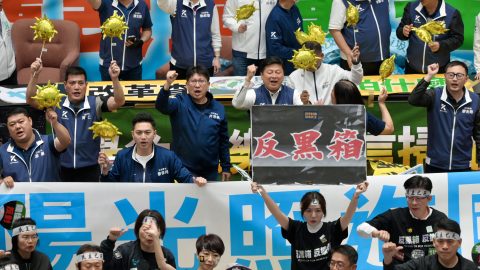
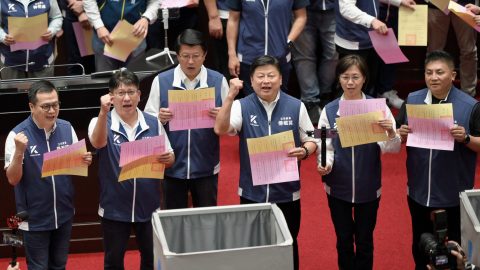
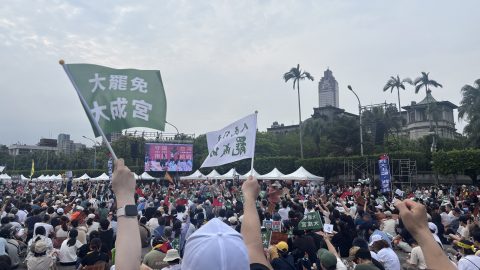
Yesterday, none of the 24 Chinese Nationalist Party (KMT) legislators facing recall were successfully ousted. This is a blow to the Democratic Progressive Party (DPP) and the civic groups at the center of the pro-recall movement, who sought to indict the KMT for what they described as “pro-China” policies. The mass recall election also presented an opportunity for the DPP to undo the coalition majority that the KMT and the Taiwan People’s Party (TPP) enjoy in the Legislative Yuan.
The movement could theoretically still recall six KMT legislators and flip those seats in the by-elections in order to regain a legislative majority for the DPP. Seven more KMT legislators will face a recall vote on August 23. But at this point, the chance of any of them being removed is very low. “I wouldn’t expect those [recall elections] to be any different. There’s a reason they’re the second wave. It was harder to get the signatures for in the first place,” said Nathan Batto, a political scientist and election studies expert at Academia Sinica. “This campaign is basically over.”
“Today’s result should not be misconstrued as a signal on cross-Strait or foreign policy, nor should it be interpreted through the lens of ‘pro-China’ or ‘pro-Taiwan’ alignment,” said Eric Chu (朱立倫), the KMT’s chairman. For their part, the DPP claimed that this result is not a referendum on their own performance. “This was not a confrontation between parties, but a demonstration of civic power,” DPP Secretary-General Lin Yu-chang (林右昌) told reporters.
Batto thinks “the KMT and their supporters are sick of being painted as either willing or unwilling lackeys of the CCP [Chinese Communist Party]. They don’t think of themselves that way. They think of themselves as loyal to the country.” This isn’t a new narrative: “the KMT has been talking about [how] the DPP doesn’t have a monopoly on loving Taiwan for, you know, at least 25 years.”
In fact, KMT spokesperson Crystal Yang (楊智伃) felt the need to clarify to Reuters on July 22 that, “We feel the same way as all the people of Taiwan — this is our business. It is the two parties, the DPP and the KMT, fighting for public support, for public recognition. It has nothing to do with the mainland.”
The KMT will certainly frame the results of yesterday’s vote as a win. “The KMT will insist that this was a vote of no confidence in President Lai [Ching-te] (賴清德) and the DPP and that it affirmed their actions and position,” said Batto.
In contrast, even though the recall movement succeeded in passing two rounds of signature collecting in order to put 31 KMT lawmakers up to a vote, it will be difficult for the DPP to frame this as a win. “All the recall votes failed, and that’s the first bottom line,” said Batto. The DPP’s message will likely be that “these were blue districts that elected blue legislators and nothing really changed.”
Indeed, Vince Yuen, a campaigner in Taoyuan who goes by the name Xiao Sze (小詩) within the recall movement, told Domino Theory that they weren’t very optimistic because these districts are historically blue leaning.
Yuen thought that part of the reason people turned out to oppose the recall was because the KMT-TPP controlled Legislative Yuan successfully passed a bill earlier this month to award every person $10,000 New Taiwan Dollars (approximately $300 USD). This might not seem like a substantial amount of money, but it’s a sizable sum if each member of a household of seven people is receiving the cash. Yuen also said that the KMT successfully framed the recall as a partisan issue in order to rally support against the DPP.
There is not a single answer to why no KMT legislators were successfully recalled yesterday, according to Batto. But the initial data seem to affirm the 2024 election results — the election that brought the DPP’s Lai to power in the Executive Yuan and the KMT to power in parliament. “In terms of, you know, the partisan balance, there weren’t any obvious, enormous shifts in public opinion.” In short, “the DPP didn’t really lose anything, the KMT didn’t really win anything.”
Even though the recalls failed yesterday, Yuen said that “the majority of the Taiwanese people do not agree with what [the KMT] are doing in the legislature.” But she also argued that those who voted against the recalls don’t know what the KMT are doing in the legislature, saying that the pro-recall movement needs to think about why it was unable to reach them with its messaging. Over the past year, the KMT has passed laws that opponents described as a power grab, drawing power to the legislature at the expense of other branches of government.
Although the recall movement was driven by civilians concerned about pro-China policies and influences, others think it failed to resonate with the country due to the focus on ideology over issues like people’s livelihood, according to Albert Chiu (邱師儀), a political science professor from Tunghai University in Taichung. Younger voters express frustration with high housing prices and low wages instead, he added, speaking at a press conference hosted by the Taiwan Inspiration Association.
“The anti-recall turnout definitely has been triggered in the last stage of the campaign, especially when KMT heavyweights all joined the local neighborhood rallies and the KMT elevated the level of this campaign to party-versus-party,” said William Yang (楊皓暐), Crisis Group’s senior analyst in North East Asia.
In eight of the 24 votes, KMT lawmakers got more votes than in 2024. But at the same time, seven of the recalls passed the 25% threshold to succeed, failing because of the larger number of dissenting voters.
“People are quite divided on the direction of our nation,” said Chia-hung Tsai (蔡佳泓), a professor at National Chengchi University specializing in Taiwanese elections.
Several experts told Domino Theory that this moment is somewhat of a reckoning for the DPP’s go-to communication strategy. “The DPP’s message was slightly confusing,” said Wen-Ti Sung (宋文笛), a nonresident fellow at Atlantic Council. While the recall campaign was framed in national security terms, the Lai administration did not assume direct leadership over the movement. (Part of the reason for this is that the DPP didn’t want to be seen as puppeteering the movement, which was ostensibly grassroots.) “National security campaign messaging usually is designed to generate a rally-around-the-flag effect. Yet the leaders weren’t there to man the flag,” said Sung.
Other experts think the DPP needs to revise the role that China plays in its central narrative. The slogan “resist China and protect Taiwan (抗中保台)” is no longer an effective strategy to attract support,” said Hsiao Yi-Ching (蕭怡靖), a researcher at National Chengchi University’s Election Study Center. Hsiao thinks that the results of the recall vote show that voters don’t think a vote for the KMT actually means that they are putting Taiwan at greater risk of being invaded by China. As William Yang put it, “the general public in Taiwan is becoming more numb to these anti-China slogans.”
In terms of policy, the DPP might feel pressured to alter their strategy, especially if KMT legislators feel emboldened by surviving the recall votes. Tsai from National Chengchi University thinks that the failure to recall any KMT legislators shows that “most people” would like the DPP to be more flexible in its approach to China. This could mean a number of things, including that the DPP is pressured to find opportunities to open dialogue with China, accept the “one-China Policy” as a condition to participating in international bodies like the World Health Organization, exercise more caution about the expansion of Taiwan’s semiconductor industry in the U.S. or take a friendlier approach to Chinese immigrants to Taiwan. “Right now, the DPP is not in a good position to argue that we have [the] support from most people, so we refuse to cooperate with China.”
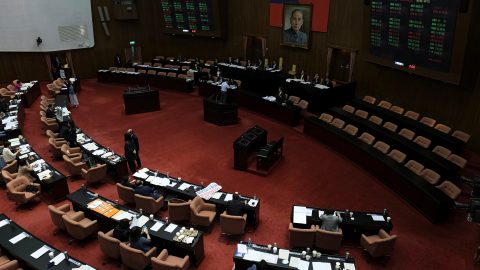
Batto does not expect the outcome of the recall election yesterday “to create a major change in legislative culture.” Even so, “the legislature is very powerful, and the executive branch is going to have to figure out how to deal with that, how to navigate a legislature that isn’t necessarily cooperative and sometimes is as actively hostile to them.”
The recalls consumed the energy and time of volunteers on both sides for the entire first half of the year. Bringing a recall to the third round vote meant gathering tens of thousands of signatures. Since another recall campaign against these legislators cannot be attempted for the rest of the term, this begs the question, where will all the energy of the movement go?
“[Their] energy and passion kind of gets diffused by the electoral result,” replied Batto. “This is, you know, democracy working … you had a fair shot, and it didn’t work.”

Leave a Reply