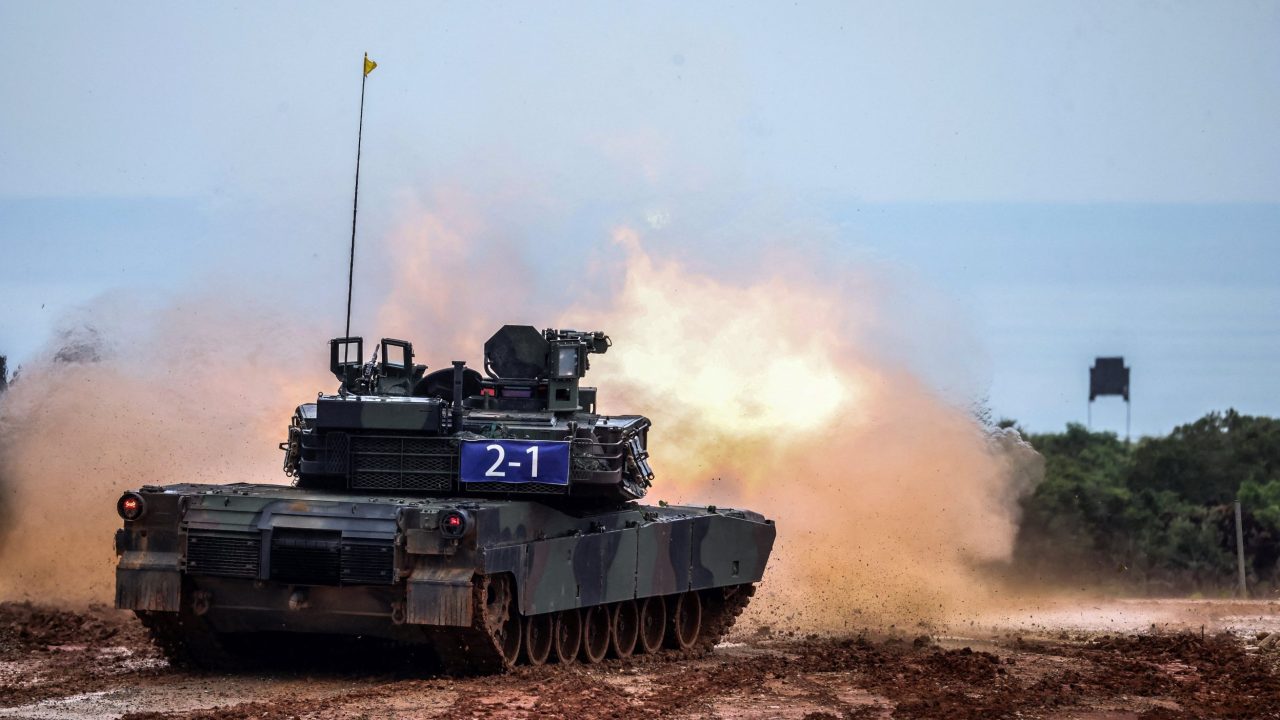
There have long been calls out of the Trump White House for a dramatic increase in Taiwan’s defense spending.
Last week, Taiwan announced that it will increase its proposed defense budget for 2026 to 3.32% of GDP. On Saturday, speaking on board a navy frigate, Taiwanese president Lai Ching-te (賴清德) went further and committed to the goal of raising it to 5% by 2030. This year, Taiwan spent 2.38% of its GDP on the military. An increase of 39% within one year, and more than doubling over the next five would indeed be dramatic, if it actually happens.
Roger Wicker, the U.S. senator for Mississippi and chairman of the Senate Armed Services Committee, arrived in Taipei today as part of a larger congressional delegation and spoke to the press at the presidential building, seeming to buy the increase at face value. “I’m delighted to say that the United States appreciated the goal of this great president to move to over three percent of the economy being spent on national defense by next year, and some five percent by the end of the decade,” he told reporters in prepared remarks.
As part of the announcement of moving to 3.32%, a figure based on projected GDP numbers for the year, Premier Cho Jung-tai (卓榮泰) revealed that Taiwan is also changing how it calculates military spending. Starting from 2026, Taiwan will follow NATO’s defense expenditure definition, including the costs of the coast guard and veteran benefits. A part of the increase is thus moving existing expenditure into the budget.
“This inflates the nominal defense budget but does not necessarily reflect proportional increases in core military spending or immediate combat readiness,” Tang Meng Kit (鄧銘傑), a Singaporean freelance analyst and commentator who works as an aerospace engineer, told Domino Theory through a direct message exchange. He suggested it was “fair to draw skepticism about the actual enhancement of Taiwan’s defense capabilities with the new budget.”
Joe O’Connor disagrees. A member of an organization at George Mason University called Taiwan Security Monitor that tracks Chinese and Taiwanese military developments, he told Domino Theory the Taiwanese coast guard is “on the front lines” dealing with the Chinese coast guard, China’s maritime militia and the Chinese navy. He suggested their expenditure should perhaps have been included even earlier. “It’s not about fraud or trying to pump their numbers up,” he concluded.
Premier Cho himself was at pains to point out that under the new calculation, Taiwan is still increasing spending by 22.9% compared with last year.
NATO’s 5%?
This year, NATO countries committed to raise their defense spending from 2% to 5% of GDP by 2035. But they have done so using a new formula: 3.5% of GDP should be spent according to the traditional defense expenditure definition, and 1.5% should be spent on infrastructure, resilience and defense industry. The Stockholm International Peace Research Institute, an NGO that monitors military spending, has said that: “It remains unclear what qualifies under this additional 1.5%.”
NATO’s guidelines are explicit that the coast guard and veterans benefits that Taiwan is moving into its military budget fall into the “hard” 3.5% rather than the “soft” 1.5%. But when Lai says that Taiwan’s defense budget “is expected to reach 5% of GDP by 2030, in line with NATO standards,” does he mean a hard 5% or the hybrid 5% that NATO members themselves have committed to reaching five years later in 2035?
O’Connor from Taiwan Security Monitor thinks it is “a hard three and a half, and a soft one and a half.” He called this “a better and more realistic plan for spending,” pointing out that “5% is a giant jump.”
Domino Theory asked Taiwan’s Ministry of National Defense to clarify if following the NATO model meant that defense spending will include measures to “protect critical infrastructure, defend networks, ensure civil preparedness and resilience, innovate, and strengthen the defence industrial base,” as well as traditional military spending, but did not receive any response.
The Chinese nationalist Party (KMT) will support raising defense spending as far as 3.5% of GDP, outgoing party chairman Eric Chu (朱立倫) announced in June, as long as it is beneficial to the country. That number was given prominence in the KMT’s Facebook post about their meeting with the American Institute in Taiwan (AIT).
An AIT spokesperson provided the following statement to Domino Theory: “As Taiwan continues to work toward increasing defense spending beyond 3% of GDP this year, and we welcome a continued strong commitment from all parties to enhancing Taiwan’s defense reforms and expenditures.”
NATO spending guidelines also specify that at least 20% of expenditure should be on “major equipment, including the associated research and development.” Premier Cho said that Taiwan will increase spending on military investment next year, but the figure he gave for the new investment level, 161.6 billion New Taiwan dollars ($5.3 billion), is only 17% of the new total budget of 949.5 billion New Taiwan dollars ($31.3 billion).
However, the presentation slides that Cho was speaking in front of show that the projected figures exclude special budgets, the majority of which is understood to be purchases of American weapons. When that spending is folded into the calculation for 2025, Taiwan spent 37.0% on investment, according to figures previously provided to Domino Theory by KMT Legislator Chen Yeong-kang (陳永康). Premier Cho stated that approximately 186.8 billion New Taiwan dollars ($6.1 billion) is allotted for special budget spending next year. That would place total investment at 36.7% of spending in 2026.
Chieh Chung (揭仲), a fellow at the Institute for National Defense and Security Research think tank in Taipei, told Liberty Times last week that Taiwan risked “structural imbalances” in its military budget, due to the amount allotted for procurement dramatically exceeding that assigned to maintenance and personnel. He said that “acquired weapons and equipment need qualified personnel to operate them, sufficient fuel to operate and necessary maintenance.”
Taiwan “may eventually have to back off that procurement,” O’Connor told Domino Theory, because “you can make a lot of orders, but if it’s something like the Harpoon missile, it isn’t going to come until the end of the decade.” Ordering too much of something could be “counterproductive.”
Can Lai’s Administration Get This 2026 Budget Through the Legislature?
Taiwan’s parliament, the Legislative Yuan, is controlled by a coalition of the KMT and the Taiwan People’s Party (TPP). In 2025, the parliament made relatively small cuts to the defense budget, but froze a significant 14% of it. Much of the funding was only released in the summer.
Legislator Chen Kuan-Ting (陳冠廷) from Lai’s Democratic Progressive Party (DPP) told Domino Theory in June that this “hadn’t hurt Taiwan” because it was “only three or four months,” but he also said he believed that the threat to opposition lawmakers from this summer’s recall campaigns had helped to get the funding unfrozen. That “threat” will not exist next year. Chen’s opposition counterparts disputed this characterization.
“[3.32%] is aspirational — the Legislative Yuan has not approved this budget and still has not unfroze the significant indigenous submarine program budget yet for 2025,” Guermantes Lailari, a retired U.S. Air Force officer and current visiting researcher at the Institute for National Defense and Security Research, told Domino Theory in writing.
“Even though AIT discussed the defense budget with KMT leadership, it does not mean that the defense spending will reach that level for 2026. For example, even the 2025 planned defense budget was 2.45%, but in actuality it became 2.38% including the indigenous submarine program.”
Lailari continued: “Recall that neither the DPP nor the KMT actually achieved their stated 3% GDP goal for the past 25 years.”
Any cuts and freezes would not be finalized until January 2026, even though KMT legislators have already started to propose cuts. The administration’s budget proposal also does not include salary increases for serving personnel, which has been a key KMT ask.
Taiwan’s parliament passed legislation to increase the salary of conscripts in June. On Saturday, Lai clarified that he had referred this legislation to Taiwan’s Constitutional Court because it was unfunded. He said that if it is found to be constitutional it will be implemented, if not “other measures will be taken to provide for the military.” Spending on personnel could go up in a way that is not represented in the proposed budget.
During his meeting with President Lai, Senator Wicker today said that this year’s national defense authorization act will once again enhance the assurance that President Ronald Reagan initially provided to Taiwan. But the larger question may be whether Taipei is able to assure Washington that Taiwan is spending enough to defend itself.
Correction:
The paragraph “Any cuts and freezes would not be finalized until January 2026, even though KMT legislators have already started to propose cuts. The administration’s budget proposal also does not include salary increases for serving personnel, which has been a key KMT ‘ask.’” was incorrectly attributed to Guermantes Lailari as a quote.



Leave a Reply