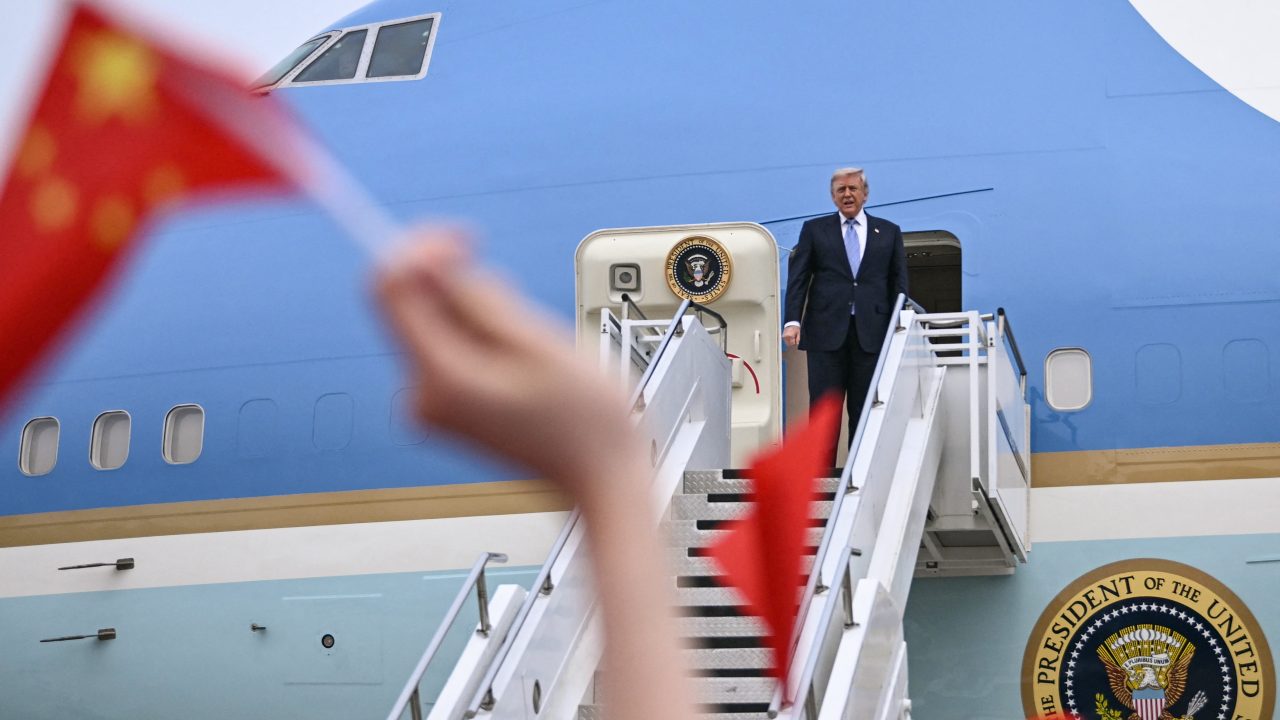
May’s summit between President Donald Trump and Chinese leader Xi Jinping (習近平) plodded along for two days of empty photo ops. Then, once the summit ended, Trump let his guard down in an interview with Bret Baier of Fox News. In their conversation, the president mimicked the Chinese Communist Party’s talking points about Taiwan, saying:
- “They have somebody there now that wants to go independent. Well, it’s a very risky thing. When you go independent, you know, they are going independent because they want to get into a war.”
- “I’m not looking to have somebody go independent, and you know, we are supposed to travel 9,500 miles to fight a war. I’m not looking for that.”
- The paused arms sales to Taiwan “depend on China. Depends — it’s a — it’s a very good negotiating chip for us.”
- “They stole our chip industry.”
Following the Fox News interview, the president boarded Air Force One to return home. While en route, he held one of his infamous press gaggles, opening his comments by announcing “We had a great stay … President Xi is an incredible guy.” Trump then again parroted the party’s position, reporting that Xi “doesn’t want to see a movement for independence” because, “He says, look, you know, we’ve had it for thousands of years.” The president thus described the free and independent nation of Taiwan precisely as Beijing sees it: As a wayward land of splittists fracturing the Chinese homeland.
That one-two punch of the post-summit Fox News interview and the Air Force One press gaggle left minds exploding all over Taiwan. Had the United States just betrayed Taiwan?
To put President Trump’s rhetorical oscillations in historical perspective, let us jump back to a meeting in Washington from November 15, 1971, when James Shen (沈劍虹), the Republic of China’s ambassador to the United States, met with Henry Kissinger. The architect of the rapprochement then brewing between the long-estranged United States and People’s Republic of China, Kissinger had been sneaking into Beijing for marathon conversations with Zhou Enlai (周恩來) that would culminate in the Shanghai Communique of February 1972. Kissinger’s diplomatic travels were secret, yet the intelligence apparatus of the Chinese Nationalist Party, or KMT, was well apprised of the talks between Washington and the People’s Republic of China, and so Shen approached Kissinger with a sense of trepidation. But President Richard Nixon’s national security advisor surprised the ambassador, telling him not to worry, for what had been happening in Beijing “was less than meets the eye.” Despite rumors to the contrary, Kissinger assured Shen that the United States was “not about to throttle their defenses.” Shen asked the obvious question: Doesn’t promising a coming unification when in Beijing while talking about defending Taiwan when in Washington amount to “an inconsistency”? Kissinger replied that the communique would be ambiguous by design, that Zhou “knew this,” and that where history took the facts on the ground was “Zhou’s problem.” Shen was stunned, finding that the man he thought was the architect of his nation’s downfall might in fact be a sneaky friend.
Ever since that meeting, we have seen a troubling pattern in U.S.-China-Taiwan communication: The United States seeks peace with China by saying things to please Beijing, only to then say different things to maintain relations with Taipei, leaving both parties feeling frustrated. Does that pattern, as Shen worried, indicate an ethically compromising “inconsistency” or the hard reality of international diplomacy? Regardless of how you answer that question, America’s vacillations have left generations of Taiwanese feeling abused. Reading Ambassador Shen’s memoir, you encounter a string of sadness: President Jimmy Carter’s administration “caused a great deal of apprehension in Taipei”; President Richard Nixon’s openings to China created “widespread indignation in Taiwan”; finding its fate compromised without consultation produced “a great deal of resentment”; learning of U.S.-China negotiations without prior notice to Taiwan led to “utter disbelief.” Shen’s recollections portray a dysfunctional relationship marked by bullying from Beijing, dishonesty in Washington, and confusion in Taipei — with all parties locked in mutual incomprehension and resentment.
As I walked the streets of Taipei last month, I thought of Shen. While studying the transcripts of Trump’s Fox News interview and Air Force One comments, I imagined Shen’s sense of personal injury and national insult as an inheritance. The players had changed over the years, yet the dynamic felt eerily familiar: Here were the brave Taiwanese, threatened by China’s incessant talk of “reunification,” finding the president of the United States announcing billions of dollars of defensive weapons were being held back from delivery to Taiwan because they served as “a very good negotiating chip” in America’s talks with Beijing.
Trump’s deference to Xi was so great that when pressed on the delayed arms sales while aboard Air Force One, he couldn’t even speak the name or title of Taiwan’s president, Lai Ching-te (賴清德), sidestepping Taiwan’s status by saying “I have to speak to the person that right now, as you know, you know who he is, that’s running Taiwan.” The clear impression was that Trump would jeopardize Taiwan’s safety to curry favor with China.
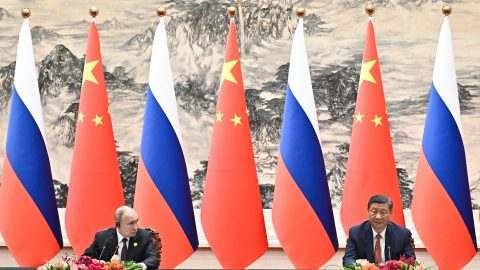
While no grand bargains or policy shifts were announced during the Beijing summit, the Chinese Communist Party used the opportunity to pound its long-standing talking points about Taiwan. According to China’s Ministry of Foreign Affairs’ readout of the talks, Xi warned the president that the “Taiwan question is the most important issue in U.S.-China relations. If it is handled properly, the bilateral relation will enjoy overall stability. Otherwise, the two countries will have clashes and even conflicts … ‘Taiwan independence’ and cross-Strait peace are as irreconcilable as fire and water.” The party has trumpeted such lines since the earliest days of the Cold War, with each new generation of leaders tweaking the language while repeating the central claims. If nothing else, and even if deluded, Beijing’s rhetoric about Taiwan has been consistent.
Other than those warnings on Taiwan, the summit was, as appraised by Patricia Kim of the Brookings Institution, “thin on substance.” So little news was generated that one all-star panel of China watchers at the Center for Strategic and International Studies struggled to find much to talk about, because, as Scott Kennedy noted, “the amount of information that we have is relatively limited.” David Shambaugh from China/US Focus evaluated the thinness of the results as secondary to the significance of the event happening at all, arguing the meeting “resulted in some badly needed stabilization in bilateral relations,” with proposed follow-up talks indicating “a return to some normalcy of regularized interactions.” Shambaugh’s reading echoed the party’s encapsulation of the summit as building “constructive strategic stability.”
Despite those positive assessments of the summit, and even for a president known to be impulsive, Trump’s post-summit comments were alarming. As Ryan Hass argued, by adopting Beijing’s narrative on Taiwan, “Trump did not reduce the risk of conflict, he raised it.” By abandoning long-standing U.S. principles, “Trump is inviting an onslaught of pressure from Beijing,” which now feels “emboldened … to press for more.” Craig Singleton from the Foundation for the Defense of Democracies put it bluntly: “This isn’t hard-nosed bargaining, it’s a dangerous misunderstanding of deterrence.” Signaling to Xi that weapons deals for Taiwan are negotiable, he argues, incentivizes the Chinese Communist Party “to make each arms package more painful for Washington … That is the opposite of peace through strength.” As The Wall Street Journal concluded, “By dragging its feet on a $14 billion arms package to Taiwan, the U.S. risks emboldening China and undermining American deterrence in the Indo-Pacific.” Channing Lee summarized these arguments in a syndicated column, observing how the pairing of the delayed arms deal with Trump’s erratic rhetoric “seemed like a gift to Xi.”
Running with that gift, Beijing’s propaganda machine kicked into high gear. China’s consul general in Australia, Wang Yu (王愚), blanketed China-friendly outlets with an op-ed, declaring “No one can ever stop the eventual reunification of China.” Illustrating how the Chinese Communist Party’s rhetoric confuses wishes with reality, Wang announced “the fundamental status quo across the Taiwan Strait is that Taiwan is a part of China.” Back in Beijing, China’s Taiwan Affairs Office launched a new round of threats against Taiwan, with spokesperson Zhu Fenglian (朱鳳蓮) announcing the island’s splittists are chugging down the road of destruction, where “they will surely suffer bitter consequences.” Zhu declared “the complete reunification of the motherland is the shared aspiration of all Chinese people, an irresistible general trend, a righteous cause and the will of the people that no individual or force can hold back.” Across Xinhua, Global Times, China Daily, People’s Daily and other Beijing-controlled outlets, and throughout their Taiwan Affairs Office and Foreign Ministry pressers, the message was clear: Trump had been rolled, “reunification” is imminent, Taiwan is done.
Faced with the dual threat of the Chinese Communist Party’s propaganda megaphones and Trump’s waffling, Taiwan’s Presidential Office replied with a strong statement, declaring “The Republic of China is a sovereign, independent, democratic country.” Contrary to Beijing’s bluster, spokesperson Karen Kuo (郭雅慧) argued “China’s escalating military threat is the sole destabilizing factor within the Indo-Pacific region.” Perhaps reminding the transactional White House of its historical and moral obligations, Kuo stated that by “collaborating with global democratic friends and allies,” Taiwan stands ready “to jointly address the risks posed by authoritarian states.”
The moment rang alarm bells in Washington as well, where foreign policy experts scrambled to contain the damage. In an interview with Tom Llamas of NBC News, conducted while the U.S. delegation was still in Beijing, Secretary of State Marco Rubio stressed that “U.S. policy on the issue of Taiwan is unchanged … We know where they stand, and I think they know where we stand.” Invoking principles enshrined in the Reagan-era “Six Assurances,” the Formosan Association for Public Affairs, one of Taiwan’s leading advocates in Washington, released a strong statement reminding the White House that “U.S. arms sales to Taiwan should never be tied to negotiations with Beijing.”
Up on Capitol Hill, a bipartisan group of senators — including Democrats Jeanne Shaheen (New Hampshire), Christopher Coons (Delaware), Elissa Slotkin (Michigan), Tammy Duckworth (Illinois), Andy Kim (New Jersey) and Jacky Rosen (Nevada), and Republicans Thom Tillis (North Carolina) and John Curtis (Utah) — was so worried about Trump’s wavering backing of Taiwan that they wrote him a letter, urging the president to “make clear that America’s support for Taiwan is inviolable.” Then, following the president’s post-summit comments, these friends of Taiwan introduced Senate Resolution 754, calling for renewed adherence to the Taiwan Relations Act and the other foundational protocols guiding U.S.-China-Taiwan relations. As Senator Coons summarized the reasoning driving these efforts, it is important to remember that “A free and open Indo-Pacific is a key to America’s safety and security.” Faced with China’s escalating aggression, “Taiwan stands on the front line of freedom,” hence meriting America’s unwavering support.
As is so often the case in American democracy, area experts, advocacy groups and long-serving legislators found themselves trying to moderate a mercurial president, hoping to rein in the White House by invoking trusted principles and norms.
To gauge how all of this was landing in Taiwan, I ventured over to the Center for Asia-Pacific Resilience and Innovation, or CAPRI, the think tank led by Syaru Shirley Lin (林夏如). CAPRI works up on the ninth floor of the old Chinese Television System Building 3, a landmark structure in downtown Taipei, where its brutalist architecture was synonymous with the abuses of the old KMT regime, which ran an authoritarian propaganda machine not unlike the Chinese Communist Party today. Lin told me how sweet it was to be managing an international NGO out of that building, near where she grew up, indicating the nation’s evolution from tyranny to democracy. Like everyone I spoke to in Taipei following the summit, Lin shared a sense of bewilderment at how undisciplined the White House is, with comments flying in multiple directions apparently heedless of precedent and protocol. She laughed when recounting how “that Air Force One session caused me to have a heart attack.”
Less concerned with a grand betrayal than the slow drip of persuasion, Lin worried that Trump’s comments would feed into the rising tide of “U.S. skepticism” seizing the island. Fueled by KMT resistance to the budgeting plans of Taiwan’s ruling Democratic Progressive Party, or DPP, and by the Chinese Communist Party’s disinformation machine, the narrative of “U.S. skepticism” suggests that America is backing away from supporting Taiwan, using it as little more than a bargaining chip in negotiations with China. That narrative had run in the face of the commitments of multiple administrations that supported Taiwan, yet Trump’s waffling appeared to confirm Beijing’s line. From this perspective, Lin worried that Trump’s Fox News and Air Force One statements, by adding fuel to the party’s propaganda, were “quite damaging for Taiwan’s domestic politics.”
To try to make sense of how the Chinese Communist Party’s propaganda and disinformation machine is hitting the island and stoking this narrative of “U.S. skepticism,” I walked over to the Taiwan FactCheck Center, one of a number of such shops in Taipei — along with Cofacts, the DoubleThink Lab, Fake News Cleaner and more — where journalists, scholars and computer scientists are trying to track, and hopefully counter, China’s communication barrage. I spoke with Taiwan FactCheck Center’s former executive director, Eve Chiu (邱家宜), who portrayed a dizzying situation where millions of pieces of disinformation — on Facebook, TikTok, X and such Taiwan-centric social media platforms as LINE — bombard Taiwan each day, leaving the average consumer awash in confounding messaging. To supplement what I had learned at Taiwan FactCheck Center, I met with Mary Ma (馬麗昕), one of the leaders of FactLink, another of Taiwan’s disinformation-tracking groups. Ma confirmed that her organization likewise finds the island under siege by troll-produced and bot-circulated disinformation that leaves many netizens awash in paralyzing junk. To corroborate these views, I spoke to Wei-ping Li (李惟平), one of the premier scholars studying how China’s disinformation attacks Taiwan. She sighed at the close of our conversation, saying “it is totally exhausting. We need to build more capacity to keep up with this rate of disinformation. As of now, we are overwhelmed.”
From this perspective, Trump’s post-summit comments were damaging not because they foreshadowed epic geopolitical change — for who knows if the president means what he says, says what he means, or remembers enough of what he says to follow through on any of it — but because they served up communicative fodder for the Chinese Communist Party’s messaging machine. While the Beijing summit featured Xi holding his robotic calm and threatening “conflict” over Taiwan, Trump’s Fox News interview and Air Force One press gaggle found the president repeating China’s talking points, hence fueling the rise of “U.S. skepticism” and making the ruling DPP’s job even harder. At this very moment, the party’s troll farms are packaging Trump’s lines into a million posts and memes, turning America’s president into an unwitting spokesperson for the “reunification” of Taiwan with the great motherland.


Leave a Reply