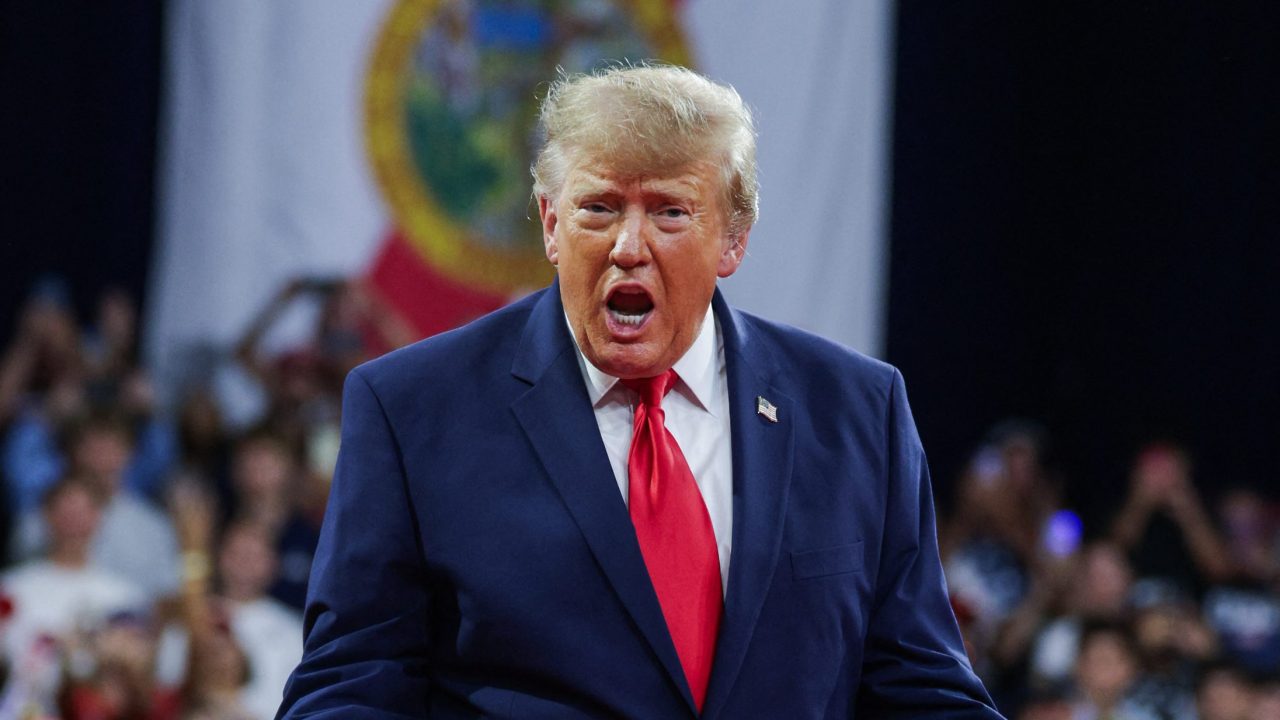
With one week to go until the midterm elections, opinion on President Donald Trump’s second term remains mixed in Taiwan and Japan. No one expects things to improve.
Trump’s first term was generally seen as positive, with more engagement and a more hawkish stance on China. The expectation for his second bite at the cherry was therefore optimistic in the Asia-Pacific.
Things haven’t quite played out that way, in large part because Trump has been much friendlier to China this time around.
Trump has also been more reticent on Taiwan. After a huge arms sale in his first year, he has been holding up an even bigger second sale, saying that it is a “very good negotiating chip” with China. This has led to widespread concern in Taiwan about abandonment by the U.S.
“It’s not the arms sales package per se,” said Chen Ping-Kuei (陳秉逵), a professor in the department of diplomacy at National Chengchi University, “it’s the fact that China and the U.S. discussed it.”
The fact that the U.S. is willing to use the sale as leverage gives China that leverage right back.
But Chen pointed out that the U.S. appears to be trying to push back against this perception. Recently, it was reported that U.S. defense officials will be embedded in Taiwan’s Ministry of National Defense. Normally such a development would be kept low key.
Now, Chen said, “the State Department has to allow Taiwan to publish this news because it wants to show Taiwan, and more importantly the Chinese people, that it is concerned about Taiwan’s security.”
Perceptions of Trump in Taiwan are still partially based on his first term, according to Chen Fang-Yu (陳方隅), an assistant professor of political science at Soochow University. And Trump would rarely talk about Taiwan then.
This term, Trump brings up Taiwan a lot, and rarely in a good way. It’s “almost invariably through a critical, transactional lens,” Chen Fang-Yu said, stoking “considerable anxiety in Taiwanese society.”
Trump has repeatedly accused Taiwan of stealing the U.S.’s chip industry and has asked Taipei to pay the U.S. for military protection.
However, this transactionalism has also created opportunities for Taiwan, said Jasmine Lee (李可心), an editor and contributor at U.S. Taiwan Watch. Because the Trump administration forced all its economic partners to negotiate on tariffs, Taiwan was able to deal with Washington on a government-to-government level. “Taiwan signed an agreement that treats it as a genuinely equal counterpart, like other ‘normal’ partners,” Lee said.
In Tokyo, Trump’s unorthodox behavior has raised deep concerns about the U.S., said Stephen Nagy, a professor of international studies at the International Christian University in Tokyo. “There have been too many strategic blunders to explain away behavior as one-off mistakes.”
The U.S.’s Asian partners have no real choice but to keep Washington close and stop things deteriorating further, said Daniel Sneider, a lecturer in international policy at Stanford. But he warned that privately Japanese and Koreans “understand very well who Trump is.”
The shifts in American policy outside of the Asia-Pacific also concern Tokyo. “Japanese are deeply worried about the abandonment of Ukraine,” Sneider said, because “they understand that if you legitimize the Russian war against Ukraine, it undermines security everywhere.”
This was a theme echoed by Zach Cooper, a senior fellow at the American Enterprise Institute focused on American strategy in Asia, who said Washington’s change of course on China and Russia had surprised many regional leaders and left them confused about the future path of U.S. policy.
But Cooper said it is about more than foreign policy. “They are disappointed by what appears to be a breakdown in U.S. democracy at home.”
Not everyone thinks that the Japanese government is so worried.
There has been a long-term, gradual withdrawal of America from Japan and the world that is not specific to Trump, said Satoru Nagao, a fellow at the Hudson Institute focused on U.S.-Japan-India security cooperation. He pointed to the fact that, under the last four administrations, the U.S. has been falling back from the first island chain, opening and strengthening bases farther back in the Pacific, in places like Guam, Hawaii and even Darwin in northern Australia.
Then President Barack Obama didn’t intervene in Syria after President Bashar al-Assad used chemical weapons, crossing Obama’s own red line, Nagao noted. Soon after that, Russian President Vladimir Putin invaded Crimea, and China started building artificial islands in the South China Sea. Biden withdrew from Afghanistan, and half a year later in 2022 Russia invaded the rest of Ukraine.
But there is something different about Trump, Nagao said. The U.S. is the one attacking countries now. China and Russia have not. “I think Russia and China are afraid of President Trump because of the unpredictability.” This unpredictability is a useful deterrent.
Next week, Americans will vote in the midterm elections. How do Taipei and Tokyo feel about what most people think will be a bad night for Trump and the Republican Party?
Taiwanese analysts are more focused on individual Congress members, rather than which party has control. There has traditionally been a strong bipartisan consensus on supporting Taiwan for decades. That might be about to change.
A significant number of politicians who support Taiwan will leave office after the midterms, said Chen Fang-Yu, the professor of political science. “Taiwan will have to work that much harder to rebuild and reinforce its legislative connections in Washington.”
A new generation is emerging, which Taiwan needs to keep monitoring, said Lee. But she also warned that the impact of a changed Congress might be limited. “Trump prefers executive action, and much of his foreign policy over the past two years has not gone through Congress.”
Nagao is more concerned about the budgetary gridlock that could occur if Democrats control the House and the Senate while Trump still holds the presidency. If the U.S. cannot decide on its direction, “that is a nightmare for Japan.”
If the Republican Party has a bad night on November 3, it would open up a two-month window before the new Congress takes its seats. That could incentivize Trump to make moves before he is subject to more oversight.
Or, in Nagao’s words: “There is a space [when] President Trump can do anything.”
Foreign policy is always the realm for lame-duck presidents, according to Sneider. And Trump has a lot of foreign policy challenges. Sneider thinks that Trump needs to end the war with Iran.
“He’s got to find a way to exit this disastrous quagmire,” Sneider said. But his fear is that this will not be resolved easily. Perhaps that means Trump, unable or unwilling to admit his mistakes, will try to fight his way out of it. “So maybe he goes and escalates.”
The implications for East Asia if that war intensifies are far from clear. The international sphere is the space where U.S. presidents have the most latitude to act independently, said Nagy, the professor of international studies. If Trump becomes more aggressive in foreign policy, it “could mean engagement with North Korea, Russia and China on terms that would suit his immediate interests.”
That’s unlikely to be good news for Japan and Taiwan.
Ultimately, Taiwan needs to be able to distinguish between trust in the U.S. itself versus trust in the Trump administration’s day-to-day machinations, said Wen-Ti Sung (宋文笛), a China specialist at the Atlantic Council. Otherwise, it might only hurt itself.
“To be moderately Trump-skeptical can be healthy, to be overly U.S.-skeptical can undermine Taiwan’s deterrence.”



Leave a Reply