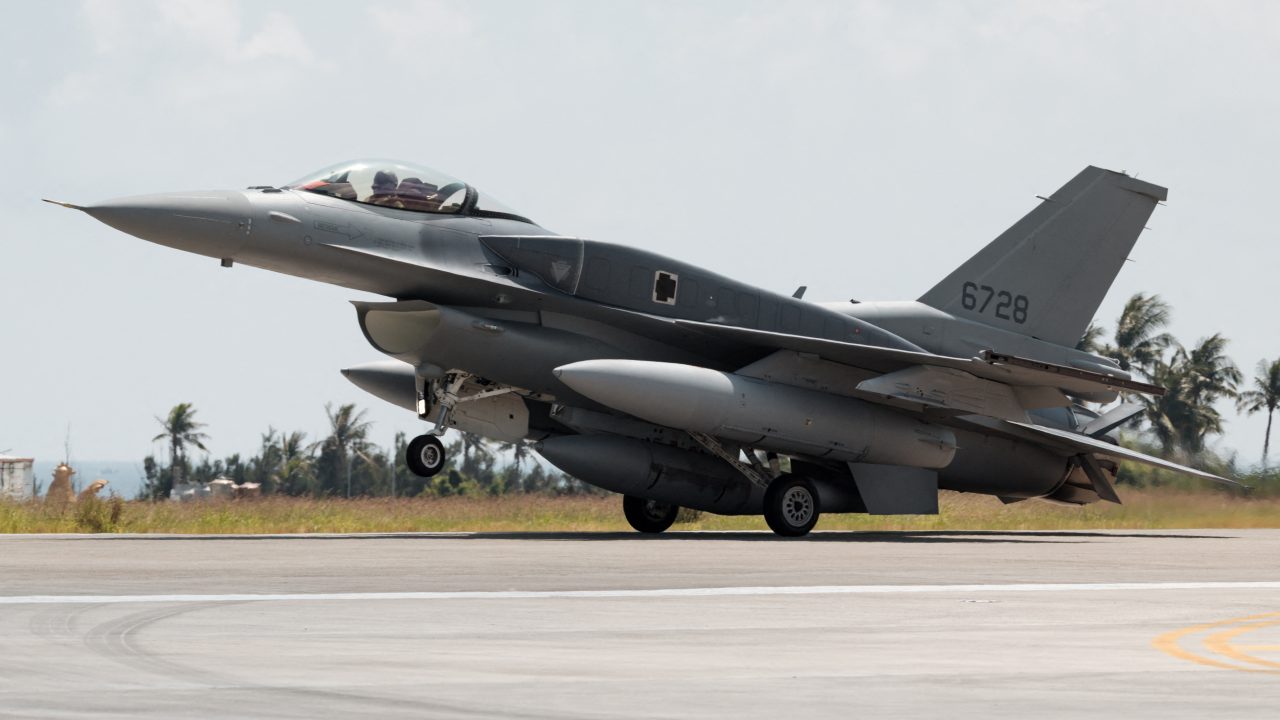
Taiwanese Defense Minister Wellington Koo (顧立雄) said today that defense exchanges between Taiwan and the U.S. are increasingly close, in his first public comments on news that the Pentagon will station officials inside Taiwan’s Ministry of National Defense.
Citing unnamed “senior military officials,” Taiwan’s Liberty Times newspaper reported this weekend that the U.S. Department of Defense has decided to send one expert representative from the Office of the Under Secretary for Policy and one from the Institute for Defense Analyses think tank to be stationed long term at Taiwan’s Ministry of National Defense headquarters.
It is understood to be the first time that American defense officials will be permanently thus embedded. There is a long and discreet history of more temporary engagement.
“If confirmed, this alters a decades-old policy of distancing U.S. military assistance from joint operations,” Dennis Wilder, a former director for China at the National Security Council, said on X.
Speaking in response to media inquiries about military and defense exchanges between Taiwan and the United States, Koo said the U.S. has repeatedly reiterated that its commitment to assisting Taiwan in strengthening its self-defense capabilities, based on the Taiwan Relations Act and the Six Assurances, remains unchanged.
Liberty Times reported yesterday that the Defense Ministry intends to conduct 50 in-person meetings and 80 virtual meetings this year as part of the joint cooperation, citing budget reports it has seen.
The development could facilitate and deepen the exchange on defense capabilities, according to the office of Chen Kuan-ting (陳冠廷), the Democratic Progressive Party, or DPP, co-convener of the legislature’s Foreign Affairs and National Defense Committee. His office said Chen supports this mechanism.
The formal announcement of defense department civilian personnel is “significant because it fits into a wider trend [of] more U.S. government and affiliated officials coming to Taiwan” said Bryce Barros, an associate fellow at the GLOBSEC think tank with a focus on U.S.-Taiwan engagement. He said that U.S. officials would likely “train on tactical and operational expertise” and also provide capacity assistance in terms of policymaking to their Taiwanese counterparts.
There have been multiple reports in recent years about U.S. special forces being permanently stationed in Taiwan. In 2024, Taiwanese media reported that Green Beret advisors were assisting Taiwan’s 101st Amphibious Reconnaissance Battalion special operations force, also known as the Sea Dragon Frogmen. That report placed them on Kinmen, just a few miles from the coast of China, as well as Penghu in the middle of the Taiwan Strait.
The U.S. denied American special forces personnel were permanently stationed there. However, when the 101st Amphibious Reconnaissance Battalion personnel were removed from Kinmen, Defense Minister Koo said training provided by U.S. personnel would continue as planned.
Another set of reporting, from July this year, concerned the apparent coming and going of U.S. military personnel from the Army Special Operations Command base in Taoyuan.
Far from denying these deployments, Taiwan has all but confirmed them. “A lot more ‘American English teachers’ will be showing up where they need to be,” Minister Koo told The Wall Street Journal immediately before the annual Han Kuang military exercises in August. “But you won’t be able to spot them everywhere they operate,” he added.
“American English teachers” is a euphemism for U.S. military who are in Taiwan and keeping a low profile.
Despite all this engagement, the U.S.’s commitment to Taiwan has been questioned more than usual in recent weeks due to reports that President Donald Trump is withholding a $14 billion arms sale until after a series of meetings with Chinese President Xi Jinping (習近平). Trump said in May after meeting Xi that the arms sales were “a very good negotiating chip.”
These doubts could also be a “calculus” for announcing the official embedment program now, Barros told Domino Theory. But he pointed out that even though capacity-building is important, the weapon sales remain frozen.





Leave a Reply