
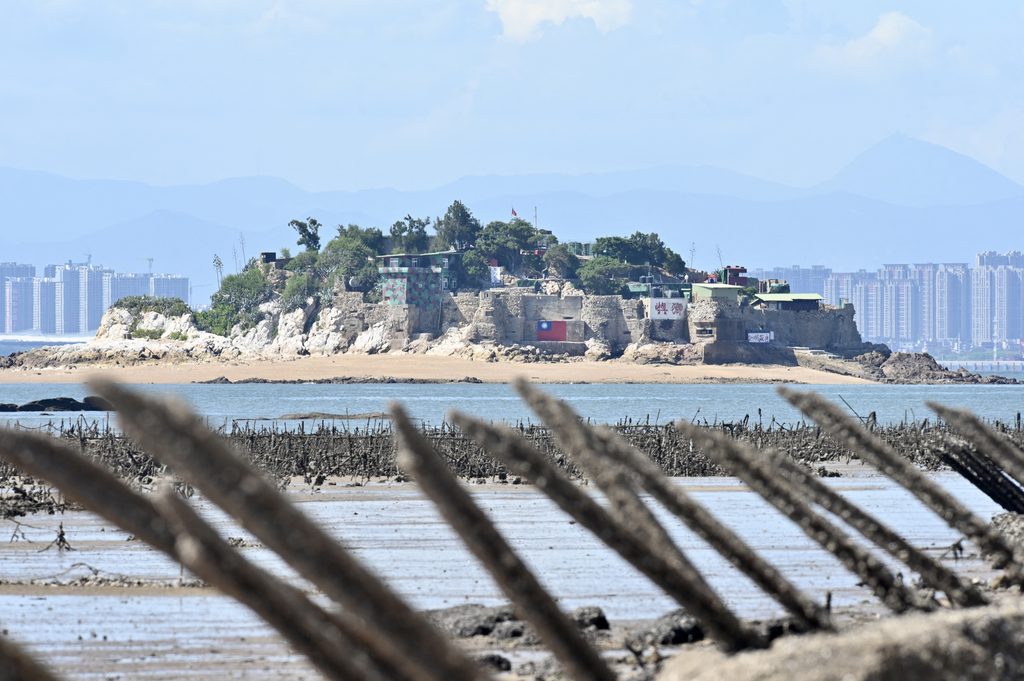
In August 2022, drones appeared in the skies above Kinmen, a Taiwanese island just off China’s coast. They were off-the-shelf, consumer drones, piloted by Chinese civilians from the nearby city of Xiamen, who posted footage from the flights online. In one video, the drone came close enough to a Taiwanese military base to capture the faces of two soldiers. One of the soldiers, aware that he was not authorized to fire his weapon at the aircraft, resorted to throwing pebbles.
The videos quickly went viral, provoking a firestorm on opposite sides of the strait. To China, it was a moment for gloating: a naked display of how futile Taiwan’s efforts to prevent unification were proving to be. To Taiwan, the footage was a humiliation. How could the country’s frontline defenses appear so hapless in the face of relatively mild Chinese harassment?
Days later, Taiwan gave its troops permission to fire. One Chinese drone was shot down, and the harassment quickly stopped. Meanwhile, Taiwan’s Ministry of National Defense scrambled to contain the fallout. It declared its intent to rapidly upgrade the defense of Kinmen and another outlying island near China, Matsu. What Taiwan’s military required, the Defense Ministry announced, was an around-the-clock system that could detect drones as they left the Chinese coast, and disable them before they got close enough to capture video, or worse.
Since the Kinmen incident, China’s military has continued to strengthen, its harassment of Taiwan has intensified, and the centrality of cheap drones in modern warfare has been laid bare on battlefields from Donbas to the Strait of Hormuz. And yet, four years later, Taiwan has still not acquired that counter-drone system.
To understand why, Domino Theory reviewed procurement tenders, government reports and product specifications, while consulting with industry experts from Europe, Taiwan and the United States. Our investigation reveals a series of oversights, missteps and misleading statements on the part of Taiwan’s government that should concern anyone invested in its continued survival.
To acquire cutting-edge technology on a condensed timeline, Taiwan’s Defense Ministry improperly appropriated research money for weapons acquisition, made funding decisions based on verbal assurances and granted procurement contracts to companies for capabilities it knew they did not currently possess. Our investigation reveals that at crucial moments in the procurement process, groups tasked with providing civilian oversight were absent or easily assuaged.
At the center of this story is Tron Future, a Taiwanese defense and aerospace startup frequently profiled in international media as one of the leading players in Taiwan’s counter-drone sector. Since the Kinmen incident, Tron has received two separate contracts to provide Taiwan’s outlying islands with counter-drone systems. The first, which the Defense Ministry terminated in November 2023, cost a government research fund at least 22 million New Taiwan dollars (roughly $700,000) out of a yearly budget of NTD 76 million. The second contract, for which the Defense Ministry first held a tender briefing in December 2023, has cost Taiwan more than two years of failed acquisition tests at a crucial moment for the development of its air defenses.
The Defense Ministry announced at a hearing in Taiwan’s legislature in July that it intends to cancel the second of those two contracts. In its place, the military will distribute handheld anti-drone jamming guns to soldiers stationed on Kinmen and Matsu — better than pebbles, but worse than the permanent installation it had once urgently requested.
The Research Project
On September 15, 2022, weeks after drones first appeared over Kinmen, Taiwan’s Defense Ministry invited two groups to a testing range in Lieyu, an area of Kinmen roughly 5 kilometers from the Chinese coast. The first was the National Chung-Shan Institute of Science and Technology, or NCSIST, a government-funded defense research institute, which brought prototypes of its handheld jamming guns. The second: Tron Future.
At the time, Tron had been around for four years. When Wang Yu-jiu (王毓駒), a professor at National Chiao Tong University in Taiwan, founded the company in 2018, it was built on a key partnership. “Tron Future was originally an academic endeavor, a collaboration between the university and NCSIST,” opposition lawmaker Chen Yeong-kang (陳永康) recently recalled. When the partnership between Tron and NCSIST ended, it didn’t end well. The two sides disagreed over the relative importance of hardware versus software development, NCSIST’s President, Lee Shih-chiang (李世強) recalled at the July the legislative hearing. “The hardware development remained with NCSIST, but the algorithms and software originally developed by Tron Future were taken away entirely, causing considerable unpleasantness,” said Chen, who was also an admiral in the Taiwanese navy.
Tron originally specialized in satellite communications. But by 2022, it had begun to offer a drone defense system as well. In September, when the government invited Tron to its testing ground in Lieyu, the company publicly advertised just one radar product: the T.Radar Pro, a portable, T-shaped device small enough to be carry-on luggage. Tron’s website claimed the T.Radar Pro had a detection range of up to 5.4 kilometers for objects with a radar cross-section of 0.03 square meters, roughly the size of a large bird. For objects with a radar cross-section of 0.01 square meters, the company claimed, the detection range was 4.1 kilometers. But at the testing session in Lieyu, the military discovered Tron’s system could only detect incoming objects at a much shorter range: 2 kilometers.
Earlier that month, the Defense Ministry had convened a “Drone Defense System” seminar with local contractors, where it explained that, to meet the growing threat of Chinese harassment on Taiwan’s outlying islands, it planned to procure two counter-drone systems: one for Kinmen, one for Matsu. The Defense Ministry also described how the procurement process would play out. The Ministry of Economic Affairs would consult with local firms and generate a list of leading candidates for the project. The Defense Ministry would conduct testing on those vendors’ products and determine a winner.
But first, the Defense Ministry needed to come up with a performance standard. From the testing it conducted in Lieyu, the ministry knew Tron’s system could detect objects at a range of 2 kilometers. But it also knew the area from which China could fly small drones toward Taiwan’s military bases was much larger. Kinmen is roughly 2 kilometers from China at the narrowest point, so close you can see the Xiamen skyline across the water. But the islands of Matsu are farther: roughly 9 kilometers from the Chinese shore.
The Defense Ministry ultimately landed in the middle. It stipulated the winning platform would need to provide both active and passive radar systems capable of detecting and jamming enemy drones at a range of 5 kilometers, with a radar cross-section of 0.01 square meters. On March 8, 2023, the Economic Affairs Ministry announced its leading candidates: Tron; Raser, which previously specialized in radar guns and breathalyzers; July Hurricanes, the subsidiary of Black Mirror Technology, a maker of counter-drone systems founded in 2020; and iWavenology, a wireless communications firm founded by a research and development team out of National Taiwan University in 2020. All four were based in Taiwan.
In the process of screening candidates, three problems had emerged. The first: None was capable of providing all three systems — active radar, passive radar and jamming — that the military required. Tron had systems for active radar and jamming, but no passive radar. July Hurricanes could provide passive radar and jamming, but no active radar. Raser and iWavenology qualified to compete in a single category each — active and passive radar, respectively.
The second problem emerged a week later, when the military invited the candidates to the Dafu Military Testing Range in Yilan, a county on Taiwan’s eastern coast. Raser’s radar system, the military discovered, could detect objects at a range of only 2 kilometers — no better than the product Tron had demonstrated on Kinmen the previous September. iWavenology’s radar achieved a similar score. Tron and July Hurricanes didn’t show.
The third problem was funding. By the time the Economic Affairs Ministry gave its recommendations, Taiwan’s legislature had already approved the government’s 2023 budget. To get money for counter-drone systems through the normal budgeting process, the Defense Ministry would have had to wait until early 2024, when the next year’s budget would be approved. “Initially, we hoped to acquire the equipment quickly because we wanted to stop the drones before the typhoon season arrived and prevent it from escalating further,” representatives from the Defense Ministry later said. (The typhoon season runs from May to October.) So ministry officials got creative. They realized that instead of treating the counter-drone system as a case of weapons acquisition, they could treat it as weapons research.
After the United States severed diplomatic relations with Taipei in January 1979, a surge of patriotic sentiment in Taiwan spawned a fund to support the country’s defense. An initial round of fundraising gathered NTD 4.75 billion (roughly $132 million at the exchange rate of the time), so much money the government decided to establish a foundation to manage it. They called it the National Defense Industry Development Foundation, or NDIDF.
Taiwan transitioned to democracy in the early 1990s, and the legislature stopped directly funding the NDIDF. But under the strength of its own endowment, the foundation has endured. In recent years, it allocated around NTD 55 million in funding annually for a range of projects. On April 21, 2023, the Defense Ministry requested more than that for a single project: It wanted NTD 60 million for the pair of counter-drone systems, and it wanted it right away.
The Defense Ministry did not officially control the NDIDF, but its leadership was stacked with officials from the highest levels of government. Defense Minister Chiu Kuo-cheng (邱國正) chaired the board. Wang Mei-hua (王美花) sat on it. She was the economic affairs minister at the time, and wife of the then-secretary general of the National Security Council, Wellington Koo (顧立雄), who now serves as defense minister.
When the NDIDF received the Defense Ministry’s request, it, too, had already allocated its budget for 2023. But the foundation’s constitution grants it greater flexibility than that enjoyed by the legislature. Soon after receiving the Defense Ministry’s request, the NDIDF convened an extraordinary meeting of the board, and the NTD 60 million was approved. Strictly speaking, there was nothing legally improper about this maneuver. Taiwan’s Ministry of Justice said as much in an official legal opinion it issued on May 22. But as a report from the Control Yuan — a branch of Taiwan’s government that acts as an internal watchdog — later concluded, using NDIDF money to directly purchase weapons violated the spirit of its charter.
The NDIDF solved the Defense Ministry’s funding problem. But the gaps in capabilities among the candidate contractors remained. The ministry decided to split them into two teams, each of which would integrate its platforms to build a complete system. Tron would link its active radar and jamming systems with iWavenology’s passive radar; Raser would link its active radar with July Hurricanes’ passive radar and jamming.
A crucial factor in the competition for the contract was the vendors’ willingness to cooperate with one another. Indeed, after Tron guaranteed it could work with iWavenology, the Defense Ministry convened a meeting to assess the candidates, and declared Tron the preferred supplier. But at a subsequent meeting on July 11, some military personnel expressed concerns about this arrangement. Instead of giving all NTD 60 million to Tron, they argued, the Defense Ministry should divide the money between the two teams and let them duke it out.
By that point, the Defense Ministry had already announced that it planned to procure an additional batch of 26 drone defense systems in 2024 and 2025, using money from Taiwan’s regular annual budget. Letting the teams led by Tron and Raser compete would yield insights that could be used to inform the military’s subsequent acquisitions, the thinking went, according to a whistleblower who later filed a complaint with the Control Yuan. And besides, adversarial tender competitions were standard practice in militaries around the world. But at the July 11 meeting, the suggestion was rejected. The military moved ahead with its plan to give all the money to Tron for its partnership with iWavenology.
The whistleblower complaint prompted a Control Yuan investigation. Taiwan’s military should not have needed the embarrassment of Chinese drones harassing its soldiers in August 2022 to realize the technology posed an immediate threat to its forces in Kinmen, it later concluded. “The Ministry of National Defense failed to learn from the experiences and warnings of other countries in war, nor did it plan ahead for the deployment of drones on outlying islands and countermeasures against enemy drones,” the report reads. “Only after Chinese drones appeared in the air did it urgently consider countermeasures and procure corresponding weapons and equipment.”
The Control Yuan report, which it published to little fanfare in March 2024, was similarly critical of the NDIDF, which it accused of being in cahoots with the Defense Ministry. “The National Defense Industry Development Foundation was aware that the purpose of the commissioned research project submitted by the Ministry of National Defense was to quickly acquire weapons and equipment,” the report said. “Yet it still cooperated, effectively turning the fund into a slush fund for the Ministry of National Defense.”
The Control Yuan unearthed something else troubling. On July 31, 2023, after the military decided on Tron as its preferred supplier, the company signed a contract to develop the counter-drone systems. The contract stipulated Tron would supply the government with a final report on its project by the end of November. But at a mid-term review meeting on September 26, the military realized Tron had been unable to secure the cooperation of iWavenology. The Control Yuan later discovered that, during the competition for the counter-drone research contract, the Defense Ministry had failed to require written confirmation — in the form of a memorandum of understanding or letter of intent — of applicants’ willingness to work together. Instead, it had approved funding for the partnership on the sole basis of verbal promises from members of Tron’s staff.

On November 7, the military terminated the project. In a normal procurement process, Tron would have been required to return the funding it had received. But since the Defense Ministry had commissioned the counter-drone systems “under the guise of research,” as the Control Yuan report later put it, Tron was allowed to keep some of the NTD 60 million budget allocated by the NDIDF. “The commissioned research is similar to that of the National Science Council,” the military later explained. “It involves evaluating research projects to determine feasibility and the best chance of success. Once the research yields results, we will pay the research funding.”
What results had the research yielded? According to the Control Yuan: “Although Tron Future failed to complete the commissioned research project, it was still able to apply for research funding using its self-developed active radar and jamming system as research results.” In other words, products it had already been developing.
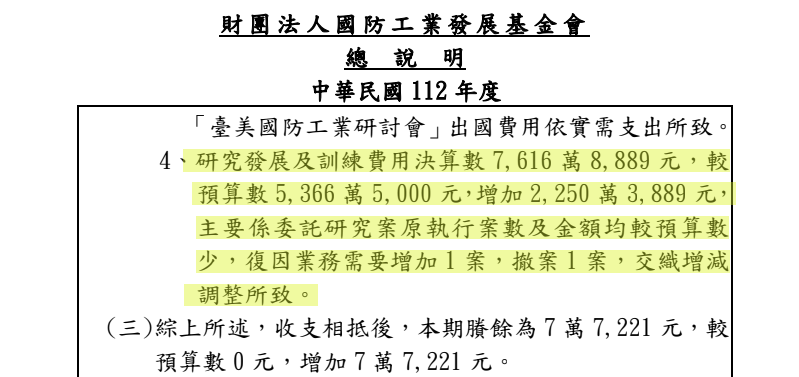
Domino Theory has been unable to determine precisely how much money Tron received, but analysis of the NDIDF’s financial documents suggests the number is north of NTD 22 million. The NDIDF’s 2023 budget for research, development and training was originally NTD 53.6 million and planned to cover 13 research projects. Its end-of-year report notes some of those ended up costing less than expected, meaning its baseline outlay was somewhat less than NTD 53.6 million. Its end-of-year report also notes the total outlay for research, development and training amounted to NTD 76.2 million, an increase it attributes to one project, which was “added and then canceled.” The money appears to have gone to Tron Future.
In March 2024, the Control Yuan released a reprimand alongside the findings of its investigation, in which it censured the Defense Ministry for numerous violations: its use of NDIDF funds for weapons acquisition disguised as research; its decision to go ahead with the project despite already knowing the suppliers lacked the relevant technical capabilities; and its failure to require written proof Tron and iWavenology had agreed to work together. “All these actions constitute violations, and therefore, a motion for correction is hereby submitted in accordance with the law,” the Control Yuan concluded.
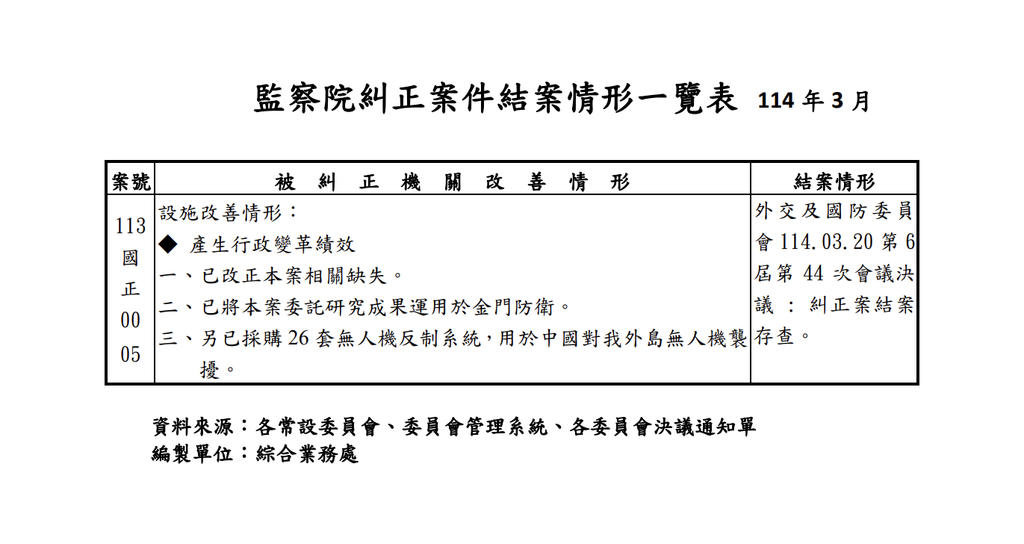
A year later, officials from the Control Yuan checked back in to see whether the military had addressed its concerns. “Deficiencies related to this case have been rectified,” it concluded after holding a meeting on the matter in March 2025. “The research results commissioned in this case have been applied to the defense of Kinmen. In addition, 26 sets of drone countermeasure systems are already being procured to counter Chinese drone attacks on our outlying islands.”
Members of the Control Yuan were assured the Defense Ministry was well on its way to acquiring counter-drone systems for Kinmen and Matsu, and this time with conventional funding from Taiwan’s annual budget. In fact, the government had already signed a procurement contract with one of its most promising suppliers: a local defense startup named Tron Future.
A Failed Procurement
After news broke this July that the military was terminating its second counter-drone contract with Tron, this time for the batch of 26 systems, Taiwan’s legislature summoned the Defense Ministry for questioning. “In recent years, some procurement cases have been affected by insufficient contractor performance capabilities,” explained Lieutenant General Chao Ya-ping (趙亞平), director of the Defense Ministry’s procurement office, in his opening statement. “For some procurement items,” he added, “it is difficult to grasp market supply capacity, technical maturity, and contractor performance capability during the planning stage, resulting in the failure to identify and respond to performance risks in advance.”
But to many of the lawmakers on hand that day, the question was not whether the Defense Ministry was encountering difficulties in its procurement efforts, but whether it was learning from them. “In the research and development process, no project is a complete success,” said Chen, the former navy admiral, who was the first opposition lawmaker to question the Defense Ministry. “It’s about continuously correcting past mistakes and turning them into stepping stones for future successes.”
One lesson the Defense Ministry could have learned from the failed counter-drone project in fall 2023: Double-check verbal assurances from Tron. Another: Avoid any appearance of favoritism. The Control Yuan’s investigation had stopped short of accusing the Defense Ministry of corruption. But it had concluded the military’s decision to award Tron the NDIDF grant despite knowing it did not possess the necessary radar system “raised concerns that the Army Command was favoring Tron Future.”
Many experts whom Domino Theory consulted for this story cautioned against placing too much blame on a single company. Counter-drone technology is still in its infancy. Even in Ukraine, most short-range systems rely on human controllers, not autonomous systems. Taiwanese companies have far less experience. “They all have marketing departments,” said one industry insider who has worked closely with counter-drone technology in Taiwan. “They’re all going to promise they can do something. The reality is that doing those things is hard and there will be ups and downs. If anyone has been able to deliver something that works at the promised rate on initial delivery, I’d be shocked. That doesn’t mean it’s a bad product; it just means these are really hard problems that we’re trying to solve.”
According to some experts, the specifications the Defense Ministry set in the fall of 2022 were too ambitious given the state of counter-drone technology in Taiwan. Yet, in April 2024, when the ministry released the specifications for its 26-set counter-drone project, the requirements got higher.
The ministry’s tender document, reviewed by Domino Theory, once again called for a system that could detect objects with a radar cross-section of 0.01 square meters, but this time with a range of 6 kilometers instead of 5. (It required the system’s jamming capability to have a range of 4 kilometers.) Industry experts were surprised to learn Taiwan would need to detect a drone that small. “An object like that could not carry any payload,” said Sebastian Merlov, CEO of Sweden Dynamics, a European dronemaker that does not do business in Taiwan. He added that a drone big enough to carry a kilogram or two of explosives — still not very much — would have a radar cross-section at least three times that.
Militaries will typically set procurement standards based on the threat they are facing, explained Ernest Ng, the Asia Pacific sales head at Echodyne, an American radar company. “If my expectation is that a truck — loaded with explosives — can drive through and hit the lobby of my building, then I would want to build bollards in front of my building to prevent the truck from coming in,” he said. “That’s an example.” Ng agreed a drone with a radar cross-section of 0.01 square meters would be much too small to carry any real explosives. But that was the standard Taiwan’s Defense Ministry continued to go with. When pressed to comment on the professionalism of the ministry’s procurement standards, Ng said: “Diplomatically, I would say that this is a great opportunity for the ministry to relook at this.”
The Defense Ministry set the budget for the new counter-drone project at just under NTD 1 billion. The NTD 38 million cost-per-unit was approximately equivalent to the NDIDF research grant from 2023. (A recent report from the U.S. Congressional Budget Office concluded that installing a comprehensive counter-drone system at a single military site would cost $74 million, with an additional $5 million each year for maintenance.) When the bidding opened, the vast majority of companies declined to participate. At that price point, “we couldn’t meet the specifications,” one sales rep recalled. “We felt we shouldn’t waste time playing this game.”
On August 1, the Defense Ministry announced the first stage of bidding had failed because of a rule that three companies must submit a bid for a contract to be awarded. According to UpMedia, a local outlet that cited unnamed sources, the only company to submit a bid was Tron. Days later, when the Defense Ministry opened a second round of bidding, it dropped the three-bidder minimum. This time, there were two bidders — Tron, and U&U Engineering, a local consultant that helps foreign defense firms operate in Taiwan’s market. But in the proof-of-concept test, both firms failed.
On October 21, the same day it announced the failure of the second bidding round, the Defense Ministry opened a third. Two weeks later, Mirror Media, another Taiwanese outlet, ran a story that referenced some of the findings of the 2024 Control Yuan report. It also cited an unnamed source who alleged that, following Tron’s failure in the second bidding round, the Defense Ministry tipped the company off to the test procedures for the third round, giving Tron information about the drones that would be used, as well as their flight directions.
In a response to the Mirror Media report, Tron called the anonymous source’s accusation a mischaracterization. If the company were being “specially treated,” Tron said, then how would it have failed the proof-of-concept test? The company did acknowledge that, following the second round of bidding, it gave the Defense Ministry suggestions for how to improve its testing methods, which the ministry accepted. Tron also called on Taiwan to move toward more flexible procurement procedures.
On January 17, 2025, the Defense Ministry announced Tron had won the counter-drone contract for NTD 987,810,000 in the third round of bidding. It was not until February at the earliest that the company began to advertise a new line of radar systems. According to product descriptions on its website, Tron could now cover the entire range of what the Defense Ministry required: active radar, passive radar and jamming. And the product specifications were perfectly in line with the military’s tender: 6-kilometer detection range at a radar cross-section of 0.01 square meters. UpMedia would later report, citing unnamed sources, that in the third round of bidding, both Tron and U&U once again both failed the proof-of-concept test, but were allowed to proceed to the final decision phase anyway.
Domino Theory has been unable to independently verify the aspects of UpMedia and Mirror Media’s reporting that relied on unnamed sources. The Defense Ministry did not respond to a request for clarification.
When we reached out to representatives from Tron with a list of questions based on our reporting, the company’s vice president for Strategic Partnerships, Charity Lin (林雅媖), replied by email. “As a pure technology company, we have the least intention to get published in a lot of false accuse as below when many are confidential information with the end buyer that we can’t disclose details,” she wrote. “As we have signed NDA with all the relevant parties please also refrain from contacting with our international partners.”
The latter remark appears to be in reference to Domino Theory’s requests for comment from defense firms outside of Taiwan who are collaborating with Tron. “What attracted us to Tron was their technical capability and dedication to produce state-of-the-art systems quickly,” wrote Tom Kim, director of strategy at Huneed, a Korean aerospace and defense company, in response to our inquiries.
“As for the cancelation of their MoD contract with the Taiwanese Government, it does not impact our planned joint development efforts since we believe their technical solution is solid and the ‘failure’ of the test and evaluation was more to do with how the requirements were conveyed from MoD to Tron,” Kim added, referring to Taiwan’s Defense Ministry.
At the July hearing in the legislature, Po Horng-huei (柏鴻輝), a former deputy defense minister who retired in November 2025, explained how the Defense Ministry decided to award Tron the contract. “The 26-set project was a pure procurement case,” he said.
“In fact, it went through a rigorous bidding process, a very rigorous procurement procedure. After the bidding was announced, there wasn’t just one single manufacturer. Two companies were selected to participate. We had an external committee to select the winner. So having conducted an actual POC test, the committee ultimately chose the candidate with the highest score, Tron Future,” Po added, referring to the proof-of-concept test.
Shu Hsiao-huang (舒孝煌), a research associate at the government-funded defense think tank INDSR, told Domino Theory that, in cutting-edge fields like counter-drone technology, it can be difficult for the Defense Ministry to find knowledgeable civilians willing to provide oversight. “Right now, everyone is at the starting point,” he said. “There aren’t actually any real experts.”
Shu recalled his own experience on a separate selection committee, also related to drones. “The committee consisted of four people,” he said. “One was a highly respected dean of the engineering college, but I felt his understanding of drones was flawed. They were academics; they hadn’t been to military exhibitions and were unaware of industry developments. Next was me; I lack technical expertise, but I at least understand the trends. The third was a retired instructor from the National Defense University, who barely spoke that day, indicating his lack of understanding. The fourth was an expert from NCSIST; he was, of course, a professional.”
Wang Yi-chuan (王義川), a lawmaker from the ruling Democratic Progressive Party, or DPP, raised similar concerns at the July legislative hearing. “The committee members you select might be those who are retired, or retired from military service,” he said. “When you make the selection they might not understand the technology very well. Does that sort of situation happen?”
Chao, the procurement office director, was unrepentant. “If it’s about purchasing a drone system, then the relevant experts on the system, such as flight control and navigation, etc., need to be included on the selection committee,” he said. “As for any problems that the Ministry of National Defense cannot handle, we have NCSIST to assist in reviewing whether the committee members are suitable. The selection process is always comprehensive.”
In Taiwan, the identity of selection committee members is public information. So, too, is their attendance record. To better understand how Taiwan’s military decided to award Tron the second counter-drone contract, Domino Theory compiled a data set of every public procurement project issued by the Defense Ministry in the year 2025. We narrowed our search to contracts awarded by the “most favored bidder” process, where private companies compete for government contracts. This yielded a list of 271 procurement contracts. Our analysis of these contracts casts serious doubt on the Defense Ministry’s claims.
The selection committee for the counter-drone project had 15 members: two active military personnel, nine retirees and four working civilian experts. This was not unusual. But the attendance at the committee meeting was: The day it met to decide whether Tron should win the contract, not a single working civilian was present.
People who serve on selection committees do not always show up: In 2025, the attendance rate for working civilians was 75%, slightly lower than the attendance rate for retired experts and active military officials. The Tron contract is still an outlier. Of the 271 contracts awarded by “most favored bidder” that year, it was the only case in which a committee composed of more than three working civilians saw not a single one show up.
Domino Theory contacted the four working civilian experts who were selected to serve on the procurement committee. Two did not respond. Those who did get back to us denied knowledge of the very technology they had been tapped to help the military assess. “Countering drones is not my area of expertise, so I am unable to give an interview,” wrote Li-Der Chou (周立德), a professor of information engineering and computer science at National Central University, in an email. “I hope you understand.”
Chen Jiann-horng (陳建宏), professor of electrical engineering at National Taipei University, gave a similar response. “I am not a military personnel and am not familiar with the planning, arrangements and subsequent deployment of the defense industry,” he wrote. When we followed up, pointing out he had been selected to sit on a military procurement committee, Chen did not respond.

In the months after Tron won the contract, Wang, the company’s CEO, appeared in public forums alongside some of the leading figures of the ruling DPP. On February 17, President Lai Ching-te (賴清德) hosted Wang at his office in Taipei to celebrate Tron’s receipt of the Outstanding Information Technology Talent Award. “In the area of technological innovation, Tron Future, led by Chairman Wang Yu-jiu, has successfully expanded into the low-orbit satellite and drone markets by developing radar technology, making Taiwan more competitive in the global defense market,” Lai’s office said in a statement. “This is a truly amazing achievement.” On March 21, Wang appeared alongside DPP lawmaker Chen Kuan-ting (陳冠廷), perhaps the party’s most vocal drone advocate, at a seminar on the defense application of low Earth orbit satellites and drone technology.
Then things went south. Tron originally agreed to deploy the 26 counter-drone systems by the end of 2025. In September, Misha Lu (呂亦塵), then a staff specialist at the company, told Domino Theory the target was now March 2026. But when Tron delivered its first batch for military testing in October, it failed the acceptance test. It failed again in March 2026. Then again in July. Each time, the military returned the units to Tron for revision. And each time, the units failed the military’s test.
At the legislative hearing on July 20, Defense Minister Koo announced the Defense Ministry was terminating the contract. “When facing multiple different drones, it could not effectively integrate them and display the parameters on the system’s operation platform,” Koo explained. To Lee, the NCSIST president, Tron’s failure was the indirect result of its messy divorce with his institute years ago, when the company professed too much faith in the power of software. “The hardware issues were never solved from the beginning,” he said. “So the signal-to-noise ratio remained borderline and couldn’t be reduced. If you rely on software and algorithms to reduce noise, when you have 26 sets of radars together, problems arise.”
Unlike the research project from 2023, the government will not lose money this time. The Defense Ministry said it plans to deploy a handheld counter-drone system developed by NCSIST to troops on its outlying islands, while the Defense Ministry explores a more permanent solution. Tron will have to forfeit the NTD 29,640,000 performance bond it had agreed to under the award contract, and pay delay penalties for the time the military took to repeatedly test its system.
At the legislative hearing, Chao, the procurement office director, invoked a more drastic possibility. His office would review Tron’s status as a supplier, he said, and decide whether to blacklist them.





Leave a Reply