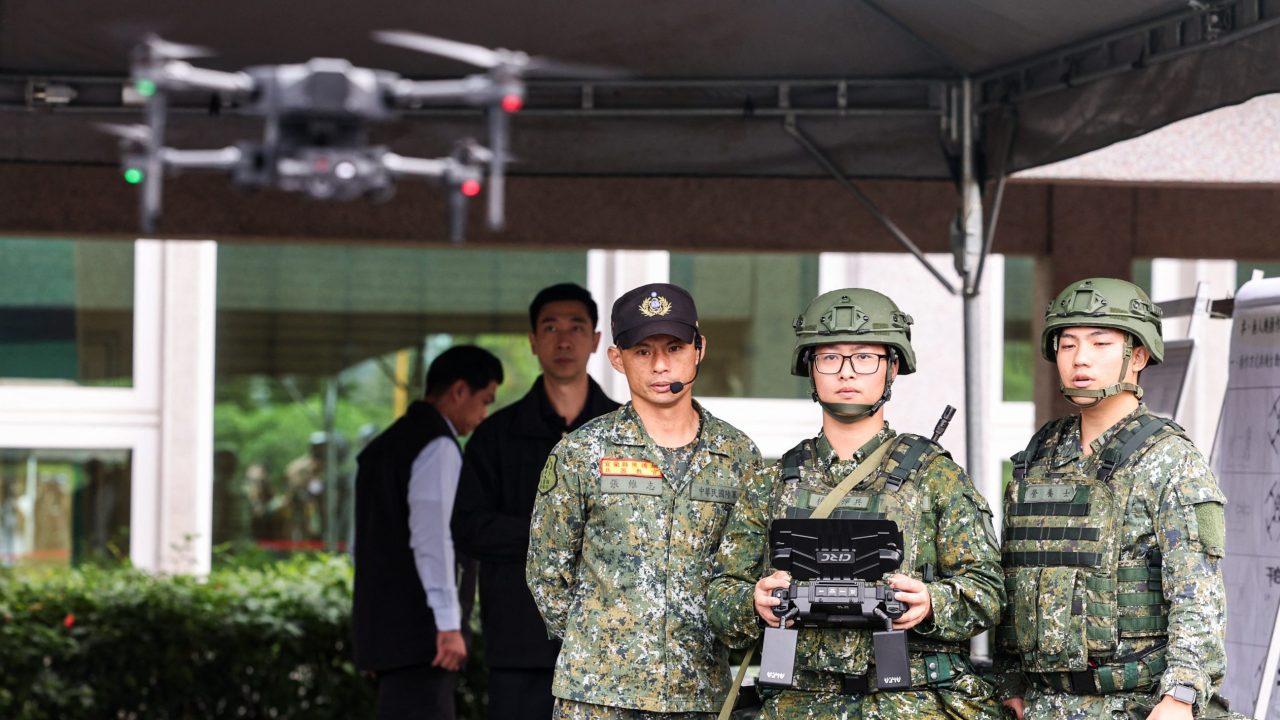
Taiwan’s government has formally proposed spending an extra 145.7 billion New Taiwan dollars ($4.6 billion) on defense in 2027, on top of the NTD 1.123 trillion already announced. Much of the money would be spent on drones previously cut from the special budget.
The NTD 145.7 billion is part of a larger NTD 607.6 billion supplementary budget revealed by the government on September 3. If approved by Taiwan’s legislature, the money would be spent next year as part of the annual budget.
Taiwan has already proposed NTD 1.123 trillion in defense spending in 2027, which is 3.01% of GDP based on current projections. Adding NTD 145.7 billion would bring the GDP share to a healthy 3.4%. This number is subject to revision, because GDP growth has exceeded projections in recent years.
The military spending includes NTD 64.5 billion for two classified projects, NTD 55.9 billion for maritime drones, NTD 13 billion for seven items including “mid-level anti-tactical ballistic missile systems,” widely understood to refer to the Strong Bow (強弓) system, NTD 7.3 billion for ammunition, NTD 2.5 billion for increased personnel costs and NTD 900 million for the Taiwan Tactical Network military software system, according to CNA. The maritime drone acquisition plans include 40,000 coastal attack drones, 600 coastal surveillance drones and 100 suicide drone boats, or USVs.
This supplementary defense spending is at least partly a response to the removal of items like these coastal drones and the Strong Bow air defense system from the infamous NTD 1.25 trillion special budget that finally passed in May with substantial reductions. “The current proposal carries out that plan and includes all 13 projects left out of the May statute,” Rupert Hammond-Chambers, president of the U.S.-Taiwan Business Council, wrote on LinkedIn.
Lieutenant General Huang Wen-chi (黃文啟), head of the Ministry of National Defense’s Department of Strategic Planning, said at the presentation announcing the supplementary budget that the drone units were already formed last year but currently lacked equipment. Drone procurement is expected to start this year, with initial combat capability established during 2027 and basic combat readiness by the end of the year. Acquisition would continue on an annual basis.
When the Chinese Nationalist Party, or KMT, removed domestic drone production and acquisition from the special defense budget in May, the U.S. State Department said “further delays in funding the remaining proposed capabilities are a concession to the Chinese Communist Party.”
The KMT has always maintained that it is concerned about how special budgets can allow corruption, saying there is less oversight compared to annual budgets. The legislature, which is controlled by a KMT-led coalition, recently passed a bill that allotted NTD 40 billion a year for six years, to be spent on drones from the annual budget. But that is just a requirement, not a new funding stream. The law also gives the Ministry of Economic Affairs control over drone spending and the legislature more oversight.
NTD 240 billion for drones is certainly welcome, but it is “below the expectations of many like me,” Jedidiah Royal, the former U.S. Principal Deputy Assistant Secretary of War for Indo-Pacific Security Affairs, told the audience at the Taipei Security Dialogue yesterday. “This budget announcement was a single base hit, not a home run.”
In a widely read article last month, The Economist described the KMT holding up drone funding as a “dramatic act of self-harm.”
Not everyone agrees.
“Drones should be used to deliver bubble tea, not weapons,” KMT Chairwoman Cheng Li-wun (鄭麗文) told a crowd in New York during her U.S. trip in June.
Whether KMT legislators, many of whom are skeptical of Cheng, who is extremely pro-China, have any appetite to block this supplementary budget is unclear. After a delay of eight months, in August they approved all the drone spending for 2026 in the annual budget.
“The legislature can pass an emergency supplementary budget if it’s urgently needed,” senior KMT figure Jaw Shaw-kong (趙少康) told Domino Theory in April. “I don’t think any legislator would dare oppose drones right now. Opposing drones would be political suicide.”



Leave a Reply