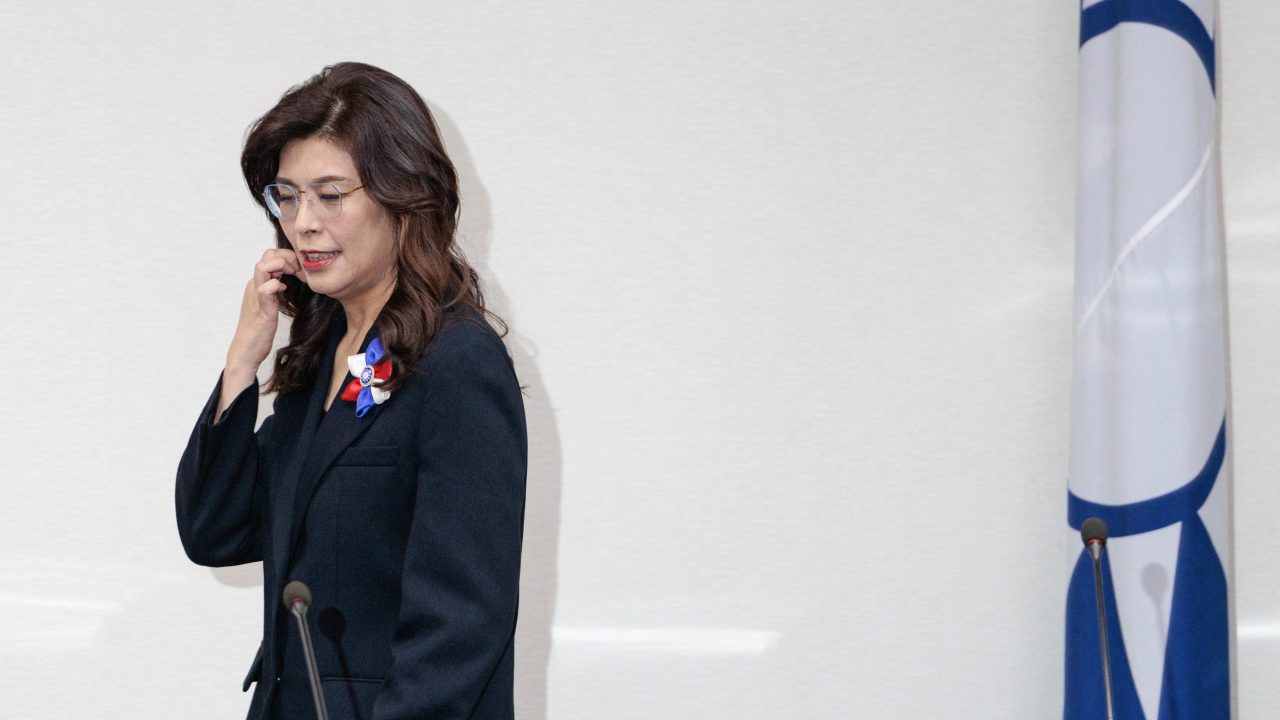
Taiwan’s main opposition Chinese Nationalist Party, or KMT, is facing a trust issue in Washington, as an internal rift widens between its pro-China leadership and party members pushing for strengthening relations with the U.S.
“I think they’re deeply divided right now,” said Kharis Templeman, program manager at Hoover Institution’s Project on Taiwan in the Indo-Pacific Region, who recently met with the party’s chairwoman, Cheng Li-wun (鄭麗文), and her team. “There are deep, fundamental divisions about how to deal with Beijing and Washington that the KMT is struggling with.”
Templeman said many in Washington believe Cheng is “doing Xi Jinping’s (習近平) bidding or she is at least too close to Xi Jinping,” referring to China’s leader. He noted that during her recent visit to the U.S., Cheng appeared more interested in delivering talking points than listening to her American interlocutors. “She really was not very curious about who was in the room or what she might learn from us … To put it bluntly, it was the Cheng Li-wun show.”
While the ruling Democratic Progressive Party, or DPP, operates based on disciplined internal factions, the KMT is organized much more around personal influence.
Taipei City Councilor Chan Wei-yuan (詹為元), a member of the KMT, describes it as a “person-centric” system where power is currently split between Cheng’s party center, a pragmatist legislative caucus, and influential local leaders like Taichung Mayor Lu Shiow-yen (盧秀燕) and Taipei Mayor Chiang Wan-an (蔣萬安).
Niu Tse-hsun (鈕澤勳), a political commentator and marketing professor at Chinese Culture University, said Cheng’s isolation is a strategic liability. “Cheng Li-wun is basically a lone wolf,” Niu said.
The KMT’s internal divisions have revealed themselves in the debate over Taiwan’s defense, a sensitive topic as Beijing ramps up military activities. While the party leadership has expressed a more skeptical view of weapons purchases from the U.S., the party’s legislative caucus has recently pushed back.
Chan described a recent dispute over the passing of a $25 billion defense package as a “victory” for the legislative caucus over the party headquarters. “When the party’s center and the legislature have inconsistent positions, the legislative caucus is currently more able to dominate the policy direction,” Chan said.
More established figures like Han Kuo-yu (韓國瑜), the speaker of Taiwan’s legislature, are also viewed more favorably in Washington than chairwoman Cheng. Templeman noted that Han “voiced open support” for a recent $25 billion defense package and “probably played a key role in getting it over the line,” which signaled to U.S. officials that the KMT remains a viable partner.
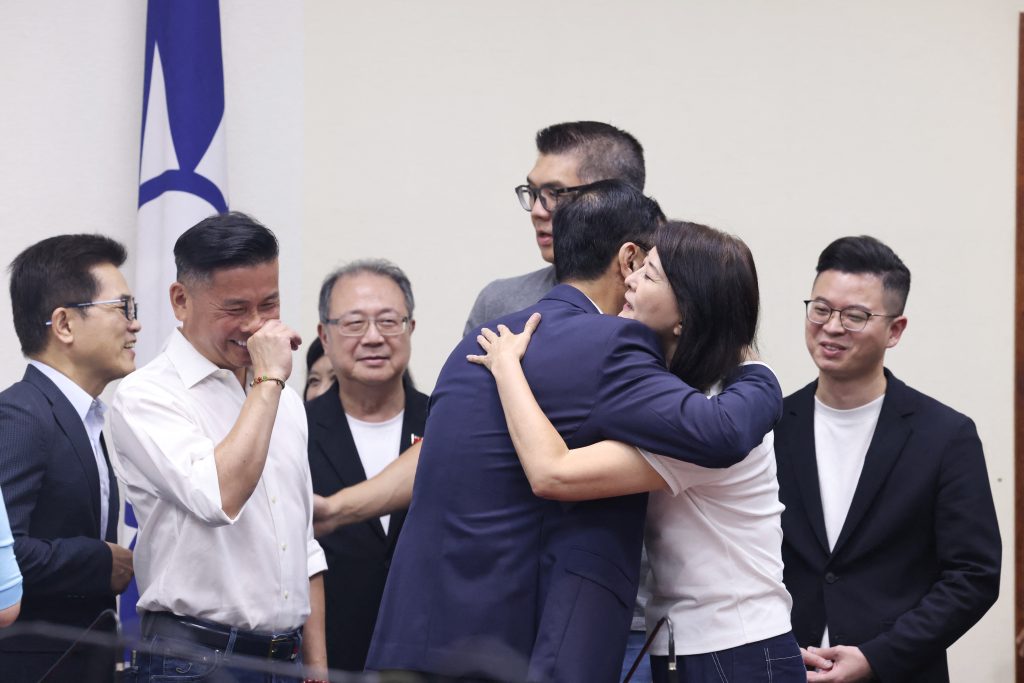
The difficulties Cheng faces in securing her status as the party’s leading figure were laid bare during a recent trip to Washington, when more than 20 members of Congress canceled meetings with her because of her perceived ties to the Chinese Communist Party.
Peter Mattis, president of the Jamestown Foundation, suggested the KMT’s challenges go beyond personalities, pointing to an institutional credibility gap. “The KMT’s fundamental problem in Washington is a trust deficit,” Mattis said. “The party has yet to demonstrate it can manage a relationship with Beijing without being managed by Beijing. They haven’t articulated a version of cross-strait engagement that addresses the reality of a much more aggressive Chinese Communist Party under Xi Jinping.”
Washington’s lack of enthusiasm for Cheng has created an opening for other KMT figures, such as Han. Another key figure is Lu, who raised her international visibility through recent visits to the U.S. and Europe. Her Taichung City Government recently hosted a drone forum with the American Institute in Taiwan, the United States’ de facto embassy in Taiwan.
Many see Chiang, Taipei’s mayor, as having a bright future, but he might not have the clout to launch a successful presidential campaign just yet.
With local elections serving as the current KMT leadership’s first major test, Templeman suggested that an unexpected victory in the south, a traditional stronghold for the ruling DPP, would fundamentally shift the island’s politics.
“If they were to win an upset [in Kaohsiung], that would certainly send shockwaves through Taiwan politics,” Templeman said. Cheng might use the momentum to mount a presidential bid for 2028. But a move like this could collide with Lu and Han, both widely seen as the party’s strongest potential candidates.
Conversely, a loss in key places like New Taipei could potentially end Cheng’s leadership. “The normal way to take responsibility is for the party chair to step down,” Niu said.
As Cheng’s KMT continues to argue it can manage relations with both China and the U.S., Mattis warns that Washington remains watchful. “Washington is looking for predictability,” he said. “The question for the KMT is whether they can prove they are a partner in stability, or a wild card in the U.S.-China rivalry.”




Leave a Reply