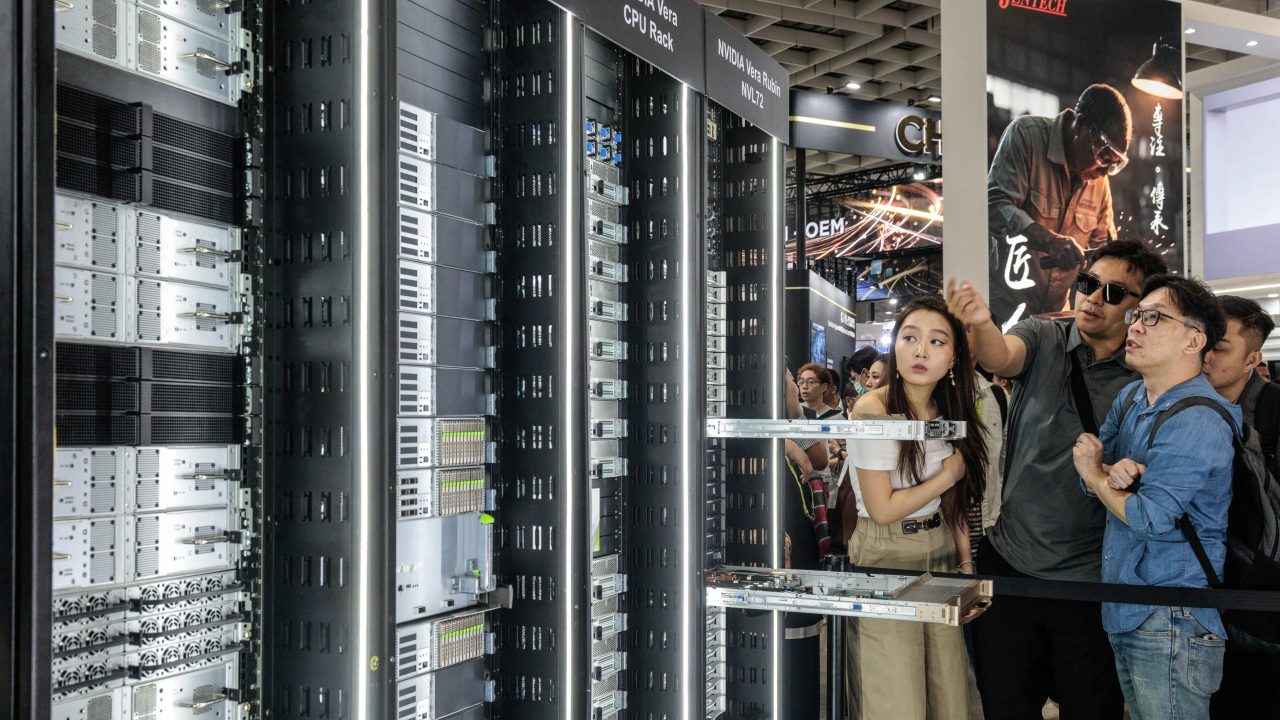
Liam Quinn remembers Computex before the AI boom, when it was a geekier, more modest affair, trafficking in consumer electronics and the occasional internet server. “If you came to this event five years ago, this is primarily what you’d see: servers on tables, maybe motherboards, stuff like that,” he said, leading us to the back of the Gigabyte booth, where open-faced servers were laid out like exhibits in a museum. “This is what you see now,” Quinn said, turning back around. At the front of the booth, young Taiwanese posed with a towering prototype of Nvidia’s latest server rack. Quinn looked on. “I mean, look how much space that’s taking up relative to everything else.”
Gigabyte, where Quinn works in marketing, has been around for 40 years, about as long as Computex, which found its current home in a pair of east Taipei exhibition centers in 2008. Even then, the conference was a symbol of Taiwan’s tech prowess. TSMC had begun to establish itself as the world’s leading chipmaker, while firms like Gigabyte and its better-known rival, ASUS, dominated the manufacturing of PC components. A few years ago, those same companies made a shrewd pivot: They started supplying hardware for AI, a technology which has taken Taiwan’s economy — and by extension Computex — to an entirely new level. In the first quarter of this year, Taiwan’s GDP grew 14%. Its stock market has overtaken those of the U.K., Canada and India to become the fifth largest in the world. And all that investor enthusiasm has cemented Computex — which drew a record 111,312 visitors this year — as the mecca of the AI hardware boom.
The main attraction this year was not the latest microchip or server rack, but Jensen Huang, who snaked through the conference hall, trailed by hundreds of admiring Taiwanese, half a dozen bodyguards, and Lex Fridman, the AI-enthusiast podcaster who came to capture the spectacle for his vlog. AI has made Huang’s company, Nvidia, the most valuable in the history of the world. For years, Nvidia primarily designed GPUs, a type of computer chip adept at processing video game graphics, until researchers discovered that they were just as good at training AI models. Now, the company designs entire server racks, those black, refrigerator-like boxes that fill the modern data center. Computex was full this year of local manufacturing firms in a frenzy to make Nvidia’s designs a reality. “Anytime Nvidia releases something new, we have a product,” Quinn said. “You know how it’s been. If you’re tied with them, you’ve profited.”
Outside of Taiwan, Huang is controversial. He has spent the last year trying — with mixed results — to convince President Donald Trump to let Nvidia sell chips in China, where AI firms are desperate to get their hands on them. Huang argues that export controls will only incentivize China to develop its own chip industry. Huang’s critics say that Nvidia’s chips would be used to enhance the Chinese military, perhaps in preparation for an invasion of Taiwan. But geopolitics have done little to taint him in the eyes of most Taiwanese, who still treat Huang, who was born here, as their hometown hero. In the week before Computex, he was on a public relations blitz — visiting night markets, posing for selfies and announcing, during the groundbreaking for its new Taipei headquarters, that Nvidia would hire 4,000 new employees, while spending $150 billion a year in Taiwan. “Taiwan is the epicenter of the AI revolution,” Huang said at the event.
“Ta hen shanliang, hen qinmin,” the owner of Ai Ling Ling, a shaved ice stand that Huang frequents, told me. “He’s very kind-hearted, a man of the people.” When Nvidia’s social media accounts posted a picture of Huang eating there recently, the shaved ice lady became a minor local celebrity. Huang’s signature is now proudly displayed on the wall, beneath the words: “Jensen was here. Amaze! Amaze! Amaze!” Down the street, a young man was working at Liu’s grilled corn stand, another place Huang went viral recently, this time for cutting to the front of the line and paying everyone’s bill. “Ta youqian jiu shi ta youqian,” the man said. “Sure, he’s rich, but so what?” The woman working the stand next to him disagreed. “He is the people’s gandie!” she said, using the traditional Chinese term for “godfather.” In modern slang, the word has another meaning: sugar daddy.
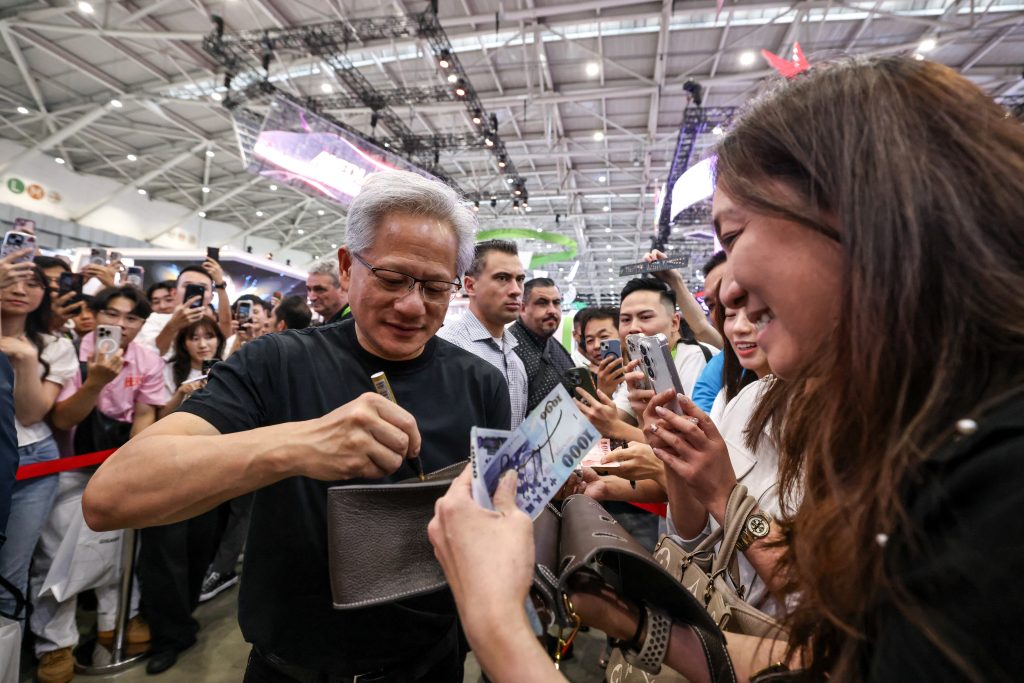
Huang’s other Taipei ritual is the supply chain dinner, when he invites the leaders of local hardware makers to dine at a local Taiwanese restaurant. In May 2024, as the wealth of the attendees skyrocketed, the local media dubbed it the “Trillion Dollar Banquet.” Photos of the banquet may one day line history books, but as a spectator sport, it’s a bit of a letdown. By 6 p.m., the crowd was packed in ten deep on the sidewalk, sweating it out in the sweltering heat. Huang emerged from his Maybach to scattered shrieks and applause, signed some autographs, and walked into the restaurant. “They might not know Jensen, but they know their TSMC stock is going up,” a man next to me said. Later, after two hours spent silently watching people mime dinner toasts through the window, the crowd had barely thinned. Huang emerged onto the sidewalk to hand out bottles of apple cider. He had two dinner guests in tow: CC Wei (魏哲家), chief executive of TSMC, and Liu Young-way (劉揚偉), chairman of Foxconn, both companies once known for supplying Apple who now make their money in AI.
Much of the enthusiasm surrounding companies like TSMC and Foxconn comes from the “picks and shovels” theory of economic booms, which holds that, in a gold rush, it’s much better to be the guy selling shovels than the one actually doing the digging. By that logic, you’d much rather be Jensen Huang than Sam Altman, the CEO of OpenAI, who might find a way to profit from ChatGPT, but might not. Computex this year brought a slightly different analogy to mind: In Taiwan’s AI gold rush, you can get spectacularly rich just by making the rivets that connect a shovel’s shaft to its blade.
JPC connectivity supplies power cables for Nvidia’s server racks. When Jessica Chang (張舒眉), the company’s founder, started to profit from the AI boom in 2024, she didn’t celebrate by having a few beers. She bought a brewery. At JPC’s booth this year, pints of the “Fuel Your Hope” American Pale Ale were on offer, ice cold, for the modest price of a LinkedIn follow. “All the companies in the Nvidia ecosystem are getting crazy stock prices now,” said Lily Tai, who works in business development at JPC. Three months ago, before JPC announced that it would partner with Nvidia on its latest Vera Rubin server racks, the company’s shares were holding steady at around 150 New Taiwan dollars (roughly $5 USD). Now, they were trading at NTD 310.
“Every year, it’s bigger — bigger and bigger,” said Sridip Banerjee, a director at Schneider Electric, one of the world’s largest AI infrastructure firms. “If you look at Gigabyte, last year they had one stall, and they have two stalls now.” It was the third day of Computex, and we were standing in a glass enclosure at the center of Gigabyte’s booth — the “VIP” box, where ordinary conferencegoers could gawk at us like aquarium fish. There didn’t used to be an enclosure, Banerjee added, recalling simpler times. Beside us sat one of Gigabyte’s newest products, a cube-shaped AI server whose components will run submerged entirely in liquid, all the better to cool its power-hungry brain. “These containers go on a truck bed,” Quinn explained. “We built a whole data center inside. We build it, test it, ship it, so they just connect it and go. It’s about speed, speed, speed.”
Last September, this same exhibition hall played host to Taiwan’s premier defense expo, where contractors showed off missiles designed to stymie a Chinese invasion. But Taiwan’s best protection might be found at Computex. The “silicon shield” — or the idea that the U.S. will defend Taiwan for fear of losing its chip industry to China — has for years been a source of comfort for people who live under the shadow of Beijing’s growing menace. The question now is whether it will hold. “An AI data center requires too many things,” said Oliver Tsai, an engineer at UNEEC, a Taiwanese firm that builds the metal skeletons that house server racks. “They won’t be able to move the entire supply all at once.” The United States, by contrast, increasingly sees its reliance on Taiwan’s chip industry as a headache. “If that island were blockaded, that capacity were destroyed, it would be an economic apocalypse,” Scott Bessent, the treasury secretary, said at the World Economic Forum in Davos, Switzerland, earlier this year.
The Trump administration has built on Biden-era efforts to reduce America’s reliance on Taiwan, albeit with a stronger emphasis on tariffs rather than subsidies. “I’d like to see everybody making chips over in Taiwan come into America, because to be honest with you, I think it’s the greatest thing you can do, because it’s a heated situation,” Trump said during his trip to Beijing last month. By some measures, 2025 was a banner year for that effort. In March, TSMC committed $100 billion to build more chip factories in the United States, adding to the $65 billion it promised to spend following Biden’s CHIPS Act in 2022. Other Taiwanese AI suppliers like Foxconn and Gigabyte have followed suit, scaling up their own U.S. operations to support the buildout.
But 2025 also brought explosive growth in the global demand for AI servers and chips, making it much harder for the United States to capture a substantial slice of the manufacturing pie. “The benefit of the AI boom is that tech companies and chip companies are doing very well, so they can afford to pay somewhat more for diversified manufacturing,” said Chris Miller, professor of international history at Tufts University and author of the book “Chip War.” “The challenge is that Taiwan is at the epicenter of the design and manufacture of AI hardware.” It’s one of the great ironies of geopolitics today: Despite all the talk about reviving American chip manufacturing, the United States may actually be more reliant on Taiwan than it was four years ago. “We were dependent on Taiwan before AI,” said Stephen Ezell, vice president for global innovation policy at the Information Technology and Innovation Foundation. “And the AI boom has only entrenched that.”
If a Chinese invasion doesn’t end Taiwan’s AI party, then a stock market crash could. Many analysts think we are already in a bubble, even if they’re not sure when or why it would burst. As Tim Culpan, who writes the Culpium newsletter on Substack, put it recently, “OpenAI today is far less sturdy than Pets.com was back then,” referring to the most notorious flame-out of the dot-com crash. “I’m also very nervous about it,” Wei, the TSMC CEO, said when asked about a potential bubble this past January. “Because we have to invest about $52-56 billion [this year].” Ming-yen Ho (何明彥), non-resident fellow at DSET, a government-funded think tank in Taipei, told me that some AI hardware suppliers are deliberately slow-rolling their expansion to protect against a bust. “These executives, they have historic experience,” Ho, who has worked summers at TSMC while pursuing his doctorate at UC Berkeley, explained. “So they will try to manage capacity build-out in a way that prolongs the prosperity, and delays [the] eventual collapse.”
Quinn didn’t seem overly concerned about any of this. Since he joined Gigabyte in May 2020, the company’s stock is up more than 600%. “If I had invested a lot more, I could be retired,” he said. He told me he’d only start to worry if he saw Gigabyte’s orders start to slow down. “We had to borrow a bunch of money recently, but it’s because we’re fueling, adding fuel to keep everything going, to keep up with the demands for AI factories,” he said, as we wrapped up our booth tour. For now, all he sees are new Nvidia designs, insatiable demand and the nearly weekly opportunity to invest in Taiwan’s latest unsung data center hero. “What’s Nvidia buying?” he said. “Okay, I’ll take some. I’ll buy that, too.”




Leave a Reply