
In line with new President Lai Ching-te’s (賴清德) inauguration pledge to transform Taiwan into an “AI Island” (人工智慧島), energy put towards artificial intelligence development in Taiwan will likely be eight times higher by the end of 2028 than it is now, according to Taiwan’s Energy Administration. Overall, Taiwan’s energy consumption will increase by 12 or 13 percent between now and 2030.
This presents a challenge. For Taiwan’s government to achieve its stated aim and legal responsibility of “carbon zero by 2050,” can growth in renewable energy developments swallow an AI-led energy spike?
“From an emissions perspective, if the increased demand is met with fossil generation, then it’s very problematic,” Josh Burke, senior policy fellow at the Grantham Research Institute on Climate Change and the Environment, told Domino Theory by email.
“Most data centers are building renewables on site to power them, but of course these are intermittent and data centers need constant power. Increased demand can also spike prices and cause blackouts, as we have seen in some U.S. states. Unless renewable supply can keep up with demand, it could spike emissions in the short run.”
It could be a problem, then, that growing demand for green energy in Taiwan hasn’t automatically been matched by supply so far.
Supply vs. Demand
Taiwan’s largest emitters, such as TSMC and Hon Hai (Foxconn), have responded to external carbon charges, plus Taiwan’s incoming carbon fee and nascent carbon credit scheme, with commitments to renewable energy sourcing. Small and medium-sized enterprises (中小企業) have also begun to demand the same access to renewables. But at the end of last month, Vice Economic Minister Lien Ching-chang (連錦漳) acknowledged corporate doubts about the government’s ability to supply enough renewable energy at prices that suit big business, albeit while saying there would prove to be enough capacity.
To date, the numbers reflect the concern. Taiwan’s renewable energy capacity has not expanded at high speed. In 2023, renewable energy made up just 9.9 percent of its energy mix. And the government has missed its own targets.
“I don’t think [the likes of] TSMC, to be honest, care about the price … They care about if they can get enough [renewable energy],” Wen-ling Tu (杜文苓), director of the Center for Innovative Democracy and Sustainability at National Taiwan Chengchi University, told Domino Theory on a video call earlier this year.
There are a couple of ways of thinking about why this hold up exists.

Green on Green Battles
The dominant explanation for the gap between supply and demand is so-called green on green battles. This concept refers to contestation between green developers and conservationists, community groups or the agricultural industry, amplified by the high density of Taiwan’s population. That density affects fossil fuel developments, too, but less so because most of those power plants are already built.
“Right now the main obstacles faced by investors are mainly related to land use regulations and public protests,” local solar developer Shinfox Energy told Domino Theory in a written statement (translated from Chinese). It added local governments were often less supportive of developments than central government because they worried about backlash from voters, with areas led by the governing Democratic Progressive Party (DPP) more supportive and those led by the opposition Chinese Nationalist Party (KMT) less.
Government Bureaucracy
Related to that explanation is the idea that government regulations also hold developers back. The European Union this week requested dispute settlement consultations at the World Trade Organization over Taiwan’s local content criteria for offshore wind energy projects — criteria that have already brought complaints from some developers within Taiwan.
Elsewhere, a high-profile bribery scandal involving one wind farm developer last year was not the first to inadvertently highlight difficulties involved in getting licenses to build renewable developments.
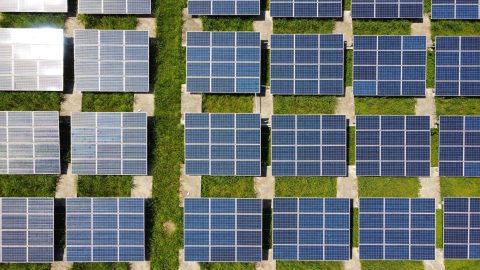
“On July 7, 2020, the Council of Agriculture announced amendments to the Guidelines for Reviewing the Conversion of Agricultural Land Use by Agricultural Authorities. These changes prohibit the installation of solar power facilities on agricultural land smaller than 2 hectares, making it more challenging to develop small-scale integrated projects,” Shinfox Energy noted as an example of tight land-use restrictions.
“These elements create uncertainty about when construction can begin, leading to project delays, overtime work to catch up, excess inventory storage and rising bank financing rates. As these delays accumulate, waiting costs continue to increase.”
Investment Questions
There is also another competing view, though — or at least one that says finding space and permission aren’t the only issues to be overcome.
Taiwan has taken a number of steps to marketize its electricity generation since 2020. These include steadily lowering the subsidized price it pays for renewable energy and attempting to replace that stability with long-term corporate “power purchase agreements,” or PPAs — long-term contracts directly between private companies and renewable developers. Those contracts set the amount and price of electricity over periods of five to ten years, pre-empting an issue for risk-averse investors found in volatile spot markets elsewhere.
But PPAs could still present an issue. In the new book, “The Price is Wrong: Why Capitalism Won’t Save the Planet,” author Brett Christophers points out that for potential investors in renewable developments, a long-term agreement to supply a company like Google, Amazon … or TSMC looks like a “bankable” opportunity. They are rich consumers that will certainly still be around when the contract concludes. But after that low-hanging fruit is picked, there are many smaller companies that may not be considered such a reliable investment bet. Under this dynamic, the few companies that can definitely offer bankable PPAs also have an advantage in dictating lower prices, because there are fewer of them than developers.
Although Christophers said he couldn’t offer an opinion on Taiwan’s case specifically, it is an obvious place to consider the potential impact of this argument. The top ten largest companies in Taiwan contributed 40 percent of greenhouse gas emissions in 2019, but there are also 1.5 million small and medium-sized enterprises to consider, and it is notable that when Taiwan’s government has begun discussing corporate PPAs for these companies, it has done so on shorter terms of one, three or five years.
The Future
Of the explanations for why renewable supply in Taiwan might not keep up with demand, the last option might have an inbuilt defense against an AI energy surge. Taiwan’s AI boom is being led by larger tech companies.
But it’s interesting to end on this here, because in terms of long-term issues it’s less widely flagged up by those in and around the industry. While there is pressure from a number of directions to withdraw government subsidies, corporate PPAs have been endorsed as the great hope for Taiwan’s energy markets by academics, activists and developers Domino Theory has spoken to in recent months. That means that while ideas abound for solving green on green battles, there is not much public discussion around the limits of PPAs.
The stakes behind getting all of these decisions right are clear for Taiwan. On a trajectory mapped out in 2021, spring rain in Taiwan is on track to decrease 13.2 percent by the middle of the century. Likewise, scientists say the frequency of typhoons in Taiwan is decreasing as global temperatures rise. By the end of the century, the number of typhoons that reach it could be reduced by half. It has already experienced prolonged droughts in recent years. A desert island would be a considerably harder sell than an AI Island.
Taiwan’s Ministry of Economic Affairs did not respond to a request for comment on the future of renewable energy subsidies.





Leave a Reply