
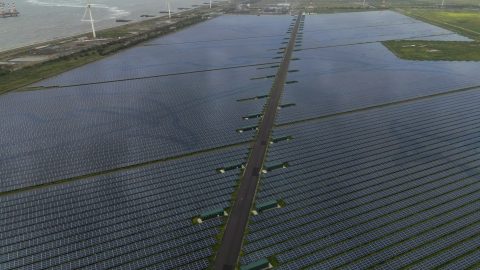
As of last June, Taiwan was on schedule to achieve 15.1 percent of its electricity from renewable sources by 2025, falling short of the 20 percent target outgoing President Tsai Ing-wen (蔡英文) set for her government in 2016, according to Taiwan’s Ministry of Economic Affairs. Simmering below the surface of this delayed progress is a question over the role of the state-owned electric power industry provider, Taipower, in renewable energy provision.
Taipower currently buys most of the energy produced by renewable energy developers in Taiwan at a fixed price called a feed-in tariff. Since the introduction of the feed-in-tariff in Taiwan in 2009, developers have regularly lobbied for the rate to be increased. Greenpeace Taiwan has now proposed that the feed-in-tariff be pulled back in the areas where renewable energy is more developed — namely wind and solar.
“Taiwan’s electricity industry actually was dominated by Taipower for a very, very long time. So for renewable energy actually there [is] a new drive to create a free market for here,” Greenpeace Taiwan’s Lydia Fang (方君維) told Domino Theory via video call.
There are several benefits Greenpeace believes this change would unlock. Renewable developers may ultimately be able to get a higher price for their energy on the free market, even if the price is more unstable, Fang said. At the same time, if the corporations become a direct consumer, they can join renewable projects at the initial stage, and “control how big the developments become.” Fang said this will also mean companies engage more directly with the developer so the two sides “can talk more about detail.”
Within this vision, the ability for energy purchasers to secure more energy directly could mean they are willing to swallow slightly higher costs.
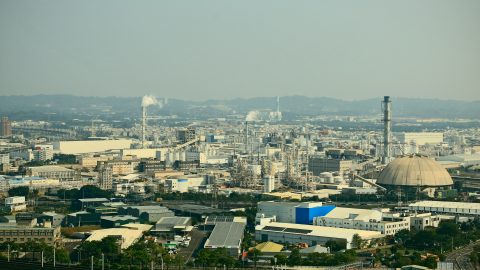
“I don’t think [the likes of] TSMC, to be honest, care about the price — the feed-in tariff. They care about if they can get enough [renewable energy],” Wen-ling Tu (杜文苓), director of the Center for Innovative Democracy and Sustainability at National Chengchi University, Taiwan, told Domino Theory via video call, explaining that compliance with environmental and social governance goals is key to this perspective. The likes of Apple, who purchase products from Taiwanese companies, have already begun to impose carbon reduction goals from further down the supply chain, and Taiwan’s government is set to introduce a carbon levy later on this year.
The theory is already backed up by shows of interest in Greenpeace’s proposal from energy purchasers in Taiwan, according to Fang, who said she was optimistic that the shift would not take years to introduce, as the government in Taiwan has already offered an enthusiastic response to the idea.
However, this is not to say that only one system is available. Germany, for instance, like Taiwan, has far from perfect geography for renewables, but renewable energies covered almost 52 percent of its gross electricity consumption in 2023, having sat just above 10 percent in 2005. Germany’s system offers a feed-in-tariff for individuals or smaller companies who host solar panels while operating a market for larger providers.
“If you are a private contributor — if you use your roof — you get a fixed price. But if you’re a company, you don’t get a fixed price, you can set your price at whatever you want. There’s no price cap for down or for up … There’s a difference between a private home that sells — that’s also a small company — and a big company that has an independent facility,” Ortwin Renn, former professor for environment and technology assessment at the University of Stuttgart, told Domino Theory via video call.
What matches Greenpeace Taiwan’s prescription with the German model is the ultimate ideal outcome of companies buying their energy from joined up small developers and host communities. Greenpeace envisages that farms and schools could host solar panels without major disruption, Fang said, and corporations who purchase energy could play an important role in convincing civil society to accept developments in local areas.
A series of public interviews Greenpeace held in July asked people if the presence of companies like TSMC alongside the government and Greenpeace would help convince them to allow developments in their area and this received “positive feedback,” she said, because the company carries a “high reputation in Taiwan’s society.”
Key to the wider vision would be that the government provides a platform for developers, smaller host sites and purchasers to come together.
Fang said this mediator role for the government would include making prices transparent and helping to connect developers and purchasers with village leaders and civil society actors who are willing to host solar panels. Tu said a “fair and flexible platform to match the company and the community that can be trusted by the public” was required and said that ultimately smaller developers or cooperatives (with lower profit requirements) could be introduced into the market. Renn noted that in Germany, initially the government had helped mediate between energy developers and local communities, but now the developers largely do this work on their own initiative, working within government regulations.
For now, Tu says Greenpeace’s proposal can “open up a discussion” for the next step, but adds: “It’s not only the choice between the government setting the price and the market space, it’s also about creating some kind of flexible mechanism to involve the stakeholders who are beginning to contribute their part in generating the green energy.”

Leave a Reply