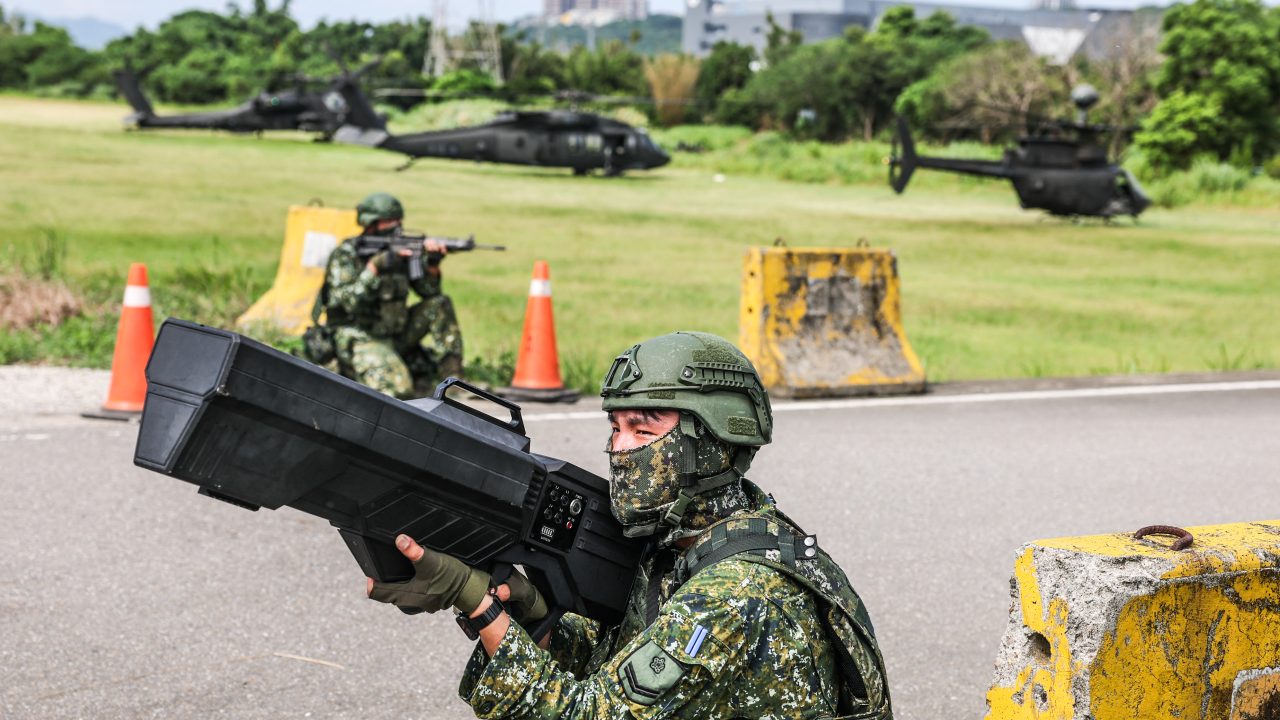
Taiwan’s opposition-controlled legislature passed the 2026 annual budget last week, a record 351 days after it was submitted. Surprising to many is the full approval of funding for the cabinet’s six-year, 44.2 billion New Taiwan dollar (about $1.4 billion) drone development program, despite the fact that the Chinese Nationalist Party, or KMT, the main opposition party, had previously threatened to cut it.
Learning from Ukraine’s example, Taiwanese leaders believe that drones can impose costs on an aggressor with many more weapons and people. But there is still a long way to go. Taiwan’s military has less than 5,000 drones, according to estimates by the Research Institute for Democracy, Society, and Emerging Technology, or DSET.
The KMT caucus said in a statement on Friday that it decided against cutting the drone funding after concluding that the proposed budget did not in fact contain a wasteful overlap between funding for drone development and procurement. It’s unclear why it took the party nearly a year to figure that out.
Some analysts, like Brian Hioe at New Bloom, see the reversal as an attempt by the KMT to recover its optics after The Economist argued last week that “self-interested Taiwanese politicians” are practicing “a dramatic act of self-harm” by stymying Taiwan’s ability to bolster its drone fleet. An unnamed KMT higher-up told The Economist that the party fears that the government will channel funding to companies that support the DPP. Paradoxically, the bigwig said that KMT-friendly firms wouldn’t dare to make drones because they often have investments in China.
After the column was published, the KMT defended itself in a post on X, arguing that it supports building Taiwan’s domestic drone industry and strengthening its asymmetric defense capabilities. The central conflict, the KMT said, was over how money is spent.
Importantly, the approval of drone-related funding in the general budget does not resolve the months-long partisan conflict over drone procurement that started with the NTD 1.25 trillion, eight-year special defense budget that President Lai Ching-te (賴清德) proposed in November 2025. The legislature finally passed a scaled-down version of the special defense budget in May, which kept funding for arms procurement from the U.S. intact, but cut funding for domestic drone procurement.
In response, the cabinet proposed a NTD 210 billion ($6.6 billion) special budget for drone development and procurement to be dispensed over a period of six years on June 18. The opposition parties, the KMT and Taiwan People’s Party, or TPP, rejected the plan and proposed alternative plans to fund drones through the annual budget, which they argue allows for more effective oversight. The DPP has criticized these alternate plans for reducing the government’s flexibility, subjecting drone funding to a debt ceiling, and drawing down funding for other government services.
The KMT’s last-minute decision to approve drone funding in the 2026 annual budget shows that pressure from the U.S. and the international community could still work in pushing the party to support Taiwan’s defense capabilities through special budgets, said William Yang (楊皓暐), an analyst at Crisis Group. The KMT’s reversal also shows that the DPP should cultivate ties with opposition lawmakers that are particularly focused in defense efforts in order to “avoid repeating the total deadlock that has paralyzed effective and rational cross-party negotiation for months,” Yang wrote in an email.
Political back and forth over drone funding creates uncertainty for manufacturers and hinders Taiwan’s ability to establish its place in this nascent, quick-moving industry. “China, the United States, and other countries are expanding procurement and production capacity at scale,” Cathy Fang (方怡然) from DSET wrote in an email. “Even if Taiwan eventually approves funding, repeated delays can widen the gap in procurement speed and industrial scaling.” Funding delays lead manufacturers to postpone contracting, complicate investment decisions and weaken visibility over future demand.
Cross-party negotiations over the cabinet’s NTD 210 billion special defense proposal for drone development are scheduled for tomorrow. “That negotiation will be a more meaningful test of whether Taiwan can provide predictable, multi-year military demand,” Fang said.






Leave a Reply