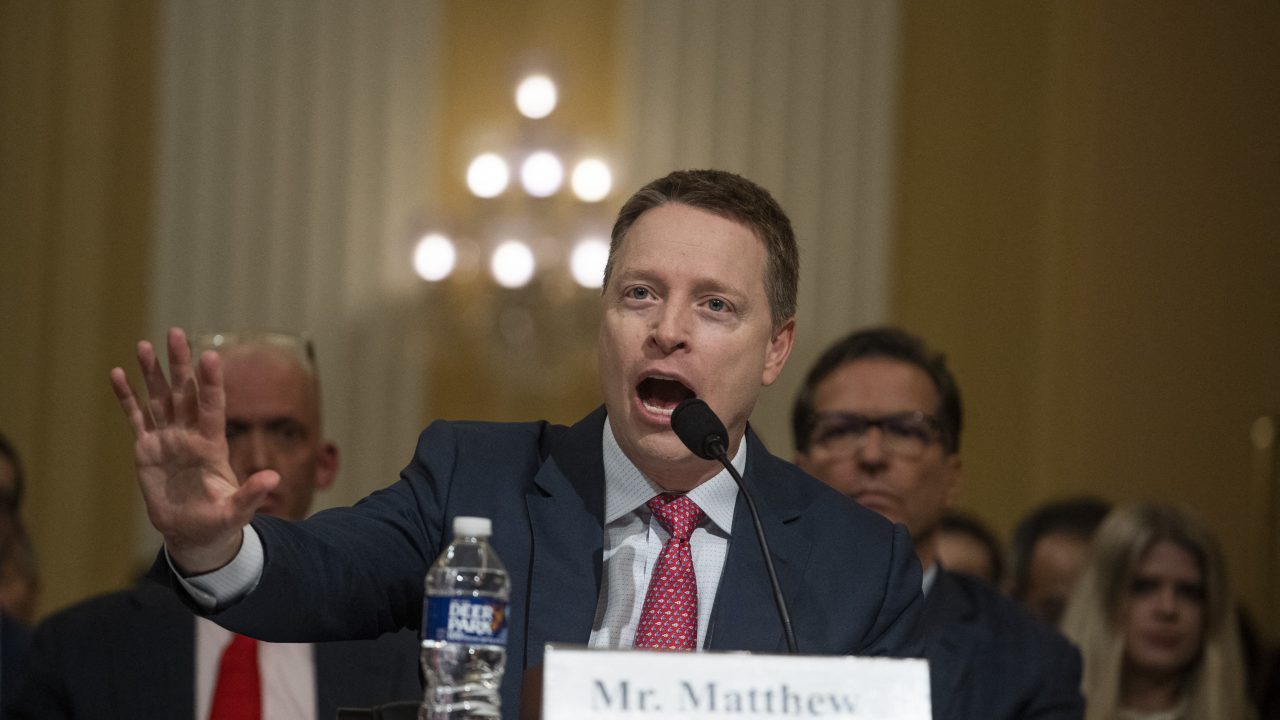
Former U.S. Deputy National Security Adviser Matt Pottinger said on Saturday that he does not expect the upcoming meeting between President Donald Trump and Chinese leader Xi Jinping (習近平) to yield a broad deal on Taiwan.
Pottinger, who served in Trump’s first administration, said the meeting could better be defined by what would not happen: a breakthrough on trade, “anything substantive” with respect to Taiwan or a wider reset in relations between the world’s two largest economies.
“I don’t see any grand bargain or some unwise deal emerging from the summit,” Pottinger said, speaking at a forum on Taiwan’s whole-of-society resilience in Taipei.
Beijing claims Taiwan as its territory and has increased military, diplomatic and other forms of gray-zone pressure to assert that claim. Xi is likely to “lecture [Trump] at length” on Taiwan as he has with previous U.S. presidents, Pottinger said. But the U.S. has had strong strategic reasons to oppose a Chinese takeover, and that its interest in Taiwan goes beyond its role in global semiconductor supply chains.
The United States, Japan, the Philippines and other Pacific democracies depend on a friendly and democratic Taiwan to limit China’s ability to project military power across the region, Pottinger said. “The myth is that U.S. leaders believe America can afford to let the Chinese Communist Party coercively annex Taiwan. The U.S. cannot afford that outcome.”
He urged Taiwan to assess U.S. policy by its actions rather than individual public statements: “Watch what America does, and not just what any one person says on a given day.”
Pottinger described U.S.-China relations these days as “a little more predictable” but “frosty,” with antagonism persisting beneath the surface of leader-level meetings. He noted that in the lead-up to Trump’s state visit to China in May, Beijing took steps to damage U.S. economic and national security interests. It also squeezed Japan on rare earths and forced Meta to unwind a deal with Singapore-based agentic AI startup Manus. Ahead of the summit in Washington this week, the Trump administration has moved to reduce its reliance on Chinese supply chains in areas such as robotics, power-system equipment and drones.
In fact, Taiwan’s surging drone production presents a key opportunity as Washington actively moves to replace Chinese supply chains, Pottinger said.
Taiwan’s government has proposed an additional 145.7 billion New Taiwan dollars (around $4.6 billion) in defense spending for 2027, on top of its previously announced NTD 1.123 trillion defense budget. The funding is intended to equip drone units formed last year and enable procurement this year. The government sees this as a way to create sustained demand for Taiwan-made maritime and coastal drones as it seeks to expand the domestic drone industry.
“It’s a good time for Taiwan to be exporting a lot of drones because we’re not going to be importing them from China for very much longer,” Pottinger said.



Leave a Reply