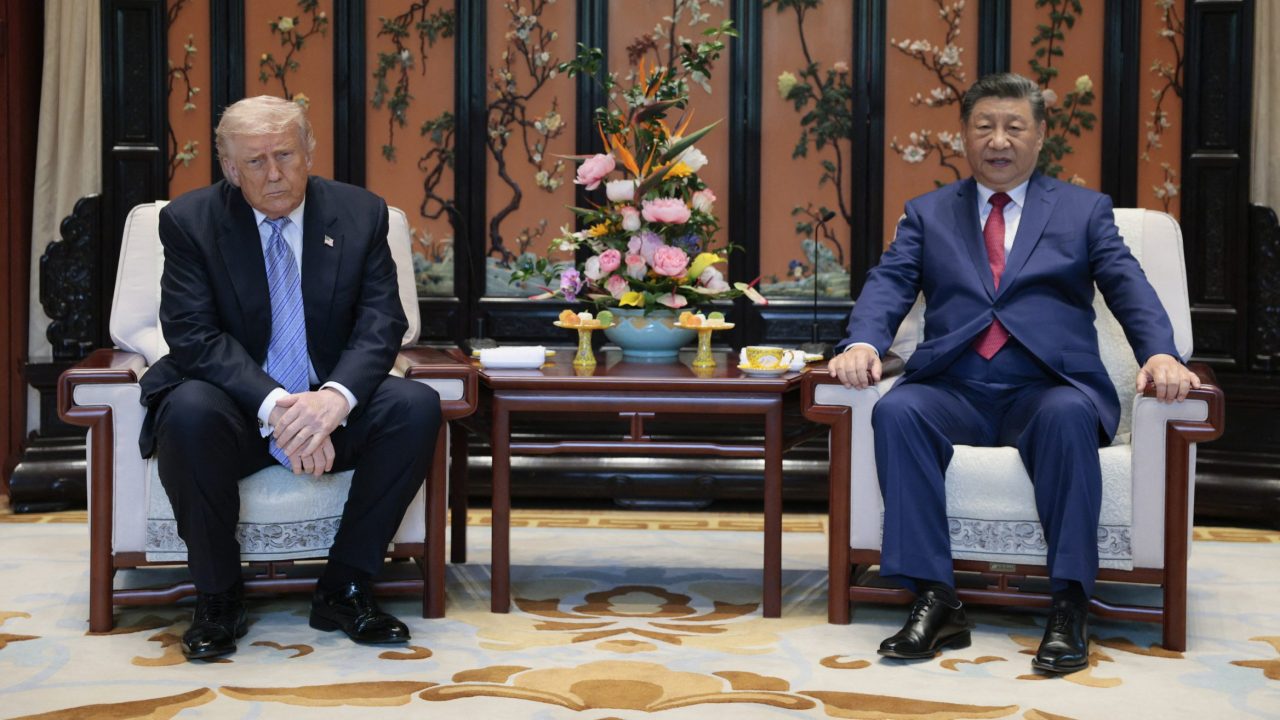
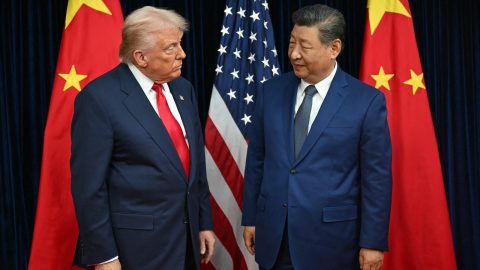
Persistent uncertainty is the new normal in Taiwan. A month after the Trump-Xi summit, Washington’s longstanding policy of strategic ambiguity toward Taiwan seems a lot more ambiguous and a lot less strategic.
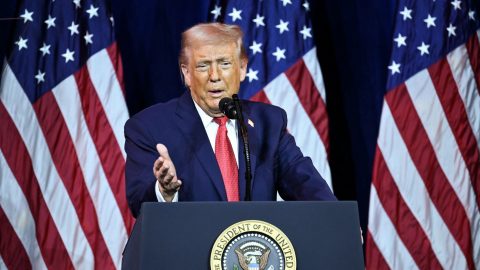
Taipei needs to navigate a path forward through a geopolitical landscape where the U.S. is seen as an increasingly unreliable partner. This is largely fueled by President Donald Trump, whose rhetoric has left observers struggling to reconcile his fiery language with the actual conduct of U.S. policy.
“There is a paradox in the Trump administration’s approach to Taiwan and cross-strait issues. Trump is undisciplined in what he says and tends to say things that align with Beijing’s preferred framing on Taiwan issues,” said Ryan Hass, director of the John L. Thornton China Center at the Brookings Institution, a Washington think tank.
“At the same time, his administration remains supportive of Taiwan in its actions. And Trump’s advisors insist that America’s longstanding policy hasn’t changed.”
For Taiwan, navigating its relationship with the U.S. feels like repeatedly opening a mystery box. This uncertainty complicates Taiwan’s strategy on defense, economic policy and how it frames its relationship with Beijing. “This paradox is unlikely to be resolved as long as Trump remains in office,” Hass added.
There are other reasons why Taiwan may not see much movement from Washington. A grand bargain won’t be forthcoming because China “feels it’s got Trump figured out,” said Wen-Ti Sung (宋文笛), a China expert at the Atlantic Council. He thinks China will see no need to negotiate with Trump over Taiwan. “Taiwan should instead fear being relegated to the back burner of Washington’s Indo-Pacific policymakers’ minds,” Sung concluded.
U.S. arms sales to Taiwan are “a very good negotiating chip,” Trump said in an interview with Fox News that was recorded in Beijing but released after his meeting with Xi concluded. The U.S. is stalling a $14 billion weapons package that was reportedly already approved by the Senate in January.
This comes after an $11 billion purchase was finally agreed by Taiwan’s legislature last month. These new systems, including HIMARS rocket artillery and drones, are designed to turn Taiwan into a “porcupine” capable of deterring invasion. However, without new quills, or weapons, the porcupine will start to look a little threadbare.
“It’s unlikely that the [delayed] arms shipment will not be passed by Congress, but the actual delivery date is I think the biggest challenge for Taiwan in terms of building their defense capabilities,” said Stephen Nagy, a professor of politics and international studies at the International Christian University in Tokyo. To mitigate against this, Nagy suggests “Taiwan needs to continue to advocate and demonstrate that it’s an international public good based on its position within semiconductor supply chains.”
And, perhaps, seek to diversify its portfolio. “The summit has exposed the risks of over-reliance” on the U.S.-Taiwan relationship, said Andrew Yeh, director of the China Strategic Risks Institute Executive. Yeh added that Taiwan must look beyond the U.S. to countries like Australia, the U.K., Germany and others for cooperation in “defense and dual-use technology sales, intelligence sharing, and the exchange of best practices.”
Taiwan should be more proactive in correcting the narrative with its international partners, said Jasmine Lee (李可心), an editor and contributor at U.S. Taiwan Watch. Beijing frequently portrays Taiwan’s president, Lai Ching-te (賴清德), as a “troublemaker” who is disrupting the status quo.
Taipei should instead frame China as the key source of regional instability, Lee said, and emphasize that Taiwan is “a stabilizing actor in the Indo-Pacific.”
Trump’s unpredictability has left Taiwan in an uncertain position. But it could be worse. That same quixotic nature means that he could easily flip in the future. Taiwan can position itself as a predictable actor by contrast. But that would require a certain amount of introspection from Taiwanese politicians.
Taiwan’s legislature has been riven by disagreement over how much to spend on defense and how to fund it. The chairwoman of the opposition Chinese Nationalist Party (KMT), Cheng Li-wun (鄭麗文), recently told U.S. audiences: The KMT is “seriously considering” drafting its own proactive defense legislation, showing a stark gap remains between her diplomatic rhetoric in Washington and the KMT’s legislative actions at home, where the party made a severe cut to the government’s proposed spending.



Leave a Reply