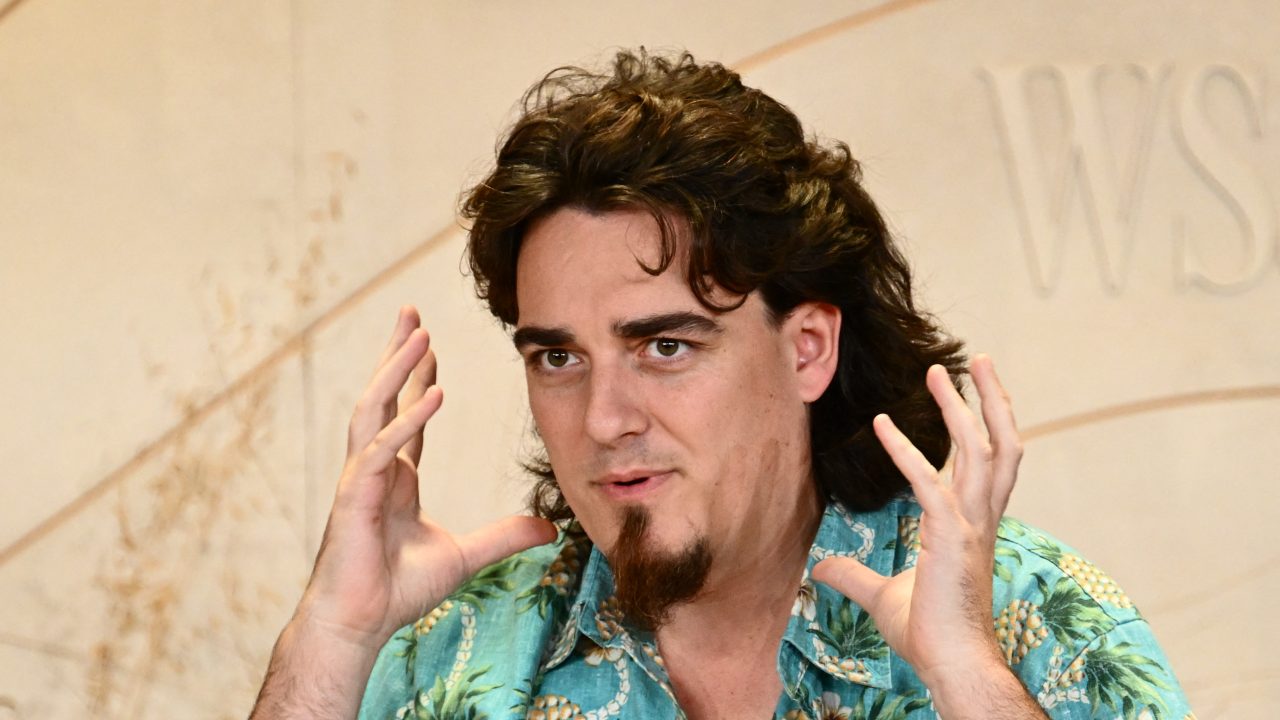
Anduril chief executive Palmer Luckey is proud to be sanctioned by China for selling weapons to “separatist terrorists” in Taiwan. “I wear it as a badge of honor,” Luckey said with a big smile, speaking in Taipei today at the Whole-of-Society Defense Resilience International Forum.
His message to Taiwan was two-fold: First, Taiwan needs to build a proper defense industrial base that not only serves domestic needs, but also makes the island into a major global defense exporter. Second, to effectively deter Beijing, Taiwan needs to achieve a durable political consensus on its future.
“Every democracy has had a tendency to wait until a threat becomes undeniable, and then discover that their factories, suppliers, pooling, and skilled workers cannot be created on demand,” said Luckey. Since Taiwan already excels at making the technology that underpins the modern defense industry — like chips, machine tools and precision components — the key is for Taiwanese companies to reorient toward weapons production.
“Your national drone champions are also making dental equipment, aerospace parts, vehicle components,” Luckey said. “Over time, those same production lines need to become increasingly interchangeable with weapons production at volumes measured in the millions.”
A defense industrial base that is powerful enough to deter China will need to serve markets outside of Taiwan, making the island increasingly indispensable, Lucky argued. While he has heard people suggest that “they wouldn’t be willing to bet their military on Taiwan” given the threat of annexation from China, he doesn’t “buy it” because the most powerful companies in the world are betting that TSMC is still going to be delivering chips this year and onward.
“I think that the fact that countries are willing to bet on Taiwan in the chips space is proof that they will bet on them in the weapon space if you can have the same types of advantage,” Luckey said, adding that the more companies that bet on Taiwan, the more likely it is that Washington will consider the loss of Taiwan to China “unsurvivable.”
A possible rejoinder to Luckey’s argument is that the U.S. is fervently pushing for parallel capability in advanced semiconductor manufacturing, precisely because its overwhelming reliance on Taiwan for chips is a massive geopolitical and economic risk. TSMC has already promised to invest $265 billion into expanding its operations in the U.S. But Luckey says that the real risk is China building that capacity. One of the reasons that “China is trying so desperately to catch up with the semiconductor industry” is that it wants to reduce global dependence on Taiwan, Luckey said.
Another potential weakness in Luckey’s argument is that no matter how much Taiwan pours into its own defense, China will probably spend more. Right now, China spends about eight to ten times more on defense than Taiwan, said Fei-fan Lin (林飛帆), Deputy Secretary-General of Taiwan’s National Security Council. But Luckey thinks that fending China off is a doable task. “You don’t need to go and invade China. You just need to make it so painful for them, and for them to know that it’s so painful, that they don’t come for you,” said Luckey.
Luckey cautioned that deterring China not only requires more weapons and more expertise in asymmetric warfare, it also requires internal cohesion. “If Taiwan can reach a durable shared view of its own future, even though that might look slightly different for everybody, and if the Chinese Communist Party understands that this view can survive any one political fight, or disagreement, or campaign, or measure of economic coercion, then you can imagine that Beijing will hold the conclusion that many nations have reached many times in history: This is a war that may be winnable, but it is not worth winning.”
The real objective is to convince Beijing that just getting to Taiwan, which they can very likely do, is not a victory, but rather “the beginning of a fight that could continue for years or even decades,” said Luckey.
“People from the outside cannot save a country from overseas, even if we really want to.”





Leave a Reply