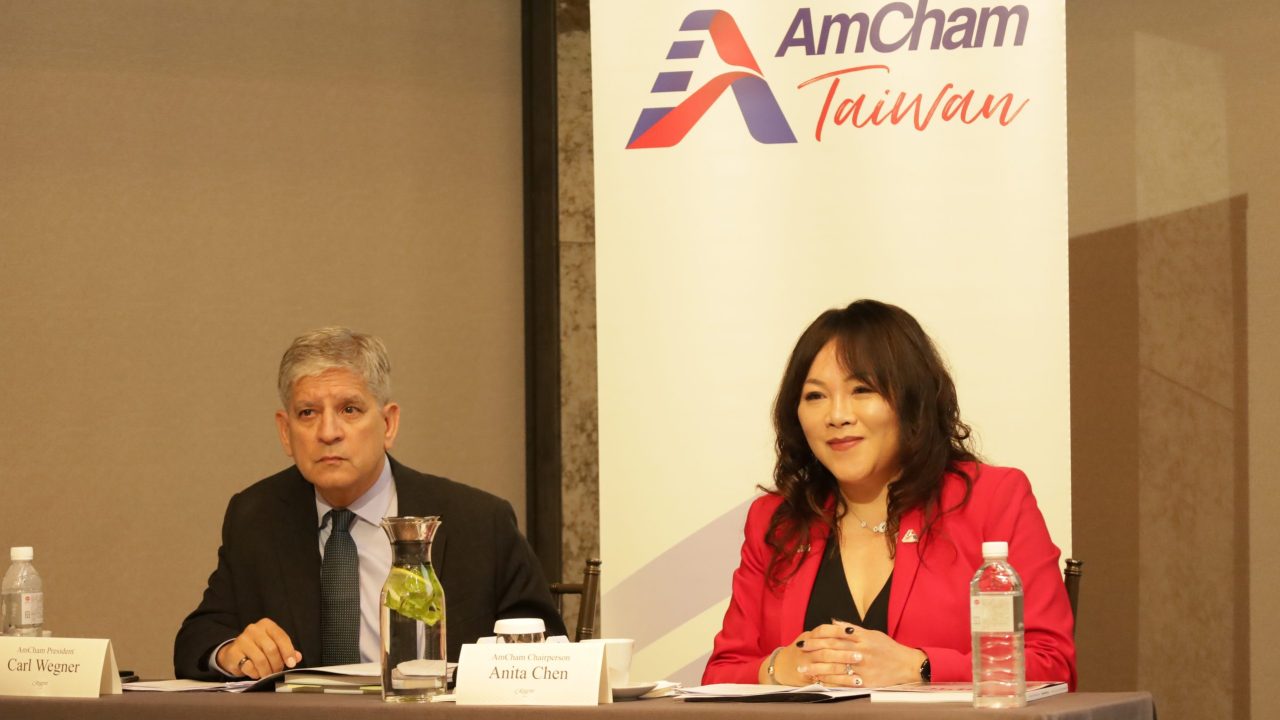
The American Chamber of Commerce in Taiwan published its annual white paper today, outlining policy recommendations for Taipei and Washington to support American businesses in Taiwan.
“In my 40 years here, we’ve seen Taiwan move from Christmas tree decorations to shoes to precision manufacturing to semiconductors and now to AI,” said Carl Wegner, the president of AmCham Taiwan. Speaking at a press conference to celebrate the launch of the white paper in Taipei, Wegner added that Taiwan and the U.S. are experiencing “what some would call a golden age in economic relations.” Over the past year, the U.S. became Taiwan’s top trading partner, while Taiwan surpassed Germany to become the U.S.’s fourth-largest trading partner for the first time in more than 20 years.
Looking ahead, Anita Chen (陳幼臻), AmCham Taiwan’s chairperson and Google Taiwan’s government affairs lead, encouraged Taiwan’s leaders to update foreign investment laws to reduce unnecessary costs and delays, avoid overly prescriptive rules that stifle tech innovation by creating premature compliance burdens, and strengthen incentives for attracting international talent.
To improve energy resilience, Taiwan is currently in discussions with U.S. companies to ramp up purchases of American liquefied natural gas, or LNG, said Chen. Under the February Agreement on Reciprocal Trade, Taiwan promised to buy $44.4 billion of LNG and crude oil from the U.S. by 2029. While AmCham Taiwan does not “prescribe a specific energy mix, we view this arrangement a vital step for Taiwan’s energy security and its economic relations with the United States,” Chen said. Taiwan currently relies on imported LNG for over half of its electricity generation, but supply has been threatened by disruptions related to the war in Iran.
A contentious energy issue not addressed in the white paper is nuclear power. Taiwan completed its nuclear phase-out last year, but the government is considering a plan to restart Maanshan, Taiwan’s fourth nuclear plant. Jensen Huang, the chief executive of Nvidia, said last year that “Taiwan should definitely invest in nuclear energy.” Nvidia is TSMC’s largest customer and invests $150 billion a year into Taiwan’s chip ecosystem. Asked whether other American companies have pushed for a nuclear restart in Taiwan, Wegner told Domino Theory that AmCham’s members care about pricing, stability and predictability, rather than any particular energy source.
Another topic not explicitly addressed in the white paper is how the risk of a Chinese invasion impacts U.S. business interests in Taiwan. “92% of our members said that they were going to invest equal or more in 2026. So, despite whatever challenges there are, they’ve assessed those challenges, and they still see Taiwan as a unique opportunity,” Wegner said in response to a question on the issue.
One notable departure from last year is that this year’s white paper did not include specific recommendations to Washington about bolstering Taiwan’s defense and diplomatic engagement. In its 2025 white paper, AmCham Taiwan urged the U.S. to facilitate and prioritize Taiwan arms sales and encourage high-level visits to Taiwan by U.S. cabinet officials. “High-level visits are not provocative when they become routine,” AmCham wrote in 2025. But this year, AmCham’s “message to Washington” focuses on outlining Taiwan’s strategic importance to the U.S. “Our goal is to remind policymakers in Washington, DC that stronger economic ties with Taiwan create clear benefits for both sides,” Chen said.
Taiwan experienced somewhat of a bruising spring in its relationship with the U.S. Following his summit with Chinese leader Xi Jinping (習近平), Trump said that he is not looking to travel 9,500 miles to fight a war over Taiwan and is now reportedly delaying arms sales to the island. While the U.S. and Taiwan finally reached a trade agreement in February, which cut tariffs on Taiwanese imports, the U.S. shortly afterward launched two Section 301 investigations that include Taiwan. On June 2, the U.S. found that Taiwan, along with 59 other countries, failed to impose and enforce a ban on the importation of goods produced with forced labor, opening Taiwan up to a range of retaliatory trade measures.
Wegner said he is “not too worried about” the investigation, adding that he believes the review period in July will show that the forced labor allegations against Taiwan “are not there.”
“Economically we’re a lot closer than we’ve ever been,” Wegner added, referring to Taiwan and the U.S. Initiatives like Pax Silica, which the U.S. is spearheading to build “trusted” technology supply chains, allow Taiwan to show that it is both a key technology partner and a key partner in the first island chain, or the string of archipelagos in East Asia that form a barrier against Chinese power projection in the Pacific.
AmCham Taiwan will embark on its annual advocacy campaign in Washington this week. Wegner said he has found the bipartisan support for Taiwan in Washington to be “just amazing.”



Leave a Reply