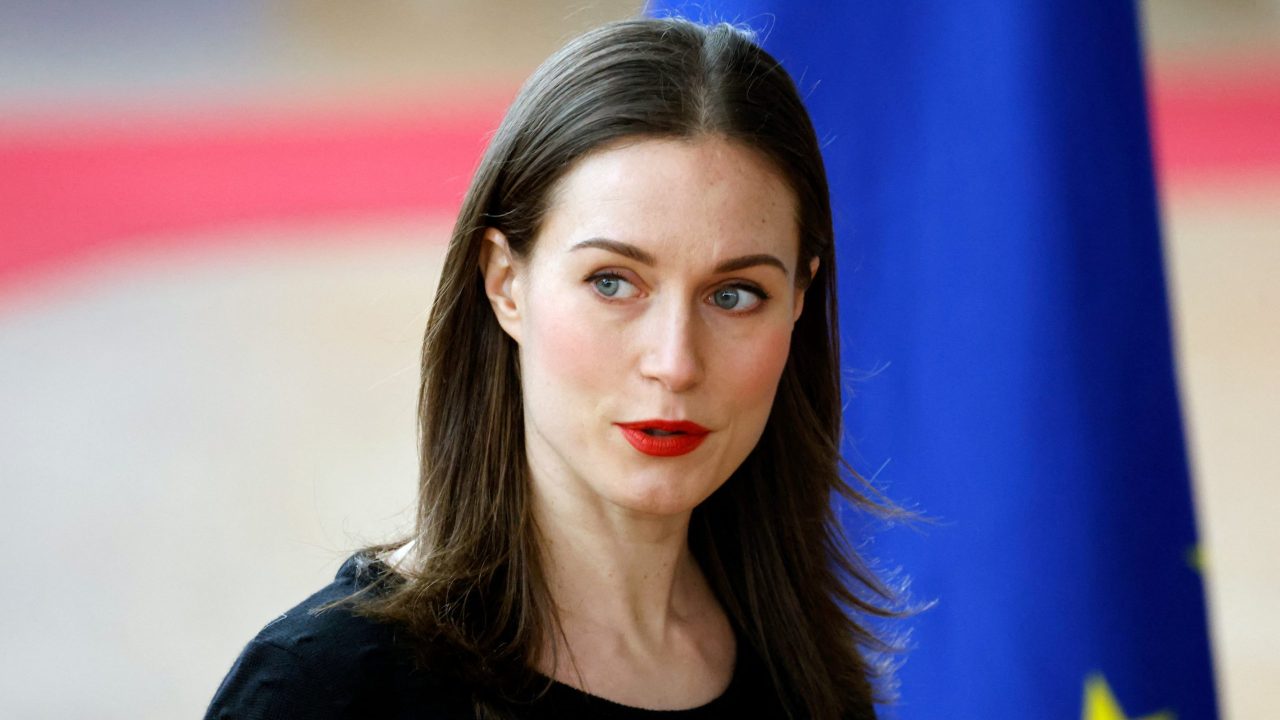
Former Finnish Prime Minister Sanna Marin gave a speech in Taipei on August 4. It was an explanation of what she had learned as leader of her country and how that should be applied to the current geopolitical reality. It wasn’t aimed at Taiwan in particular, but there was a heavy sprinkling of useful comparisons between situations in Europe and East Asia.
Marin was speaking at the Ketagalan Forum, one of Taiwan’s annual foreign policy events that serve as an anchor point for hosting former, and even sometimes current, senior political figures from around the world. She gave a keynote address in the afternoon, introduced by Francois Wu (吳志中), Taiwan’s deputy foreign minister.
Marin’s speech was a full-throated declaration of solidarity between Europe and Taiwan, arguably more so than Taipei has seen in some time.
“I want to thank and share my admiration for Taiwan and its people for your courage in defending our shared values,” Marin said. “In Finland, we have always understood what it is like to live in the shadow of a beast,” she continued. “We also know how it feels to encounter that beast alone.”
“Our shared values” is something that we heard a lot from Europeans about Taiwan in the aftermath of Russia’s full scale invasion of Ukraine in 2022. It’s been in somewhat shorter supply more recently.
But Marin brought the comparisons between Taipei and Kyiv back into vogue in a big way, implicitly recognizing Taiwanese sovereignty in her choice of phrasing. “We need to understand that the matter of Ukraine, just like the matter of Taiwan, isn’t an issue of a single country,” Marin said. “If we let countries like Russia attack an independence-oriented nation without serious and long-lasting consequences, it will set an example for others to use aggression to get what they want.”
This continued when she added: “I fully agree what Vice President Hsiao [Bi-khim (蕭美琴)] stated earlier today. To build lasting peace, we need strength and deterrence of our own.”
The website of the Chinese embassy in Finland quotes foreign ministry spokesperson Mao Ning (毛寧) on this matter: “Taiwan is part of China and there is no such thing as ‘vice president’ of the Taiwan region.”
The former Finnish prime minister ended her speech with a nice flourish: “Even now, when the world seems so grim and fragmented, when the international rules-based order is questioned and challenged, we can influence and change our future, just like Taiwan did 30 years ago when your brave people chose democracy.”
But in the question and answer session that followed Marin was pressed by the audience. Domino Theory asked about the decisions and trade-offs that former world leaders face when they come to Taipei and support Taiwan, but say nothing whilst they are in office.
“As a former prime minister, it is of course much easier to speak [than] as an active one,” Marin replied. But she then said countries cannot trade-off their principles and values, and that compromising on these in the present will lead to trouble in the future, especially for small mid-sized countries if the international rules-based order is damaged as a result.
“That’s why it’s so important, for example, to be here today to speak about the principles and the values that we believe in: democracy, the right of certain nations to decide by themselves without the fear that it might lead to aggression,” she said.
Marin’s track record as prime minister was arguably quite hawkish: “China is less and less a partner to Europe and increasingly a competitor and challenger,” she told the European Council in 2022. Speaking to the media on the same day she said: “We shouldn’t be dependent on authoritarian regimes on critical issues such as technology” — a theme that formed one of the backbones of her speech in Taipei this week.
The second question, from Mukesh Kaushik, currently a visiting scholar at the Center for Chinese Studies in National Chengchi University, was blunter. “99% of democracies all over the world are having relationships with China, not with this democracy [Taiwan]. What is this paradox?”
We can see the resemblance between Taiwan and Ukraine, Marin replied. “A bigger aggressor next doors, attacking an independent sovereign nation with brutal force, no right to do so.” She said she was proud of how Europe responded.
“But when we look at the situation in Taiwan, between Taiwan and China, there are the questions of the international response because of the one-China policy,” Marin said. “It might be much more complicated for different countries internationally to respond.”
“I don’t think it should be like this, but I’m speaking from a realistic perspective, and I think this audience here really well knows this and understands this.”
“I believe that the international community should always stay strong and always should defend the values and principles that I was mentioning in my speech,” Marin concluded.
During Marin’s premiership, Finland joined NATO. Her country no longer has to face its beast alone. Perhaps, when Marin is back in Helsinki, we’ll hear her advocating more for “serious and long-lasting consequences” if Taiwan’s beast ever attacks.



Hi Josh
Thank you for quoting my question by name. That is really a nice gesture on your part. You even highlighted that question was blunter than yours. That is called magnanimity.