The Central European Institute of Asian Studies (CEIAS) published a major new report on Europe-Taiwan relations today, with individual chapters on 30 European countries and their ties to Taiwan.
Domino Theory’s biggest takeaway? Despite growing ties, Taiwan isn’t doing enough to drive the relationships forward, and hasn’t adapted to the changed geopolitical landscape left by China’s support for Russia’s invasion in Ukraine.
“There is no point for Taiwanese to target specific individuals too much given they will stop serving in the government in a couple years, and then we’ll have new politicians,” said Dana Duda, a researcher from the Latvian Institute of International Affairs.
Duda, who wrote the Latvian section of the report, pointed out that there are limitations to guanxi (relationships) in European politics, where short-term officials make individual targeting inefficient. “It’s better to educate the overall society and focus on the younger generation,” she said, arguing that Taiwan should provide more scholarships and training, “because it’s the people in Latvia who vote” who have the actual power.
Duda said that Taiwan is doing the same things in Latvia it was doing before Russia invaded Ukraine. She described this as “a little bit ineffective.”
One of the key recommendations the report makes for Taiwan is to “deliver on economic promises.” This has been an area where Taiwan has failed in the past. Those with long memories will remember that in 1999 the country that was then known as Macedonia flipped from recognizing China to Taiwan. The investment that Skopje claimed Taipei had promised never materialized (and Taiwanese officials disputed that such promises were made). Two years later, Macedonia was back in Beijing’s embrace.
A previous report from CEIAS in 2023 said that “Taiwan needs to fulfill its (economic) pledges in order to demonstrate that having relations with it brings long-term benefits.” Now, in 2025 it warns that “this remains an urgent task for Taiwan.” Otherwise, “expectation fatigue” could set in.
Most concerningly, the report states that “early warning signs of this potential development have already been observed in Lithuania and Czechia,” two of the three countries it identifies as Taiwan’s key “new friends.”
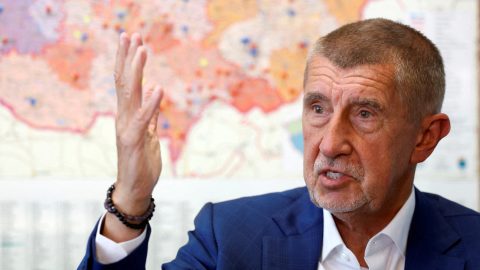
“Taiwan faces the symbolism versus substance dilemma in approaching Europe,” according to Matej Simalcik, the executive director at CEIAS and one of the report’s editors. He said populist leaders like Czechia’s new Prime Minister Andrej Babis “don’t really care about the normative alignment in cooperation with a like-minded partner, instead being focused more on bread-and-butter economic achievements.”
Today’s report also recommends that Taiwan focus on identifying overlapping economic interests; Duda mentioned agricultural tech as being an area where Latvia would welcome more trade with Taiwan.
The third economic recommendation is removing trade barriers. Because of unofficial ties and Chinese pressure, striking a trade deal with the EU will be challenging for Taiwan to say the least. But the United Kingdom has shown a way forward: it recently signed an Enhanced Trade Partnership with Taiwan. CEIAS’s report describes this as a “workable compromise,” avoiding politically sensitive language whilst deepening cooperation.
Elsewhere, there are more missed opportunities. “The double tax agreement [between Finland and Taiwan], we haven’t been able to solve it… they’ve been negotiating for years and got stuck somewhere, unfortunately,” said Julie Yu-wen Chen (陳玉文), a Professor in Chinese Studies and Asian Studies coordinator at the University of Helsinki.
In spite of this, Chen, who wrote the Finnish section of the report, praised the Taipei Representative Office in Finland’s diplomatic effort, particularly during the Covid-19 pandemic. She said it was a golden opportunity to promote Taiwan’s “different way,” combating the pandemic while still maintaining its democracy. She also commended the former representative signing an air service agreement with Finland earlier this year, and the newly arrived representative, former politician and current heavy metal star Freddy Lim (林昶佐).
“Unlike all the other former representatives, the Finnish media just think he’s an interesting person to write about, you know, and that, of course, agitates the Chinese side … basically the Chinese Embassy is very unhappy with his visibility,” Chen said, highlighting that Lim’s media-savvy personality and cultural diplomacy gives Taiwan an unusual visibility in Finland that has become a friction point for China.
Nowhere is the failure of Taiwan to move from symbolism to substance more apparent than in the case of the stalled Taiwanese representative office in Estonia. Tallinn granted permission for Taipei to open an office in 2023, but two years later it hasn’t happened.
The reason is that Taiwan wants to open it under the name of Taiwan, whereas Estonia expects that it will use the name Taipei. In 2021 Taiwan opened the Taiwanese Representative Office in Vilnius, Lithuania. It is the first representative office in Europe to use this name rather than one featuring the word “Taipei.”
China threw a temper tantrum and withdrew its ambassador, subsequently attempting to inflict substantial economic punishment on Lithuania. So Taiwan’s eagerness to show this hasn’t worked by opening a similar office in Estonia is understandable, but currently it can’t open the office because Estonia apparently thinks that China’s punishment did work.
Mart Tsernjuk, a scholar at the University of Tartu who authored the Estonian chapter of the report, wrote that “being more cautious in words than in deeds would allow Estonia to advance practical cooperation with Taiwan.” He also pointed out that momentum is with Taiwan: In 2023, the Estonia-Taiwan Support Group in Estonia’s parliament surpassed the Estonia–China Friendship Group in size in 2023, with 24 members compared to the China group’s 15 (down from 49 in 2011).
The naming of the office in Estonia also has to take into account Lithuania’s views, Lin Chia-lung (林佳龍), Taiwan’s Foreign Minister, said at a briefing organized by Taiwan Foreign Correspondents’ Club last month. “It should be a name that both Taiwan and Estonia agree on, and one that neighboring countries also find appropriate, since they are in the same region,” Lin said.
CEIAS’s report takes a far clearer stance than Lin: “To challenge Beijing’s deterrence and demonstrate institutional momentum, it is crucial for Taiwan to open a new representative office, regardless of its name.”


Leave a Reply