
Americans are voting today in the midterms, marking the transition into the second half of President Donald Trump’s four years in office.
Trump looks set to lose the House and maybe the Senate, leaving him a lame duck for the last two years of his term. Such presidents typically become more active in foreign policy, where they have more prerogative. Trump has already made quite an impact internationally, to say the least.
This period often prompts a reshuffle in a president’s cabinet, as he looks to effect change and his officials think about a future outside the White House. Domino Theory asked a number of experts on U.S.-Taiwan and U.S.-Japan ties what they think about how Trump’s team has performed so far.
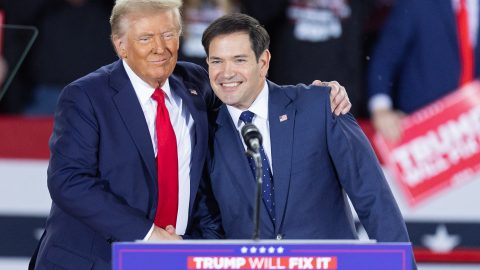
The Secretary of State: Marco Rubio
As someone who very much represented a form of Republican foreign policy hawkism, Secretary of State Marco Rubio was not an obvious pick to lead Trump’s international team. Over the last two years, he’s been the subject of much analysis about why he took the job and what he’s doing with it. He has also emerged as a political meme, the man who realizes he has to add yet another job title to his resume.
Rubio has maintained a firm grasp of the U.S.’s Taiwan policy, said Chen Fang-Yu (陳方隅), an associate professor of political science at Soochow University. Chen argues that Rubio has consistently tried to steer the administration’s public posture on Taiwan back toward established positions.
This has been apparent when Trump himself has made remarks that have alarmed Taipei. When Trump told Fox News he was making arms sales to Taiwan conditional on China, and that Taiwan wanted to go independent, Rubio said: “U.S. policy on the issue of Taiwan is unchanged.”
But while Rubio has a tremendous amount of power on paper, in practice his own previously held convictions on issues like Russia or China policy seem to have disappeared, according to Daniel Sneider, a lecturer in international policy at Stanford. “As far as I can tell, he’s completely subordinated himself to Trump’s sort of narcissistic blurtings,” said Sneider. “I don’t know that he honestly plays any central role in any key foreign policy decision.”
This was echoed by Stephen Nagy, a professor of international studies at the International Christian University in Tokyo, who pointed out Rubio had a long track record of pushing back against communism and authoritarian states but has adopted a more conciliatory tone as secretary of state.
In the past few years, Rubio’s public support for Taiwan has been enough to reassure Taiwanese people, said Chen Ping-Kuei (陳秉逵), a professor in the department of diplomacy at National Chengchi University. But he questioned how long this can continue. “We don’t know if that will be still enough for Taiwanese people when they see Trump and Xi Jinping (習近平) stand together, shaking hands, and talking about Taiwan’s future.”
The Under Secretary of Defense for Policy: Elbridge Colby
Similar to Rubio, Under Secretary of Defense for Policy Elbridge Colby is a professional foreign policy analyst, according to Chen Ping-Kuei. “They have a grand strategy about America’s foreign policy.”
But Colby appears to have gone on more of a journey than Rubio. He is well known for his book “Strategy of Denial,” but has pivoted in a direction that is not consistent with his scholarly and strategic work, said Nagy.
“Strategy of Denial” is a kind of blueprint for the U.S. to combat a rising China. But since becoming undersecretary, Colby has spoken less and less about China. He didn’t mention the country once in a speech in Manila this summer, despite frequent clashes over disputed territory in the South China Sea.
Before joining the government, Colby was almost infamous in Taipei as a voice calling for massive increases in defense spending, calls that have also been taken up by Trump in the last two years.
Colby’s role seems to be a “hawkish taskmaster,” said Chen Fang-Yu, the political science professor at Soochow University. But this may no longer be so difficult for Taipei. Because his position now broadly aligns with the Taiwan government’s own defense modernization agenda, Colby can be an accessible interlocutor, Chen thinks.
Colby authored a significant part of the Trump administration’s national security strategy, according to Sneider. He suggested Trump himself likely never read the strategy, but it nonetheless reflects the administration’s strategic worldview, with “a hemispheric focus, this kind of dividing the world in spheres of influence.”
The Secretary of Defense: Pete Hegseth
Secretary of Defense Pete Hegseth was the most surprising pick by Trump. A Fox News anchor rather than a politician or policy wonk, and much criticized for his lack of relevant experience, Hegseth has brought a certain kind of energy to the role.
“I think the most unstable one is Hegseth,” said Chen Ping-Kuei, the professor of diplomacy at National Chengchi University. “He put his personality into defense affairs, and a lot of things he is doing are hurting America’s strategic and fighting capability.”
Hegseth is a bit of a “muscle-type” defense secretary, conceded Satoru Nagao, a fellow at the Hudson Institute focused on U.S.-Japan-India security cooperation.
But even though Hegseth changed the name of the U.S. Indo-Pacific Command back to the U.S. Pacific Command, a move Nagao said was “not welcome” in Tokyo, the actual work of the U.S. military is still spread across both regions. Washington is, of course, fighting a war with Iran and has substantial naval assets deployed in the Indian Ocean.
When Hegseth goes on foreign trips, he sticks to the script prepared by the Pentagon, said Sneider. Leaders in Asia therefore see a different side of him than the domestic audience in the U.S.
The dynamic that Hegseth has with his Japanese counterpart, Defense Minister Shinjiro Koizumi, is also heavily impacted by the fact that Koizumi aspires to be prime minister. The two officials have been photographed working out together with the troops. Koizumi’s goal is “to show that he can manage the relationship with the Trump administration,” said Sneider, who formerly worked as a journalist in Japan. “So he lends himself to these silly displays.”
Despite the functional relationship he has with Asian allies, Hegseth is “a dangerous idiot,” Sneider warned. “He has only one audience for everything he says and does, and that’s Donald Trump.”
Whether that will be enough to protect his job if Trump decides he needs a scapegoat for the war in Iran is probably not a difficult question to answer.





Leave a Reply