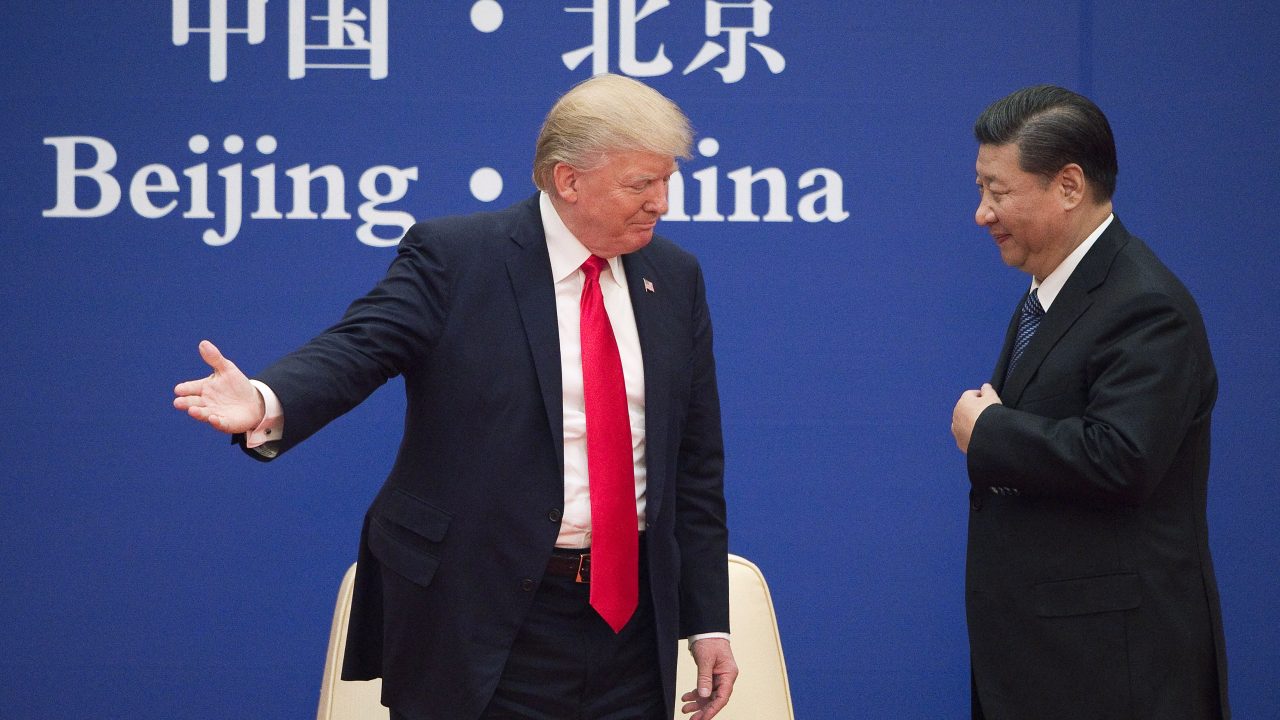
When U.S. President Joe Biden met with Chinese President Xi Jinping (習近平) on the sidelines of APEC on Saturday, observers guessed that Xi was really communicating with the U.S. president-elect, Donald Trump. In his remarks to Biden, Xi unsurprisingly mentioned Taiwan. But his first point to Biden was this: “There must be correct strategic understanding. The ‘Thucydides Trap’ is not historical destiny, a ‘new Cold War’ cannot and should not be fought, containment of China is unwise, undesirable, and will not succeed.”
The “Thucydides Trap” is a long-standing narrative driven by Chinese officials and state media. Originally developed by American scholar Graham Allison, the Thucydides Trap argument describes the tendency for rising and established powers to clash. In Allison’s own words, “when a rising power threatens to displace a ruling power, the resulting structural stress makes a violent clash the rule, not the exception.” China has embraced its own narrative based on the Thucydides Trap so whole-heartedly that some are calling Allison China’s new Henry Kissinger. However, while China accepts the premise of the Thucydides Trap — that China’s rise has created tension with the U.S. — China does not believe (at least according to public narratives) that the two countries are destined for war.
China began mentioning the Thucydides Trap in earnest after Xi’s visit to Seattle in 2015, during which he stated: “There is no such thing as the so-called Thucydides Trap in the world. But should major countries time and again make the mistakes of strategic miscalculation, they might create such Traps for themselves.” Since then, Chinese officials and state media have mentioned the Thucydides Trap countless times to home in on the same basic point: War is not inevitable if the U.S. can respect China’s core interests. Taiwan has often been the subject of China Thucydides Trap narratives, as it is perhaps China’s most important core interest. According to Allison himself, China began using this narrative after it proposed in 2012 the concept of a “new form of great power relations” in which the U.S. and China could coexist by respecting each other’s bottom lines. Then-President Barack Obama rejected the proposal, unwilling to blanketly accept China’s various territorial claims.
The Thucydides Trap narrative serves as an anchor for China’s ultimate argument, which is that a war over Taiwan would be the U.S.’s fault. There are a few layers to this. First is a corresponding narrative that China will be calm until one of its red lines is crossed. State media tends to juxtapose China’s calmness with the U.S.’s relative chaos, consistently maintaining that the U.S. is prone to misjudgement, miscalculation and prejudice. But given Trump’s unilateral and unpredictable nature, his second term will likely provide more fodder for China to lean into this narrative. Indeed, Chinese state media portrayed Trump as random and destructive during his first term. On the Taiwan issue, Chinese state media once reported that Trump “could blow up in anger,” potentially leading him to “play the ‘ultimate’ card [the Taiwan card] in his final acts of madness.”
A second layer is a narrative commonly dubbed “U.S. skepticism.” This narrative is often disseminated in Taiwan, with the aim of convincing Taiwanese that the U.S. is an insincere and unreliable partner. During Trump’s first term, his friendly actions toward Taiwan were painted by Chinese state media as “malicious” and underhanded, aimed not at protecting Taiwan, but rather at serving the U.S.’s own interests — primarily, thwarting China’s rise. “Using the issue of Taiwan to contain China’s rise is a ‘zero-cost strategy for the U.S., but can fool Taiwan’s politicians and bring about benefits for the U.S., as the move may jeopardize China’s sovereignty and shortcut China’s peaceful development,” wrote one contributor to the Global Times, a prominent state-run publication, in 2020.
This narrative continued in earnest during the Biden administration. The Financial Times reported this summer that Xi in April 2023 had warned Ursula von der Leyen, president of the European Commission, that “the U.S. was trying to trick China into invading Taiwan, but that he would not take the bait.” This narrative has also borne out in China’s commentary on Ukraine, which contends that the U.S. pushed Russia to the brink by meddling in European geopolitics in order to satisfy its desire for power, ultimately compelling Russia to intervene.
We are already beginning to see the U.S. skepticism narrative play out in the context of Trump 2.0. In response to Trump’s recent comments in Bloomberg Businessweek and elsewhere that Taiwan stole the U.S.’s semiconductor business and owes the U.S. for defense support, Global Times wrote, “Trump’s remarks reflect the shameless but true thoughts of many U.S. politicians. The U.S. wants to maximize its exploitation of the Taiwan island’s interests, use it to contain the mainland geopolitically, and gain economic benefits as much as possible.” Another Global Times staff piece said, “These remarks expose the so-called U.S. commitment to Taiwan as an empty promise, and many people on the island have expressed their anger at being coerced into becoming cannon fodder for the U.S.”
The goal of U.S. skepticism and the broader Thucydides Trap narrative is to justify China’s argument that the U.S. is goading it into an otherwise avoidable war over Taiwan. Case in point, in response to then-Speaker of the House Nancy Pelosi’s visit to Taiwan in 2022, the Global Times wrote, “In contrast to China’s long-term strategic determination and patience, the U.S.’ biggest miscalculation is to undermine the overall China-U.S. relations for the selfish interests of certain politicians, and when the U.S. is playing the Taiwan card to create crisis scenarios across the Straits [sic], China is steadily turning those scenarios into opportunities to achieve its goal of reunification.”
A third layer to the Thucydides Trap narrative is that the U.S. is an irresponsible global leader that is dividing the world through interventionism. This argument seems to be targeted at Europe, in particular. In 2023, the Global Times reported on French President Emmanuel Macron’s “rational” and “pragmatic” warning about Europe being “lured” by the U.S. into a conflict over Taiwan. The argument that follows from this narrative is that China can provide a more responsible and equitable form of leadership. Trump’s next term will likely give China another “chance to occupy the global moral high ground” by claiming that Trump’s “America first” approach to foreign policy undermines the international order.
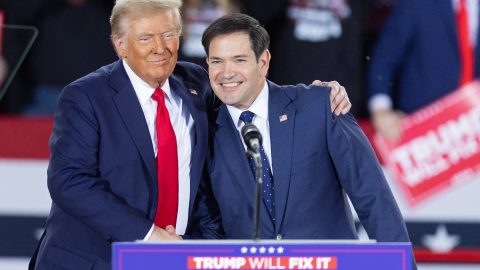
On the whole, Trump’s second term gives China the chance to continue running its tried and true narratives, while adapting somewhat according to Trump’s distinctive approach to China policy. China will likely lean into the “provocative” hawkishness of Trump’s new Cabinet, as individuals like Marco Rubio and Mike Waltz are part of a group of China hawks in Congress that Chinese media has continuously labeled as “anti-China.” Rubio, Waltz and other conservative China hands believe that the U.S. is in a new Cold War with China, which they argue requires Cold War-era deterrence activities like military buildup. This might make it easier for China to paint the U.S. as an unreasonable aggressor. But Trump will ultimately call the shots and he has empirically been willing to compromise with China. Only with time will tell how Trump’s decisions shape China’s narrative strategy.



Leave a Reply