
Last night, an AI-generated picture of Taipei 101 circulated around Taiwanese social media. The iconic sky scraper was lit up with a sign saying, “He’s back.”
“He” could only refer to one person: local hero Jensen Huang, who was reinstated as chief executive of Nvidia on Monday, just two weeks after he admitted to an affair with an alleged Chinese spy and resigned.
While Huang’s abrupt return to power has been met with skepticism in the U.S., the reaction is largely positive in Taiwan, Huang’s place of birth and the epicenter of his celebrity.
“I officially announce that I want to restore the father-son relationship with Jensen Huang. Even if I have three moms, I don’t mind at all,” wrote one Taiwanese commentator on Threads, making reference to his moniker “Daddy Huang” (黃爸爸).
View on Threads
Jensen Huang resigned as Nvidia’s CEO on November 12 after admitting to marital infidelity. Reports indicate that Huang had at least two affairs with employees, as well as with Alice Huang (黃樂), a Chinese business executive suspected by U.S. officials of having ties to Chinese intelligence. Alice Huang is linked to the Singaporean server company Megaspeed, which is being investigated for illegally diverting Nvidia AI chips to China, and today was added to the U.S.’s trade blacklist.
Huang’s departure saw a global technology-stock selloff, with Nvidia’s stock price falling to as low as $148.80 per share the day when he resigned.
Many Taiwanese social media users expressed sadness for the fallen hero and worried about what his absence would mean for Taiwan. Taipei 101 was lit up with a sign, this one real, that said “We Love Jensen.”
“Taiwan may never again find a global tech heavyweight as supportive of Taiwan as Jensen Huang,” one user wrote on Threads.
Others noted that gossip about Huang’s affairs had already been circulating in Taiwan for a year or two, and that Taiwanese culture is fairly tolerant of extramarital affairs among the ultra rich.
But support for Huang was not unequivocal, with some people expressing unease at Huang’s desire to sell advanced chips to China.
Jensen Huang’s public image was close to perfect here in Taiwan, where his success is a point of national pride. “The Taiwanese like to think of themselves as nerdy, hardworking and humble. Huang wore the same leather jacket, ate at street stalls, and signed the wall of a restaurant bathroom. He was born in Tainan and left at nine, but he looked like someone who could have stayed. He was an engineer who made it,” wrote Chang-Tai Hsieh (謝長泰), a professor at the University of Chicago, in an article for Commonwealth Magazine.
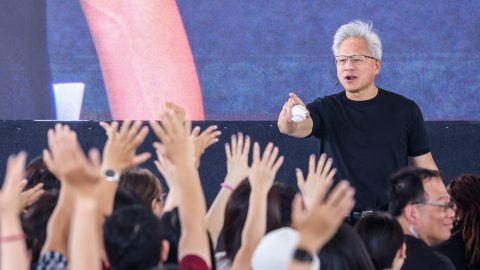
Huang also helped to elevate the global perception of Taiwan amid the AI boom, communicating effusive praise and evident pride for the island and its chip industry. He has hosted Taiwanese suppliers at the famous “trillion-dollar banquets” in Taipei, lauded Taiwan as the “epicenter of the AI revolution,” and happily posed for pictures with fans countless times.
These shows of respect are meaningful to Taiwan’s tech industry, which at earlier times has been treated by American corporations as subordinate. “It was not until the AI boom that Taiwanese suppliers suddenly found themselves upgraded from economy class to first class,” wrote tech journalist Liang-rong Chen (陳良榕) in another article for Commonwealth Magazine.
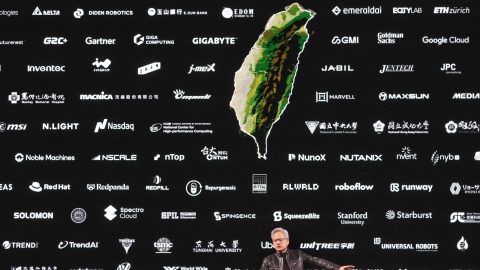
Moreover, Huang has cultivated unusually close relationships with Taiwanese suppliers, which fosters the trust needed to plan and invest in product cycles years in advance. And he is seen as an advocate for Taiwanese interests in Washington, especially in the face of evolving technology regulations, according to previous reporting by Domino Theory.
Following Huang’s reinstatement on Monday, the relief in Taiwan is palpable. Taiwan stocks surged 9% on Tuesday morning, after plunging almost 18% last week.
For Lai Ting-yu (賴庭宇), a 36-year-old stock trader, excitement over Huang’s return to Nvidia outweighs concerns about his troubling past. “I really don’t care what happened in the past, anybody can make mistakes.”
Some people say they don’t want to paper over the scandal. “I wonder whether a woman would get a second chance if one day she betrayed her partner, formed friendly ties with a spy, and sold products to countries considered security risks,” wrote one user on Threads. “There’s no need for a hero’s welcome, no need to whitewash his record.”
“Now that Huang is back, every comment is about how impressive he is,” another Threads user wrote, criticizing his supporters for “ignoring the consequences of supplying chips to China.”





Leave a Reply