
Jensen Huang (黃仁勳), chief executive officer of Nvidia, today described an industrial machine so complex that it can only be built in one place: Taiwan.
“Taiwan was with us at the beginning and here today as we bring Vera Rubin to the world. Thank you, Taiwan,” Huang said during his keynote address at Nvidia’s GTC conference in Taipei.
Nvidia has officially entered full production for its Vera Rubin architecture, its next-generation artificial intelligence computing platform that is designed to run autonomous AI systems, often referred to as agentic AI. “Agentic AI is just a digital robot. It understands, it reasons, it plans, and it acts and uses tools,” Huang explained.
Nvidia even made a seemingly AI generated music video to highlight Taiwan’s role in this phase of AI deployment, which played at the end of Huang’s speech. “Agentic AI, the next wave has arrived. Useful and profitable, staying alive. Taiwan ecosystem, the supply chain’s core. Jensen and NVIDIA opening the door,” sang a cartoon robot while strolling through a night market in Taipei.
The creation of Vera Rubin was a “miracle to witness,” and it was made possible by a network of 150 supply chain partners in Taiwan, Huang said. “This is what we call extreme co-design. We did this with Taiwan.”
The Taiwanese companies explicitly named by Nvidia as partners include TSMC, SPIL, Kinsus, KYEC, UMTC, Foxconn, Pegatron, Quanta Cloud Technology, Wistron and Inventec. The scope of these companies reflects Taiwan’s involvement across manufacturing, packaging, server assembly and integration.
“The supply chain we created for Vera Rubin is twice as large as Grace Blackwell,” Huang said, referring to the current generation AI computing platform.
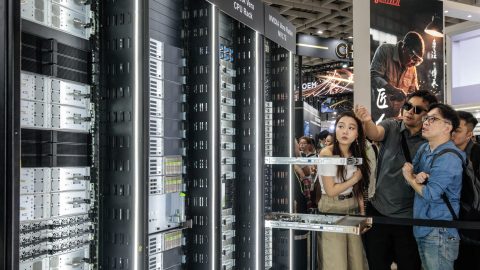
These partners help orchestrate a staggering level of complexity. A single Vera Rubin rack contains 1.3 million components, with over 18,000 components per board, and integrates around 6 trillion transistors. The cable-free design reduces the time it takes to physically assemble an AI server rack to just five minutes.
As Huang said, Nvidia went from a company that makes chips for video games to an “AI infrastructure company” that provides the blueprint for AI factories, the term Huang likes to use for data centers. These facilities are the most expensive industrial assets ever created, costing as much as $100 billion per gigawatt. “100 gigawatts of AI factories will come online before the end of the decade,” Huang said.
The scale of this business is helping to power Taiwan’s economy. Huang cited projections that Taiwan’s annual GDP growth will hit almost 10% this year, driven almost entirely by the AI industry.
The contribution of Taiwan’s tech ecosystem also extends beyond agentic AI to the realm of embodied AI, or AI-powered machines that can interact with the physical world. Huang introduced Cosmos 3, a model that helps robots understand physics and movement.
As Huang noted, the computer industry has changed more in the last six months than it has in the previous 40 years. The global economy is paying more and more attention to the factory floors of Taiwan. “Taiwan’s rich ecosystem. The richest ecosystem, the world’s best supply chain ecosystem. Unbelievable,” Huang said.







Leave a Reply