
On Day 6 of the Han Kuang exercise, Taiwan’s largest annual military drills, the focus moved from the coastline to the heart of the island’s cities.
Today marks a major expansion of the Urban Resilience exercises. Over the course of the week, Taiwan’s military will coordinate with local governments to prepare its military and civilian population for potential military aggression by China, including blockade and invasion scenarios.
Unlike previous years, these drills now simulate modern electronic warfare, including planned disruptions to mobile communication networks. The drills are intended to test how well society and local authorities maintain order and facilitate logistics when digital infrastructure is compromised, a likely scenario in the opening stages of a cross-strait conflict.
In the city of Taichung, as well as the whole of the central part of Taiwan, mobile networks were reduced from 5G to the lowest available bandwidth. That meant only text could be downloaded, rather than video or photo. Despite the mobile network slowdown, essential services such as ATMs, traffic lights and emergency services were not affected, nor were landlines and cable internet works, according to officials.
At 2:30 p.m., an alert was sent to the phones of everyone in the area, stating: “missile attack. seek immediate shelter.” Inside Taichung’s train station, a piercing siren went off, and businesses inside the train station began to close down. However, the evacuees, all volunteering civilians, were guided to the basement for shelter before the drill had officially started.
At the train station, as well as the basement of a shopping mall and a government district office, all the evacuees squatted down, their hands above their heads for 30 minutes. This was all executed under local officials’ observation.
When asked about the drills, 40-year-old insurance agent, Chen Chi-Wen (陳祈文), said he did not read carefully what was written in the government text message. “But I do think it doesn’t hurt to practice for scenarios that are worrisome, plus we get a lot of earthquakes and typhoons,” Chen added.
Lutpi, a 47-year-old Indonesian living in Taichung who runs a southeast Asian grocery store near the train station, said he’s used to the annual drills but is indifferent about the mobile network slowdown. “It doesn’t affect my business, but it’s good that Taiwan keeps practicing [the drills].”
Wu Ching-tien (吳敬田), commissioner of the Taichung City Police Department, who was among the officials observing the drills, noted that the mobile network slowdown serves as a reminder that essential functions, such as text messaging and calling, remain viable. “Satellite phones are also an option if communications infrastructure is attacked.” Wu added.
If critical infrastructure is destroyed, “we have generators to keep the essentials, such as air-conditioning running,” said Eric Liang (梁獻元), a representative from the Taichung High Speed Rail.
When asked why the trains were still operating during the air raid drill, he said:
“If we pause the train rides [for drills], it takes a huge toll on the commerce of Taiwan.”
To prepare Taiwanese society for these drills, the government sent reminders in Mandarin and English on August 3 and 7, and posted a video on social media over the weekend.
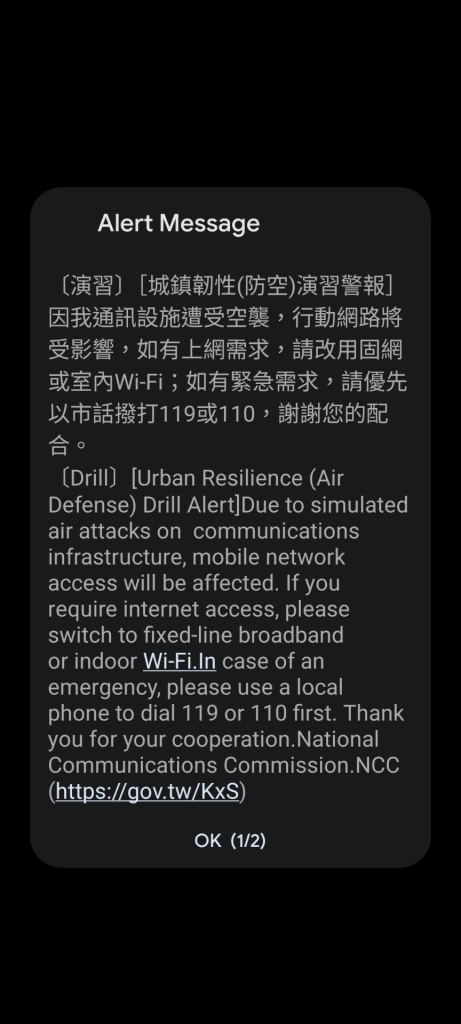
Huang Pei-wen (黃沛雯), a 34-year-old marketing professional, said she did not know about the drill but did remember receiving a text message with the alarm sound. “I remember receiving these text messages, but the noise was so loud and scary so I quickly shut it off. And it’s not like we are going through an earthquake.”
Lin Chin-fa (林勤發), a 56-year-old Uber driver who was expecting the drill, thinks there’s not much difference between the drills from this year and last year. “I don’t think too much about the drills. This year the mobile thing is new, but once everything goes back online, there will be lots of Uber requests. Traffic is gonna be bad.”
Another round of urban resilience drills will take place on August 13 in northern Taiwan, including the capital city of Taipei.
Update: The Executive Yuan, Taiwan’s executive branch, said the speed-reduction drill lowered mobile download speeds to 256 KB/s to simulate communications constraints during major disasters or wartime while simultaneously testing the backup capabilities of government and key public services.


Leave a Reply