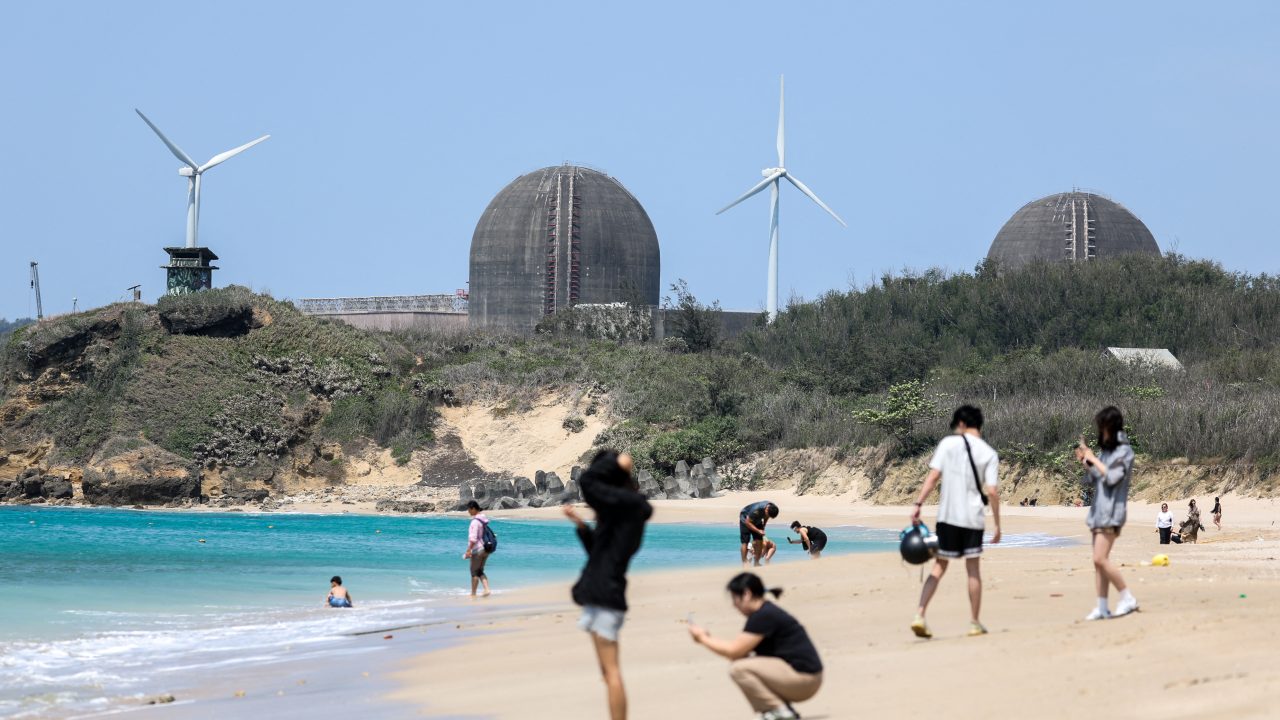
At two of Taiwan’s most popular beaches, sunbathers relax in the shadow of decommissioned reactors. Nuclear power once contributed more than half of the island’s energy needs. But over the past seven years, Taiwan has shut down its reactors one by one.
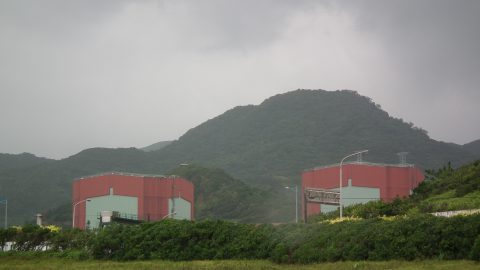
The Maanshan Nuclear Power Plant was the last operational nuclear plant in Taiwan before it was decommissioned in May. Later this month, Taiwan will hold a nationwide referendum vote on whether to restart it.
Energy supply is a crucial economic and national security issue for Taiwan. The island is the center of the global semiconductor supply chain and a burgeoning AI hub. And energy demand is expected to increase 13% by 2030, according to Taiwan’s Ministry of Economic Affairs. But many predict that China’s worsening aggression toward Taiwan will eventually manifest in a maritime blockade. Taiwan and the U.S. are planning for blockade scenarios that could occur as early as 2027.
Since Taiwan imports 97% of its energy, a blockade would effectively cut off all of its energy access. As Bruce Bateman, technologist and Taiwan energy expert, told Domino Theory, “Taiwan’s greatest vulnerability is its electric supply.”
Taiwan’s nuclear energy debate deals not only with this current dilemma, but also with a complicated political history dating back to the 1970s. All three of Taiwan’s once-operational nuclear plants were proposed and constructed during the Chinese Nationalist Party’s (KMT) enforcement of martial law in the 1970s and 1980s — something that antinuclear activists have long pointed out.
The first wave of Taiwan’s antinuclear movement began in the 1980s, amid discussions about building a fourth nuclear plant. A confluence of international and domestic events influenced the rise of the movement: the disasters at Three Mile Island and Chernobyl in 1979 and 1986, respectively; the end of martial law in 1987; and the subsequent explosion of social, political and environmental activism.
Taiwan began constructing the fourth plant in 1999, after the island democratized but before the first democratic transition of power from the KMT to the Democratic Progressive Party (DPP). When Chen Shui-bian (陳水扁), the first DPP president, came to power in 2000, he immediately halted construction on the fourth plant. The DPP later crystalized its “nuclear-free homeland” policy under the leadership of President Tsai Ing-wen (蔡英文). The KMT has remained pro-nuclear to this day.
In 2011, an earthquake and tsunami off the coast of Japan led to a nuclear meltdown at Fukushima, majorly impacting public opinion on nuclear power in Taiwan. As in Japan, Taiwan’s nuclear reactors are located in “very high seismic hazard areas.” Taiwan is also small and densely populated. As per one anti-nuclear talking point from this time: “5 million people in northern Taiwan live within an 18-mile radius of two nuclear plants.”
“After Fukushima, our society has realized that nuclear power is not only expensive but also unsafe,” said Tsai, the former president, when campaigning for the 2012 presidential election.
Since Fukushima, public opinion on nuclear power has ebbed and flowed. Chia-Wei Chao (趙家緯), research director at the Taiwan Climate Action Network, thinks that the 10-hour, island-wide blackout that occurred in 2017 increased support for nuclear power by fostering anxiety about Taiwan’s energy supply.
According to Chao, the blackout made nuclear power seem important to preventing power shortages from happening again, even though all three of Taiwan’s nuclear power plants were operational at the time. After the blackout, the percentage of Taiwanese worried about power outages jumped from 40% to 70%. Reporting indicates that the incident led to heightened scrutiny of Tsai’s efforts to phase out nuclear power.
According to the most recent public opinion polling from the Taiwan Public Opinion Foundation in June 2024, 45.1% of Taiwanese believe Taiwan should pursue a “non-nuclear homeland,” while 43.3% oppose the total phase out of nuclear power.
International perspectives might also be increasing the appeal of nuclear power, according to Chao. When Jensen Huang (黃仁勳), CEO of Nvidia and a major celebrity in Taiwan, visited Taipei a couple months ago, he called on Taiwan to invest in nuclear energy. Additionally, the U.S. and Japan have each taken steps to expand their nuclear power, increasing the sense that Taiwan should, too.
For Chao, the deepest issue with nuclear power is competition with renewable energy. Chao thinks that restarting nuclear power would take away from Taiwan’s investment and momentum into renewables.
“In Taiwan there is a very significant crowding out effect between nuclear development and renewable energy,” said Chao.
Taiwan aims to boost renewable energy generation to 30% by 2030, while most that Maanshan could provide is about 5% of Taiwan’s total electricity needs.
While the party platforms of the KMT and the Taiwan People’s Party (TPP), which form a coalition majority in parliament, support the development of renewables, their pro-nuclear defense also plainly includes skepticism toward it.
In the proposal to get the upcoming nuclear referendum put on the ballot, which was introduced by the TPP and backed by the KMT, half of their argument focused on how the DPP’s renewables strategy has been costly, ineffective and led to “a hotbed of collusion between political and business interests.”
During the contentious budget debates in parliament earlier this year, a TPP lawmaker justified budget cuts to Taiwan’s state-owned electric utility due to its resistance to nuclear energy and the high cost of renewable energy.
Many people in Taiwan believe that despite the high costs and safety concerns, restarting Taiwan’s nuclear power is the most pragmatic option for Taiwan’s energy security. The pressures of a potential Chinese blockade weigh heavily on this analysis.
Nuclear power might not produce as much electricity as renewables, but it is a more stable source of energy, Jong-Shun Chen (陳中舜), associate researcher at Center for Green Economy at the Chung-Hua Institution Economic Research, told Domino Theory.
While renewable energy output varies based on daily weather patterns, nuclear power can be a baseload source, meaning that it can meet the grid’s foundational and constant energy needs.
Chen also noted that many renewable energy providers in Taiwan connect to the grid via wireless. This creates a vulnerability in the event of a Chinese blockade — if the wireless communication system is disrupted, renewable energy may not be able to be dispatched. Nuclear-generated electricity is transmitted to the grid via land-based transmission cables.
Finally, while it would take years and hundreds of millions of dollars to restart any of Taiwan’s nuclear power plants, Chen said that expanding the technical capacity of Taiwan’s other energy sources would be even more costly. For example, a new liquid natural gas power plant would take about nine years to build and a new coal plant would cost 20 to 30 billion New Taiwan dollars ($670 billion to $1 billion).
Kevin Ting-chen Sun (孫廷禎), senior policy advisor for KMT lawmaker Ching-Hui Chen (陳菁徽), added that regardless of how long it would take to restart Taiwan’s nuclear plants, it’s the right thing to do to bolster Taiwan’s national defense.
Evidently, the nuclear debate in Taiwan is polarizing and dynamic. This can make it tricky to understand whether nuclear power is a good idea for Taiwan in a purely pragmatic sense.
“It’s not a precise mathematical problem,” Sun said, when asked if he could quantify the impact of nuclear power on Taiwan’s energy security during a blockade. “It’s an issue about will and about [the] value of being protective.”
“We are worth protecting.”




Leave a Reply