
Taiwan wants to buy a bunch of air defense systems from the U.S., but President Donald Trump doesn’t seem so keen. Maybe that’s not so bad.
When Taiwan finally passed funding for its defense special budget, it put aside $15.1 billion, or 480 billion New Taiwan dollars, to fund a future arms sale from the U.S projected to be worth $14 billion. That sale reportedly includes $8.6 billion to purchase Northrop Grumman’s Integrated Battle Command System and more Patriot air defense systems.
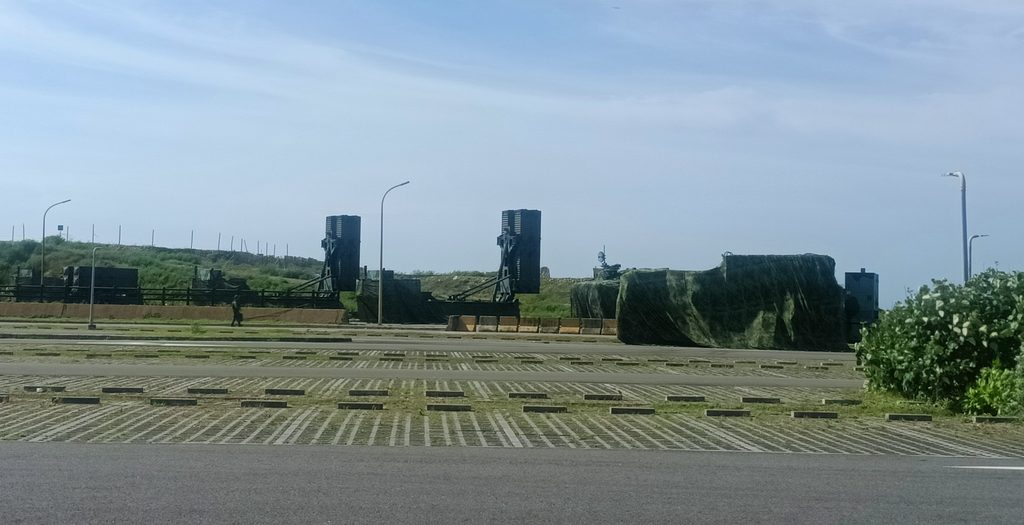
Taiwan already operates nine Patriot PAC-3 batteries. The number of interceptor missiles is not known exactly but is estimated to be 200 of the less advanced PAC-2 GEM (Guidance Enhanced Missile) interceptors, and 380 PAC-3 CRI (Cost Reduction Initiative) interceptors. The new sale is reportedly for four more batteries, and an additional 500 missiles, of the most advanced PAC-3 MSE (Missile Segment Enhancement) variant.
An additional estimated 102 PAC-MSE missiles are separately on order and due to be delivered this year.
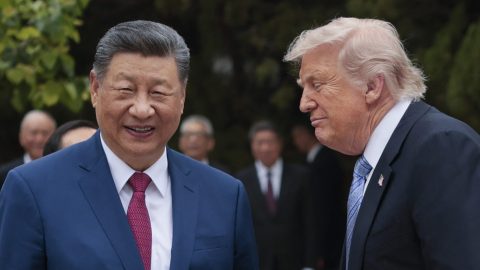
The $14 billion weapons sale was reportedly prepared early this year, but has effectively been sitting on Trump’s desk ever since. Trump said after meeting Chinese President Xi Jinping (習近平) in May that he was holding the sale in abeyance and that: “It’s a very good negotiating chip for us, frankly.”
Xi seems to agree. Reuters reported this week that he plans to ask Trump to halt arms sales to Taiwan during their talks today.
Senior U.S. figures like Rupert Hammond-Chambers from the U.S.-Taiwan Business Council have said this is a mistake. “The Trump Administration has let the fox in the henhouse,” Hammond-Chambers wrote on September 22, saying that the president was allowing China to affect his decisions, rather than considering the American national interest.
All of this is complicated by the fact that the U.S. has expended much of its own stocks of Patriot missiles during its war with Iran. The Center for Strategic and International Studies estimated in July that only approximately 800 interceptors remained from a pre-war stock of 2,330. The U.S. has now made vast orders for more, and suppliers are planning to dramatically increase annual production, but this will take years to achieve.
To handle the demands of modern warfare, where expensive air defense systems may be called into use against cheap drones or missiles, Lockheed Martin is now proposing a cheaper variant of the Patriot called the PAC-3 ACE (Adapted Capability Effector), estimated to cost $2.5 million, as opposed to the PAC-3 MSE, which costs $5.3 million.
The cheaper price seems to have been achieved by removing the PAC-3 MSE’s side motors, said Xu Tianran (徐天然), a senior analyst focusing on Northeast Asian security and missile systems. The PAC-3 MSE is highly maneuverable and operates as hit-to-kill; it directly strikes the incoming threat. This means it doesn’t need to carry a blast fragmentation warhead.
The PAC-3 would thus very likely have a warhead to make up for its lack of maneuverability, Xu said. Unsurprisingly, given the lower price tag, it would be a less capable interceptor suited to lower-end threats.
So should Taiwan aim to order some PAC-3 ACE interceptors instead of, or in addition to, the high-end and high-cost PAC-3 MSE missiles?
Maybe not.
Taiwan already has an air defense system that uses a blast fragmentation warhead instead of being hit-to-kill: the domestically-produced Tian-Kung 3, or Sky Bow 3 (天弓三型). There are 12 Tian-Kung 3 batteries in service.
Even though the Tian-Kung 3 is not as cutting-edge as the PAC-3 MSE or CRI variants, it’s easier for Taiwan to maintain a larger stock of interceptors, Xu said, and that has become increasingly important.
The cost of a single Tian-Kung 3 interceptor is not known, but Xu estimates it to be around $2 million, based on Taiwanese defense budgets. Cheaper than the PAC-3 ACE, in other words. More Tian-Kung 3 missiles are still on order.
Taiwan is also planning to bring the more advanced Chiang Kung, or Strong Bow (強弓), system into production this year. That will add better anti-ballistic missile defense to Taiwan’s domestic roster, taking more pressure off the advanced PAC-3 interceptors. A military spokesperson told Domino Theory last year that Chiang Kung will also be cheaper than Patriot, although that was not said in reference to the ACE variant.
Taiwan’s Liberty Times newspaper reported in February that the 102 PAC-3 MSE interceptors on order had started to arrive, and Taiwan’s Ministry of National Defense said in March that it was not expecting the missiles to be delayed by the war in Iran. But by August, the message had flipped to an expectation of “significant delays,” according to The Washington Post.
The U.S. used a further 60 to 70 Patriot interceptors in early September, defending an Iranian attack against Jordan, per The Wall Street Journal.
Reporting from Bloomberg subsequently cited U.S. officials saying allies could expect delays of up to five years for delivery of ordered weapons, although this was not specific to air defense.
“You’re looking at South Korea, Japan [and] Taiwan being the countries that are most closely affected,” said Matthew Reisener, an analyst from the Center for Maritime Strategy, pointing out that the U.S. military may still expend a lot more missiles over the coming months.
All of this adds up to an environment that isn’t exactly fertile ground for a large new Patriot order by Taiwan. Even though the opposition-controlled legislature has budgeted $15.1 billion for the next arms sale, it has done so in a way that leaves the release of those funds open to legislative review.
If the 102 missiles due this year haven’t arrived in Taiwan, questions will surely be asked about the wisdom of ordering more. Americans may also wonder why they are committing to send interceptors abroad when their own stocks are so low, although Reisener pointed out that there are also those in the U.S. who would be upset if they think the U.S. is taking away missiles from Taiwan.
All of this is academic until Trump decides to release the arms sale. If Xi has his way, that could go on indefinitely, or at least until 2028.
It may well be the case that some of that $15.1 billion could be better spent closer to home.


Leave a Reply