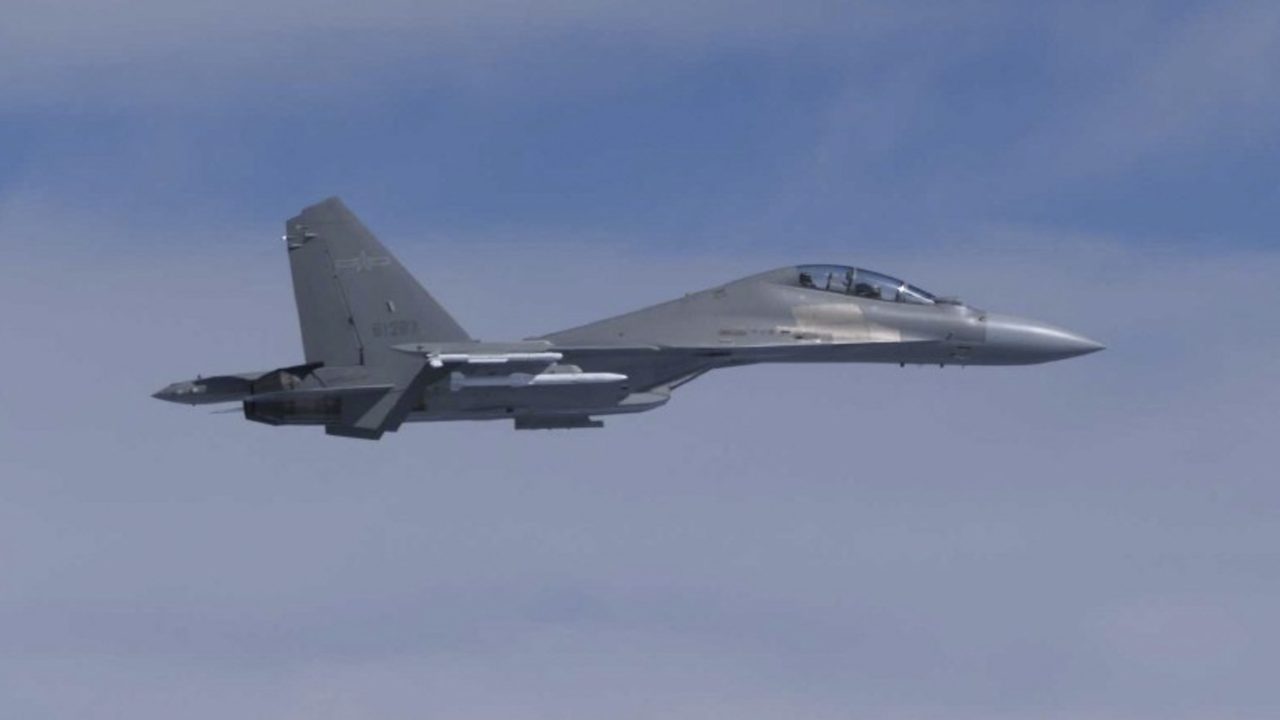
Many in Taiwan have treated Chinese military exercises this week as significant, following President Lai Ching-te’s (賴清德) National Day speech. But analysis of the location and timing of the drills suggests they are more routine than they are extraordinary.
“China launches 5-day military exercises after Taiwan’s National Day,” read one typical headline, from Radio Taiwan International. Reuters described “a series of Chinese live-fire drills,” based on navigation restriction notices published by the China Maritime Safety Administration for five zones in different regions. These areas are all close to China’s coast and range from the Bohai Sea in the north to the South China Sea in the south.
The Chinese Communist Party’s decision to conduct live-fire drills immediately after the National Day address “does nothing to advance regional peace and will only heighten regional tensions,” said Chuang Jui-hsiung (莊瑞雄), head of the Democratic Progressive Party caucus, speaking at a press conference on Monday about a different National Day speech by opposition leader Han Kuo-yu (韓國瑜).
In previous years, China has launched major military exercises around Taiwan after National Day, framing them as a response to perceived provocations in the president’s speech.
But is that actually what is happening here?
There are some problems with this theory.
As all the coverage acknowledges, these drills are neither around nor close to Taiwan. China has not publicly commented on the exercises this week, nor tied them to Lai’s speech.
The five drill areas described appear to be a partial snapshot of scheduled Chinese military activity at sea this week. A comprehensive review of the Maritime Safety Administration’s website by Domino Theory revealed a total of 12 relevant notices published before Monday. Four of them were for live-fire exercises, the remaining eight were for non-specified military training. The drills are of varying lengths of time, some even extending longer than seven days.
In September, 28 navigation restriction notices were published for live-fire exercises alone. It doesn’t appear that any of these were reported on as being unusual, despite there being broad crossover in the locations involved with the “five” this week.
“I don’t see anything in these notices that strikes me as particularly unusual or significant,” Ethan Connell for Taiwan Security Monitor, a group at George Mason University, told Domino Theory.
The Maritime Safety Administration regularly issues navigation warnings for live-fire exercises and military training, Connell said in a written response, adding “there isn’t much evidence that these five exercises are part of any larger, coordinated training or operation.”
Taiwan’s defense minister, Wellington Koo (顧立雄), told the legislature on Monday that the drills appear to be a “not particularly large,” routine exercise, adding that Taiwan must be cautious and will continue to monitor the situation, adding, “You can see that the timing was deliberately chosen to follow the October 10th National Day address.”
The drills “are likely a response to Lai’s speech, which is to be expected,” said Lyle Morris, a senior fellow at the Asia Society Policy Institute’s Center for China Analysis. “But nothing to panic about.”
The number of exercises is noteworthy, Morris said, but doesn’t rise to the level of something like the “Joint Sword” drills from previous years. Those were among the exercises that took place around Taiwan.
Other analysts disagree about the timing.
“I would not interpret these as exercises targeting President Lai Ching-te,” said Chieh Chung (揭仲), a fellow at the Institute for National Defense and Security Research think tank in Taipei.
Chieh wrote to Domino Theory that Lai’s speech had been uncontroversial this year, but pointed out: “Leaving observers to speculate whether the drills were triggered by Beijing’s displeasure with President Lai’s speech is enough for Beijing to achieve its objective.”
Lai’s only significant mention of China was to say it was engaged in authoritarian expansion, applying pressure “through military and gray-zone activities in an attempt to alter the status quo across the Taiwan Strait.”
“Most notices were issued before Lai’s speech, so the drills look routine,” said Ben Lewis, who runs the website PLATracker, which records Chinese military activity around Taiwan. Lewis doesn’t think that the drills are any more significant than they look. But he warned that a closure moving into the Strait or near Taiwan would change this view.
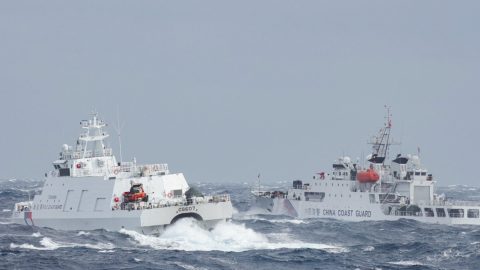
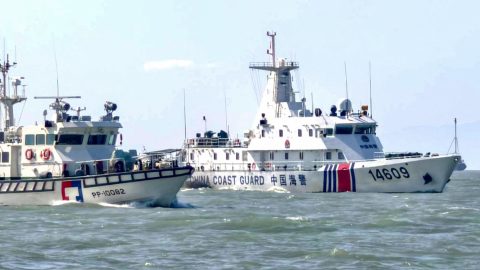
“The CCP disguises its intrusive actions under the pretexts of law enforcement and scientific research, attempting to expand its operational scope during non-conflict periods and create the illusion of de facto jurisdiction,” the Defense Ministry told Domino Theory, answering a question on whether the five drill areas were different in some way. “These moves severely undermine the international order and challenge our law enforcement authority within our waters.”
The Chinese military near Taiwan had been relatively quiet earlier this week, according to data published by the Ministry of National Defense, although its data for yesterday showed more activity, including a circumnavigation of Taiwan by an uncrewed aerial vehicle, or UAV.
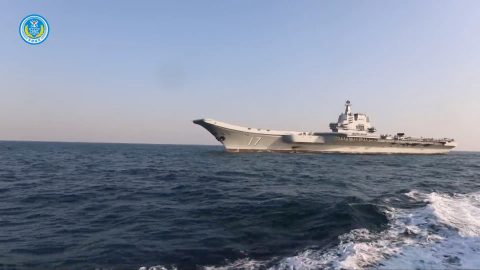
China has also this week deployed a carrier battle group into the Western Pacific, centered around the Liaoning aircraft carrier. Based on information published by the Japanese military, the battle group passed through the Okinawa archipelago and was located approximately 370 kilometers to the east of Taiwan on Wednesday.
Taiwan’s data for Chinese activity do not routinely show information about ship type and location, unlike the data for aircraft. Wednesday’s data do not appear to show any flights by Chinese naval aviation east of but close to Taiwan. Taiwan’s Defense Ministry said today that it wouldn’t comment on specifics of the carrier’s activity.
Jason Wang, the chief operating officer of geointelligence firm ingeniSPACE, said it was wrong to associate the drills with the National Day speech and that tying the two together helped with United Front narratives. “These drills were planned and should be seen in the context of raising overall readiness,” Wang said.
Experts contacted for this story did not think the five drill areas reported on this week are different or more significant than the other announced drills that have received less attention. Nor is there any obvious reason that attention should be placed on these when similar exercises last month were largely ignored.
Nonetheless, even if this week is not unusual, that may be its own problem. This high tempo of training is cause for concern in itself. China, said Wang from ingeniSPACE, is exercising more than it is resting.


Leave a Reply