
Taiwan’s partners often call for things to stay the same around Taiwan.
“We reiterate our opposition to any unilateral change to the status quo, particularly by threat or use of force or coercion,” read a recent joint statement by the British, French and German representative offices in Taipei.
But at the Taiwan International Ocean Forum on July 8, Kuan Bi-ling (管碧玲), the head of Taiwan’s Ocean Affairs Council, posed a question to the audience:
“What exactly is this status quo we speak of?”
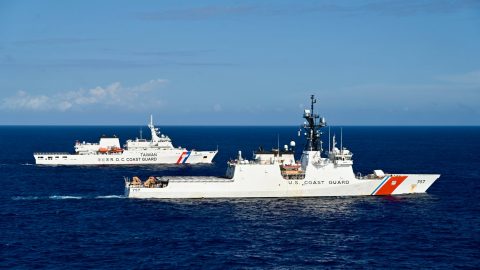
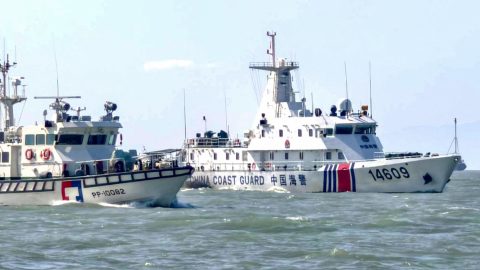
Part of Kuan’s responsibility is Taiwan’s coast guard. These white-hulled ships are at the frontline of Taiwan’s defense against gray-zone aggression and territorial encroachment, going out to meet their Chinese coast guard counterparts or the myriad other civilian vessels.
In June, China launched a “special maritime law enforcement operation,” where for the first time Chinese law enforcement vessels hailed international shipping to the east of Taiwan. Experts described it as an attempt to assert jurisdictional authority in those waters.
Kuan listed the ways that China is slowly adjusting its own behavior and by extension the international norms around Taiwan, including increased coast guard activity, expanded military exercises, “so-called law enforcement inspections” on merchant ships, and interference with Taiwan’s undersea cables, maritime order, and information systems.
Almost by definition, a concept of the status quo should be static. The situation around Taiwan for decades had been that both sides kept their ships and planes on their own side of the strait and didn’t interfere with commerce or economic activity. While hardly perfect, this understanding broadly held until 2022 when then House Speaker Nancy Pelosi visited Taiwan, an event that China subsequently cast as norm-breaking.
Since then, China has frequently crossed the median line of the strait, and regularly holds major military exercises around Taiwan. Over time, Chinese vessels have also pushed closer toward Taiwan, and now encroach into the contiguous zone, a 22-km-wide strip of sea that surrounds Taiwan’s sovereign territorial sea.
Kuan’s speech made a simple argument. In the gray zone, there are no red lines. “Each individual action seems insufficient to trigger an international crisis,” she said. “But the accumulation of a series of actions could create a brand new status quo.”
The special maritime law enforcement operation is the most pressing example of this. If repeated and expanded, it starts to look a lot like the kind of quarantine scenarios that many analysts have warned about — a soft civilian-led blockade that would allow China to dictate what goods and resources, if any, reach Taiwan.
China has already announced on July 4 that its ships are continuing to conduct law-enforcement patrols in the Western Pacific waters, or the east of Taiwan.
Beijing is trying to establish a new norm that is in contradiction to the law of the sea, visiting U.S. Senator Tammy Duckworth told the forum. “They’re doing this not just on the ocean, but also in the skies as well,” she said, pointing to a recent episode where Indian Ocean states denied overflight permission to Taiwanese President Lai Ching-te (賴清德).
The international community could end up in a place where China decides that no one can go through the Taiwan Strait without registering first with the Chinese coast guard, Duckworth warned. She didn’t directly draw the parallel to what is currently happening in the Straits of Hormuz, but it was surely on her mind — the moderator had mentioned Hormuz and Iran in the previous question.
“The way to prevent that from happening is to exercise our rights internationally as a community to transit all of these waters,” Duckworth said. “The United States is not asking nations to choose between the PRC and the United States, we’re just asking nations to choose international norms.”
Kuan seemed to be asking for a little more than that.
“Ultimately, we might suddenly find that no decisive war ever occurred on any single day, yet the original status quo no longer exists,” she said. “We need a common understanding of the status quo, common early warnings for escalating risks, and we need to prepare coordinated response methods before the next crisis occurs.”



Leave a Reply