
Since the beginning of the 21st century, the median line of the Taiwan Strait kept the forces of the People’s Liberation Army Air Force (PLAAF) and the Republic of China (Taiwan) Air Force (ROCAF) apart. For the most part each side tacitly acknowledged the line and didn’t cross it, which enabled a relatively stable status quo.
However, in the last two years, the PLAAF has begun to routinely cross the line at many points along its length, which raises the question, does the line even have relevance anymore. In this article, I will first explain what the line actually is and what it is not, and then show the very obvious correlation between Nancy Pelosi’s visit to Taiwan and the increase in “line crossings.”
What is the median line? As the name suggests, it is a line that runs approximately down the middle of the Taiwan Strait. It is also known as the Davis Line, so named after General Benjamin O. Davis Jr., who proposed it. (Davis incidentally also commanded the famous Tuskegee Airmen “Red Tails.”) Taiwan’s Ministry of National Defense recently provided the coordinates of the median line for the first time in 15 years. China has always denied the existence of the line, even as it previously observed it.
The line has a surprising feature, which is that it ends abruptly at either end. This will be important later.
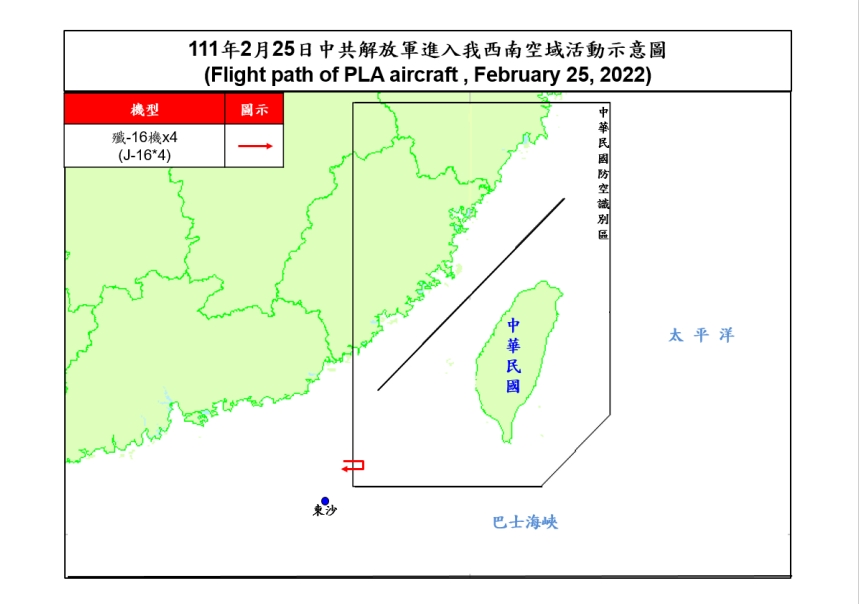
The above map, published by Taiwan’s Ministry of National Defense on February 25, 2022, was selected by myself because it shows a “minimal” incursion, and thus the ADIZ can be most clearly seen. The red line shows the approximate path of PLAAF J-16 fighter jets.
What is the difference between Taiwan’s airspace and Taiwan’s Air Defense Identification Zone (ADIZ)? Taiwan’s airspace is the area directly over Taiwan’s land and sea territory. A country’s territorial sea extends 12 nautical miles (approximately 22 kilometers) from its shores, including outer islands. Note that Kinmen and Matsu are handled quite differently; it will be easier if you don’t think about them in this article. Countries can exert the right to militarily enforce the protection of their airspace.
An ADIZ is different. It is a much larger area that a country unilaterally establishes to exert some control over the skies beyond its territory.
China does not enter Taiwan’s territorial airspace. When you read reports about ADIZ incursions, it’s important to understand that the PLAAF is entering the airspace around Taiwan, but not into Taiwan’s territory.
Taiwan’s ADIZ also has some counterintuitive features. It’s a rectangle that is not centered on the island of Taiwan. In fact, much of the ADIZ is over the Chinese province of Fujian. The ROCAF used to patrol over the PRC, as depicted in stunning watercolor in the Air Force Museum in Kaohsiung, but this practice eventually ceased except for reconnaissance flights. Even in the 1990s, Taiwan was still regularly crossing the line for recon purposes.
Note that ROCAF cargo planes regularly fly to Kinmen and Matsu. This “doesn’t count.”
Because there are many PLAAF bases inside Taiwan’s ADIZ, the median line acts as a “de facto border” of the ADIZ. When the media or Taiwan’s Ministry of National Defense report that Chinese jets entered the ADIZ, they mean the part of the ADIZ that is to the east of the median line.
The rectangular nature of the ADIZ and the fact that the median line ends well before the edge of the ADIZ produce a strange consequence. The PLAAF can enter the northeast and southwest corners of the ADIZ without crossing the line. Furthermore, these parts of the ADIZ are relatively far from Taiwan and have no tactical or strategic significance. Before 2022, this was how the PLAAF would pressure Taiwan, by “forcing” the ROCAF to fly out to these areas of ocean to warn away Chinese jets.
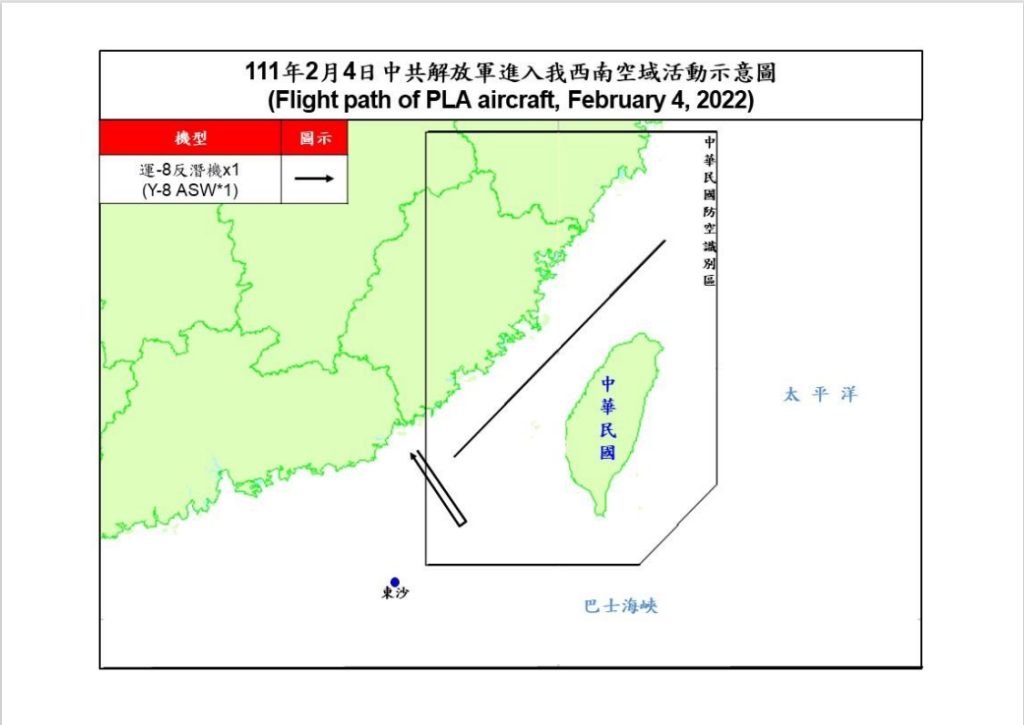
The above map, published by Taiwan’s Ministry of National Defense on February 4, 2022, shows a typical ADIZ incursion from the period.
For data on Chinese ADIZ incursions, there is the superlative Taiwan ADIZ Violations spreadsheet from PLATracker. This collates the information that the Taiwanese Ministry of National Defense publishes daily on its website and on X. From these data, the following simple observation can be made:
Between September 9, 2020 (the earliest date for which there is data) and August 2, 2022, PLAAF aircraft crossed the median line on three different days. Between August 3, 2022 and August 8, 2024, PLAAF aircraft crossed the median line on 321 different days. That’s a staggering shift from once every eight months to once every two days (although the data is very granular, the crossings are certainly not evenly spaced).
So what happened on August 22, 2022? The answer is very simple: Nancy Pelosi visited Taiwan, the first visit by a U.S. speaker of the House since Newt Gingrich in 1997. China raised large threats before her visit but only responded after she left, with major drills around Taiwan of a kind that had not been seen since the Third Taiwan Strait Crisis in 1995-1996.
Since Pelosi’s visit, China has completely normalized crossing the median line. This has implications for both Taipei and Beijing. Taiwan will feel more pressure, up to a point, and the military will have less time to respond to further escalations because the “new normal” moves Chinese forces closer. Beijing might be satisfied that it is ramping up the pressure and “salami slicing” its way across the strait, but it should be noted that it has lost a clear and cost-free way to signal to Taipei that it is extremely dissatisfied. That role is now played by major drills, which have many other extraneous implications.
In order to get a qualitative sense of the new normal as well as a quantitative one, I reached out to Ben Lewis, the defense analyst who maintains PLATracker, and asked him whether PLAAF planes still “dip” across the line before heading back to the “Chinese side” of the strait. He told me, “They only cross it for short periods, but repeatedly, in the center of the line. I think that is mostly because they simply don’t have much further to go before they hit the contiguous zone. Other than that, they seem to ignore it completely in the Southwest and Northeast.” He also emphasized Chinese planes have repeatedly flown close to the Taiwanese contiguous zone.
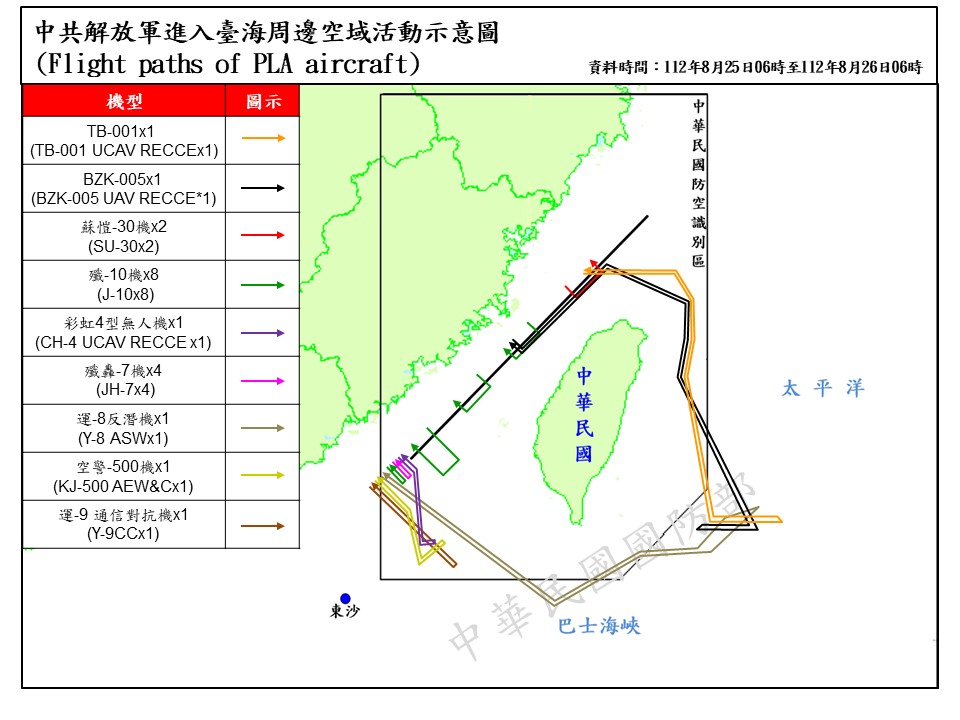
The above map shows a busy day on August 25, 2023, with Chinese drills after then-Vice President Lai Ching-te (賴清德) transited through the U.S.
The contiguous zone is a second 12-nautical-mile strip that sits outside a country’s territorial sea. Countries can exert their jurisdiction within the contiguous zone, subject to restrictions.
It would appear then that the new normal is that China approaches Taiwan’s contiguous zone but does not cross into it.
Is the median line dead? To all intents and purposes, yes. Taiwan has not been able to enforce it for a long time, observing it was just a way for China to keep the status quo tension at a certain level. The trouble for us all is that the closer Chinese planes get to Taiwan’s territorial airspace, the closer they get to a line Taiwan would have to enforce.







Leave a Reply