
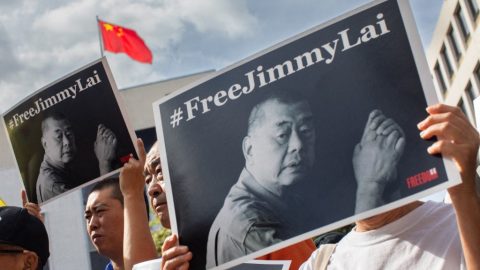
President Donald Trump is on Air Force One headed to Beijing. Soon he will have the opportunity to raise the issue of Jimmy Lai’s (黎智英) detention with Chinese leader Xi Jinping (習近平). Failing to press for Lai’s release would be a mistake.
Lai, a democracy activist and founder of the now-defunct Apple Daily, has been incarcerated in Hong Kong since December 2020 for “colluding with foreign forces” under the city’s draconian national security legislation. In plainer language, he was jailed for criticizing the Chinese Communist Party. After five years of detention, the vast majority of which transpired in solitary confinement, Lai was finally handed a 20-year sentence in January. For the 78-year-old, this amounts to a death sentence.
Trump might be the only one who can convince Xi to free him.
From the trade truce to Iran to fentanyl, there is a lot to discuss this week, to be sure. Trump said that he plans to bring up Lai’s case, too. “That’s one of the many things I’ll be talking about,” Trump told reporters at the White House on Monday.
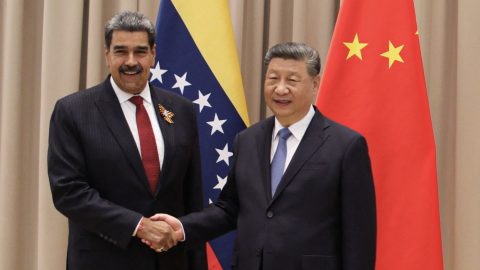
Trump has already demonstrated his willingness to stand up to authoritarian leaders. Within the first quarter of 2026, the U.S. captured and placed Venezuelan leader Nicolas Maduro in a Brooklyn jail and banded with Israel to kill the Ayatollah in Iran. Seeking Lai’s release should be relatively simple.
But Trump must not merely mention Lai, he needs to show the world that he made a strong case. Failing to move the needle on Lai’s release would make Trump seem complicit — no better than the growing chorus of leftists who laude China’s high-speed rail and cyberpunk cities but fall silent when it comes to China’s human rights record. It would also make him seem weak, lending credence to the argument made in The New York Times and elsewhere that the war in Iran has undercut the U.S.’s leverage vis-a-vis China.
Democracy activists, free speech defenders, China watchers and politicians around the world are asking Trump to leverage his distinctive approach to personalized diplomacy to save Lai, and are establishing high expectations for Trump’s ability to succeed. “Jimmy Lai’s Freedom Hinges on Donald Trump’s Dealmaking” is the title of a recent article written by the columnist Matthew Brooker in Bloomberg. Jimmy Lai’s son, Sebastian Lai, told The Independent on Sunday that Trump’s “record as an incredible negotiator” has given him “so much hope on [Trump’s] visit.” “Hopefully I’ll get to see my father again,” the younger Lai said.
Congressman Chris Smith told Catholic News agency EWTN last week that Trump has “an ability to persuade” like “no other president Iʼve ever known. And I hope he can persuade Xi Jinping to let this great man go.” The release of Lai, a devout Catholic, would certainly bolster support for Trump from that demographic.
Smith and more than 100 other U.S. lawmakers signed a bipartisan letter calling on Trump to raise Lai’s case with Xi this week. “Now is a key time to re-emphasize the case, not only given Mr. Lai’s age and health, but also because this will be the first time you are meeting with Xi Jinping since the Hong Kong legal proceedings against Mr. Lai came to an end earlier this March,” the letter says. “Your direct engagement is critical to securing Mr. Lai’s immediate release on humanitarian parole.”
Trump has already made the release of prisoners from Russia, Venezuela and Belarus a priority of his second term, human rights expert Olivia Enos noted in an article for the Hudson Institute. “Given this track record, the president risks appearing weak if he travels to China without raising these cases and ideally bringing several of them home,” Enos said. In contrast, securing the release of Lai and other high-profile prisoners like pastor Ezra Jin Mingri (金明日) “would underscore American strength and leadership.”
Lai was imprisoned at the very end of Trump’s first term. His release would be a full circle victory for Trump and a demonstration of his ability to achieve what others could not. Neither former U.S. President Joe Biden nor U.K. Prime Minister Keir Starmer managed to do so, despite Starmer raising Lai’s case when he visited Beijing in January.
Lai once called Xi the most absolute dictator in human history due to his ability to leverage new tools like artificial intelligence. “Bad behavior must be confronted not appeased,” Lai said during an interview with the Hoover Institution in 2019. “America has a vital interest in Hong Kong. Washington simply cannot allow China to tell the U.S., ‘we want your money but you have no say in what is going on.’”



Leave a Reply