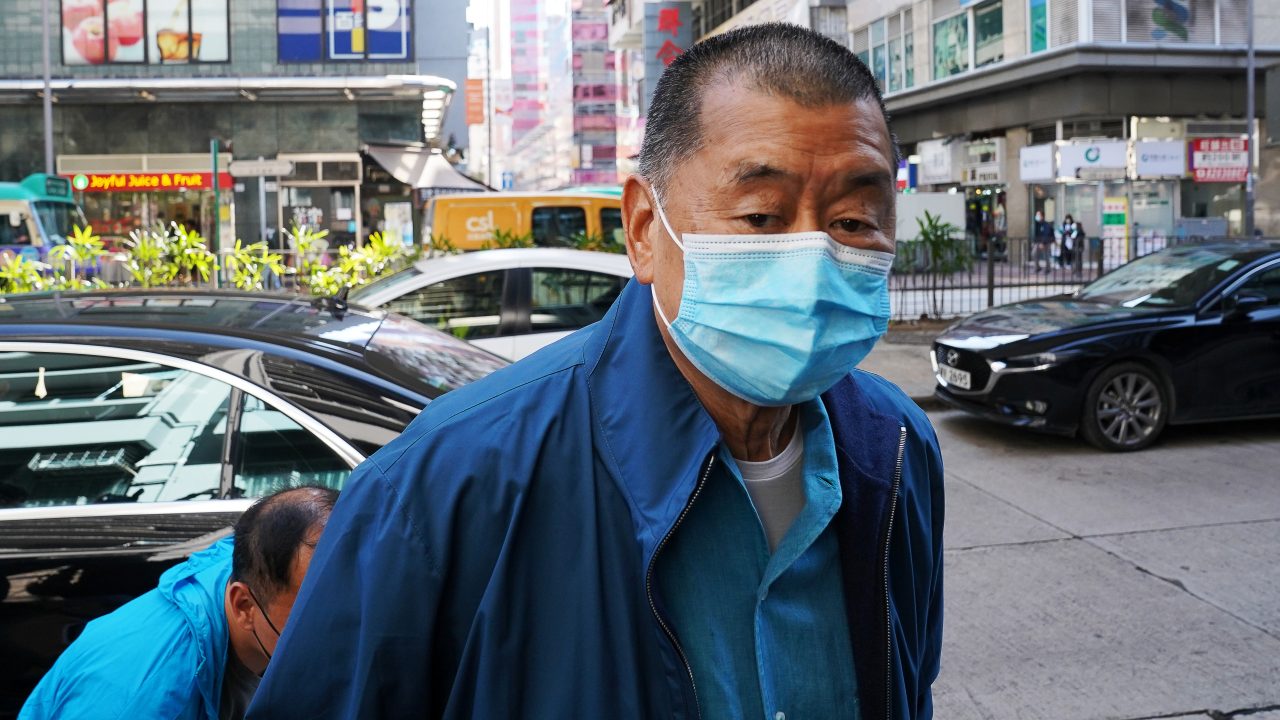
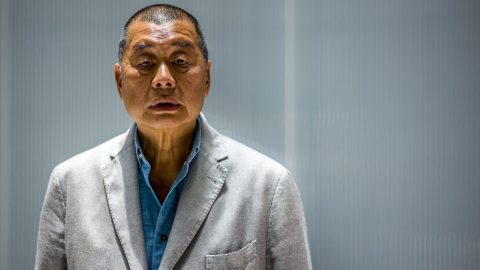
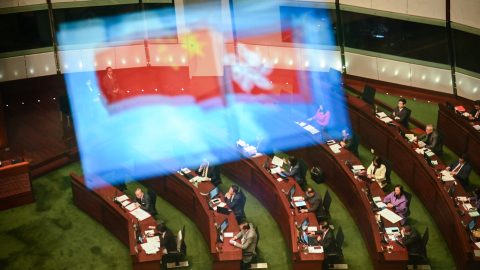
China’s takeover of Hong Kong has always been about control. First the legislature, then the courts, finally the press. If Beijing lets pro-democracy activist Jimmy Lai (黎智英) die in prison, they will be jeopardizing just that: control.
Lai is in a prison cell in Hong Kong, awaiting a verdict in his national security trial. He suffers from diabetes and has heart problems. He is 77 years old. Right now, he is still a dissident, a political prisoner in a city once hailed as a beacon of press freedom in Asia. If the court finds him guilty, sentences him to years in prison and denies him the medical care he needs, Lai would no longer be just a dissident, he would become a martyr. Nobody has any illusions about whom the judges in Hong Kong answer to. If Lai dies in prison, responsibility for his fate would fall squarely on the shoulders of Beijing.
Today’s Chinese leaders are obsessed with the past — the wisdom of the ancient strategists, the century of humiliation, the collapse of the Soviet Union. They cite historical episodes like an evangelical cites bible verses. As they consider what to do about Lai’s case, here’s something to remember: Nothing galvanizes dormant political opposition like the death of a sympathetic figure. It would be a massive error to let Lai become one.
For most of his life, Zhou Enlai (周恩來) was a faithful and skillful deputy to Mao Zedong (毛澤東). He survived the purges that sent Deng Xiaoping (鄧小平) and Xi Jinping’s (習近平) father to the countryside for hard labor. He was a true believer in Chinese Communism who had been there from the start. But in his later years, during the worst days of the Cultural Revolution, he worked to curb the excesses of the Red Guards.
When Zhou died in January 1976, Mao said nothing — no public acknowledgement of his contributions to the party, no condolences for his grieving widow. The party even banned public mourning. But sympathy for Zhou continued to simmer. In April that year, on the eve of China’s Qingming Festival, traditionally reserved for remembrance of the dead, millions of people gathered in Tiananmen Square to pay homage to Zhou. Every type of person, from the poorest peasants to high-ranking members of the Chinese military, was there. Their stated purpose was to memorialize Zhou, but their eulogies were also an outlet for a deeper discontent with Mao.
The public mourning for Zhou is now referred to as the 1976 Tiananmen Incident. It might just be called the Tiananmen Incident, if it weren’t for what happened in that same square 13 years later. The reader needs not be reminded of the brutal massacre that the party carried out against its own people on June 4, 1989. But often forgotten is what precipitated the protests in the first place. Students originally gathered in Beijing that spring to memorialize Hu Yaobang (胡耀邦), a former party secretary who had pursued a series of economic and political reforms throughout the 1980s. The students’ grievances were many: inflation, job insecurity, political corruption. But in China, economic abstractions don’t usually bring people into the streets. Memorials do.
Today, China’s youth are more likely to show their frustration through hashtags and viral internet memes. Information flows quicker than ever, and online censorship has inspired netizens to new levels of linguistic creativity. Even in this online age, grief over the death of courageous figures remains a preferred outlet for political dissent. In April 2020, Li Wenliang (李文亮), the Wuhan doctor who became one of the most well-known of the Covid-19 whistleblowers, died of the exact disease he had tried to prevent. Expressions of grief spread across social media. But the most-viewed hashtag, before the censors removed it, had nothing to do with Covid-19. It was simple: “We want freedom of speech” (我們要言論自由).
It would be hard to imagine a better way for the Chinese people to remember Jimmy Lai.


Leave a Reply