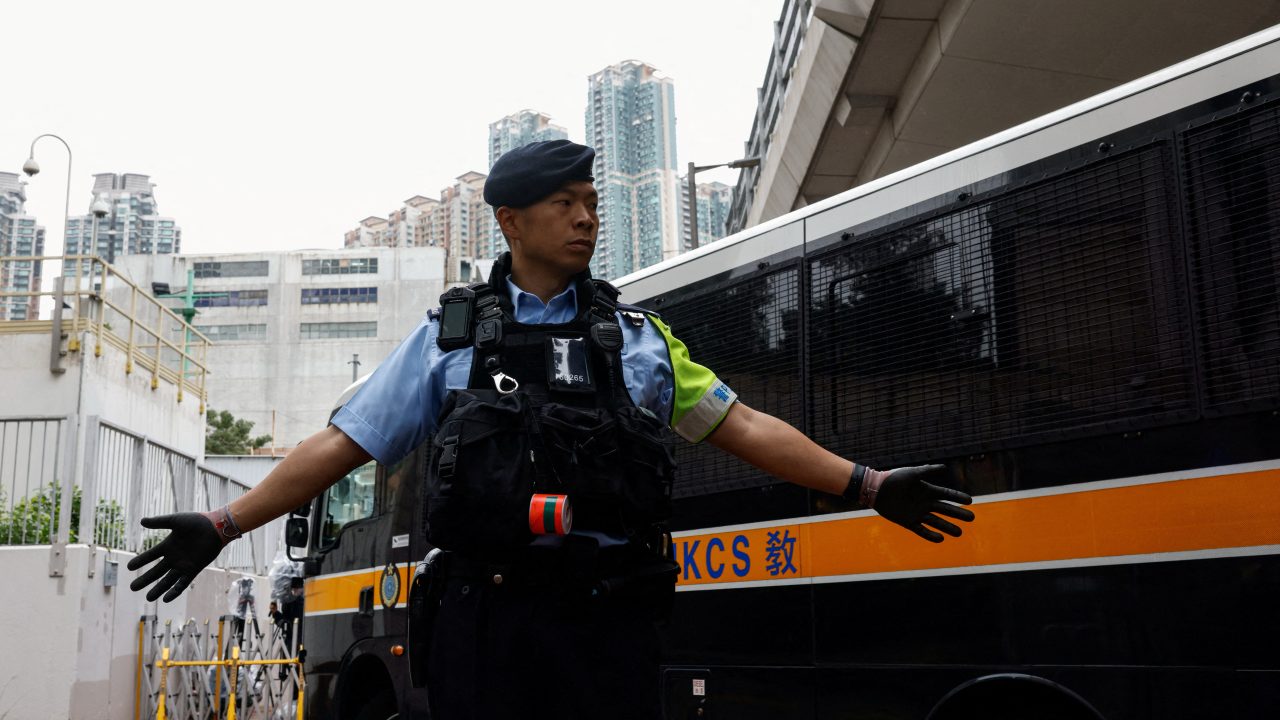
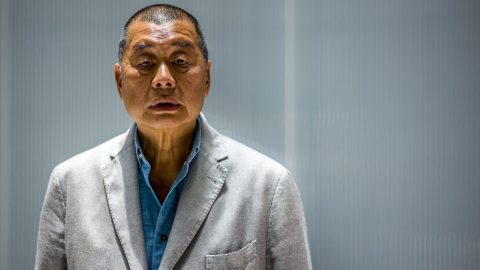
Jimmy Lai (黎智英) spoke for the first time at the resumption of his national security trial on Wednesday, with the broader political and journalistic implications already clear.
Faced with a life sentence on two different charges under Hong Kong’s 2020 National Security Law, the 77-year-old founder of pro-democracy newspaper Apple Daily said he had not tried to influence foreign policy in Hong Kong. He also defended the idea of “delivering freedom” through his newspaper’s journalism and denied becoming more radical as the U.S. had become more hawkish toward China.
“If I was radical, I was radical all along,” he said.
But whatever is said between now and a verdict — Lai is likely to spend weeks giving testimony — it’s already widely believed that the trial is being used as a warning to others not to follow in Lai’s footsteps.
“I think the Hong Kong government (literally the Chinese government) wants to set a precedent to warn other media outlets in Hong Kong,” said Patrick Poon, a visiting researcher at the University of Tokyo who studies freedom of expression in Hong Kong and China. “The message is clear. If you don’t want to become the next Apple Daily, the only way that you can survive is to stop criticizing the government.”
This message has already reverberated through Hong Kong in the form of other legal rulings, most recently in the case of the Hong Kong 47 earlier this week. In that instance, 45 Hong Kongers were sentenced to serve prison time for their parts in organizing an illegal poll to choose candidates in local elections. But Lai’s high-profile trial is likely to have a reinforcing effect.
“Certainly, what the Hong Kong government has done in the past few years after imposing the notorious [National Security Law] can already create such a chilling effect. But it can reinforce the impact and legitimize imposing further restrictions with the courts’ verdicts,” Poon said via email.
This view resonates with those of journalism advocacy groups.
“The case of Jimmy Lai is not an outlier, it’s a symptom of Hong Kong’s democratic decline,” the Committee to Protect Journalists said in a written statement it passed on to Domino Theory. “Hong Kong’s treatment of Jimmy Lai — and more broadly of independent media and journalists — shows that this administration is no longer interested in even a semblance of democratic norms.”
Reporters Without Borders’ (RSF) Aleksandra Bielakowska echoed the same sentiment: “This trial is not just about Jimmy Lai, it’s press freedom in Hong Kong, and all those who embody this idea,” she said in an emailed statement. “The press freedom situation in Hong Kong has worsened considerably since the adoption of National Security Law, with Hong Kong placed 135th on the RSF press freedom index.”
At this point, none of this is speculative. Bielakowska herself was detained at Hong Kong’s international airport before being deported from the territory, having intended to monitor a hearing in Lai’s trial and, over the past four years, 28 journalists have been punished in similar cases to Lai’s, according to RSF. Eleven of those are currently detained and at least a dozen independent media have closed.
The structure of the case against Lai itself reflects this broader impact.
Lai’s charges include two counts of “conspiracy to collude with foreign countries” and one count of “collusion with foreign forces,” as well as two years in jail for one count of “conspiracy to publish seditious publications.” But these necessarily invoke the work of many others.
Prosecutors have cited over 150 Apple Daily articles as examples of “seditious publications” and named several human rights defenders, with whom Lai was in touch, as “co-conspirators” in colluding with foreign forces. At the same time, Lai’s colleagues from Apple Daily are being punished in separate cases. Six senior Apple Daily staff remain detained and are facing life sentences under the National Security Law.
“What happens to Jimmy Lai matters deeply for Hong Kong but also for journalism and press freedom around the world,” Bielakowska summarized.
That sentiment will now be tested by the reactions of those outside of Hong Kong as well as those inside.
One hundred politicians from the U.K., Canada, Ukraine, Australia and elsewhere have signed a letter calling for Lai’s release. British Prime Minister Kier Starmer brought up the plight of Lai in his first meeting with Chinese President Xi Jinping (習近平) this week. And shortly before his election victory in the U.S., president-elect Donald Trump pledged that he would “100 percent” get Jimmy Lai (黎智英) free and out of Hong Kong.
For its part, China’s foreign office maintained in a statement on Tuesday that Lai was “an agent and lackey for anti-China forces.”



Leave a Reply