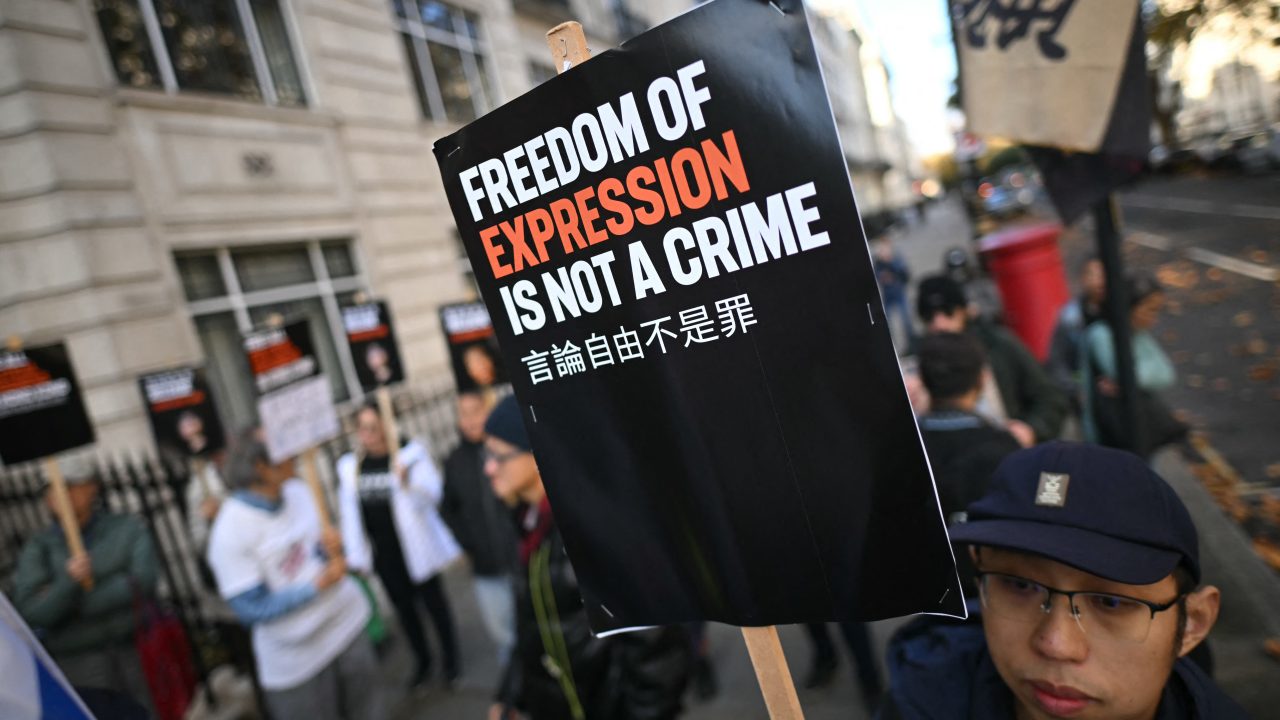
Chinese authorities surrounded a church in Wenzhou last week with hundreds of armed and special forces police as well as bulldozers and other demolition material with the presumed purpose of demolishing it, freedom of religion group China Aid reported, part of the biggest crackdown against Christians in China since 2018.
The siege against the Yayang Christian Church (雅阳教堂) follows the reported arrests of about 100 of the church’s members between December 13 and 18, 2025. Elsewhere in China, police detained nine leaders of the underground Early Rain Covenant Church in Chengdu on January 6, including leader Li Yingqiang (李英强), according to the BBC, and nearly 30 from Zion Protestant Church in October, including its founder Pastor Ezra Jin (金明日), U.S.-based NGO Human Rights Watch reported.
Beijing requires all religious groups to be registered and affiliated with state-controlled organizations. Restrictions on religion have escalated since 2016 under President Xi Jinping’s (習近平) push for the “Sinicization of religion.”
Department of Homeland Security
A Chinese whistleblower who helped expose a network of detention facilities in Xinjiang is still being held by U.S. Immigration and Customs Enforcement after a judge in upstate New York denied his request for bail — and now faces deportation to China.
Guan Heng (關恆), who secretly filmed re-education centers and detention facilities in Xinjiang and later entered the U.S. illegally, has spent months in Immigration and Customs Enforcement custody. The Department of Homeland Security dropped plans to deport Guan to Uganda after a media outcry last month, but according to a report by German television network DW, ICE is now pushing for his deportation to China.
“I would jump off the plane if deported,” Guan told DW in an interview from a detention facility. “I would rather die than face imprisonment in China.”
Veteran Journalist Charged With ‘Picking Quarrels’
Independent photojournalist Du Bin (杜斌), who has extensively reported on human rights abuses committed by the Chinese regime, has been detained again following a “long campaign of harassment” by authorities, according to the International Federation of Journalists.
Bin, who previously worked for state-owned newspapers and whose work has been published in The New York Times and The Guardian, was briefly held in 2013 for a documentary about torture at a labor camp and again in 2020 for for “picking quarrels and provoking trouble,” a vague charge frequently used against journalists and dissidents and the same charge he is currently under detention for. His family said police are withholding all documents related to his arrest.
China is the world’s largest jailer of journalists, with 143 behind bars as of the latest tally by the IFJ.
EU Condemns China’s Rights Record
The EU marked the occasion of Human Rights Day 2025 by expressing deep concern over China’s “systemic and severe restrictions” on the exercise of fundamental freedoms and the rights of minorities to enjoy their own culture and use their own language.
In a statement released on December 10, the EU Delegation to China highlighted abuses in Xinjiang, including forced labor and state‑imposed labor transfer schemes involving Uyghurs. The statement cited numerous credible reports indicating serious human rights violations in Xinjiang that “may constitute international crimes, in particular crimes against humanity.”
The statement also called out mandatory boarding schools and surveillance in Tibet, and the marginalization of local language instruction in Tibetan and Mongolian areas, and the tightening control over religious communities and online religious activities, including the recent nationwide crackdown on the Beijing Zion Church network.
Tibetan Groups Flag Concerns Over Proposed Chinese Embassy
Rights groups led by Free Tibet have reiterated their opposition to the proposed Chinese Embassy in London, which would be China’s largest such facility in Europe. In a letter to the U.K.’s Secretary of State, the groups cited concerns that the U.K. may compromise national security by granting China a prime intelligence hub in the heart of London and said China would use the facility to harass dissidents on British soil. A decision on whether to grant planning permission to construct the embassy has been delayed to January 20, ahead of an expected visit by British Prime Minister Keir Starmer to Beijing.
Canadian Leader Urged to Confront China’s Repression
Human Rights Watch has urged Canadian Prime Minister Mark Carney to make human rights a key focus of his January 13 to 17 visit to China, the first such visit by a Canadian prime minister in eight years. Canada-China relations have been strained in recent years over Chinese human rights abuses, but Carney is seeking to reset ties with Beijing amid poor relations with Washington under President Donald Trump. Human Rights Watch asked Carney to press the Chinese government to end its repression in Xinjiang and ensure full compliance with international labor rights conventions, citing evidence firms linked to forced labor in Xinjiang ship to Canada. Carney’s office said in a statement earlier this month that it is seeking to diversify Canada’s economy away from the U.S.
Human Rights Defender Placed Under House Arrest
Tsering Tso, a Tibetan known for criticizing discriminatory practices and abuses by Chinese authorities, has been sentenced to one year in prison on charges of “picking quarrels and provoking trouble,” according to English-language Tibetan media. The sentence was suspended for two years and Tso was placed under probation.
Tso denies the charges and has accused the authorities of obstructing her right to appeal. She has been targeted repeatedly for her activism since 2017, when she was denied a travel permit. In 2024 she was held in 10-day “administrative detention” for “endangering social stability,” and later for “spreading false information” and “causing trouble” on social media.
Tibetans Protest Mine
Tibetan activists say authorities arrested more than 80 Tibetans, of which seven are still being held, for protesting a gold mine project in Gayixiang township, Sichuan province. People in the Tibetan autonomous area in Sichuan protested on November 5 after learning the mine was being built in a pasture area used by nomads, according to exiled activists and the Tibetan government in exile. Chinese authorities have blocked access to Gayixiang, which Tibetans refer to as Kashi village.






Leave a Reply