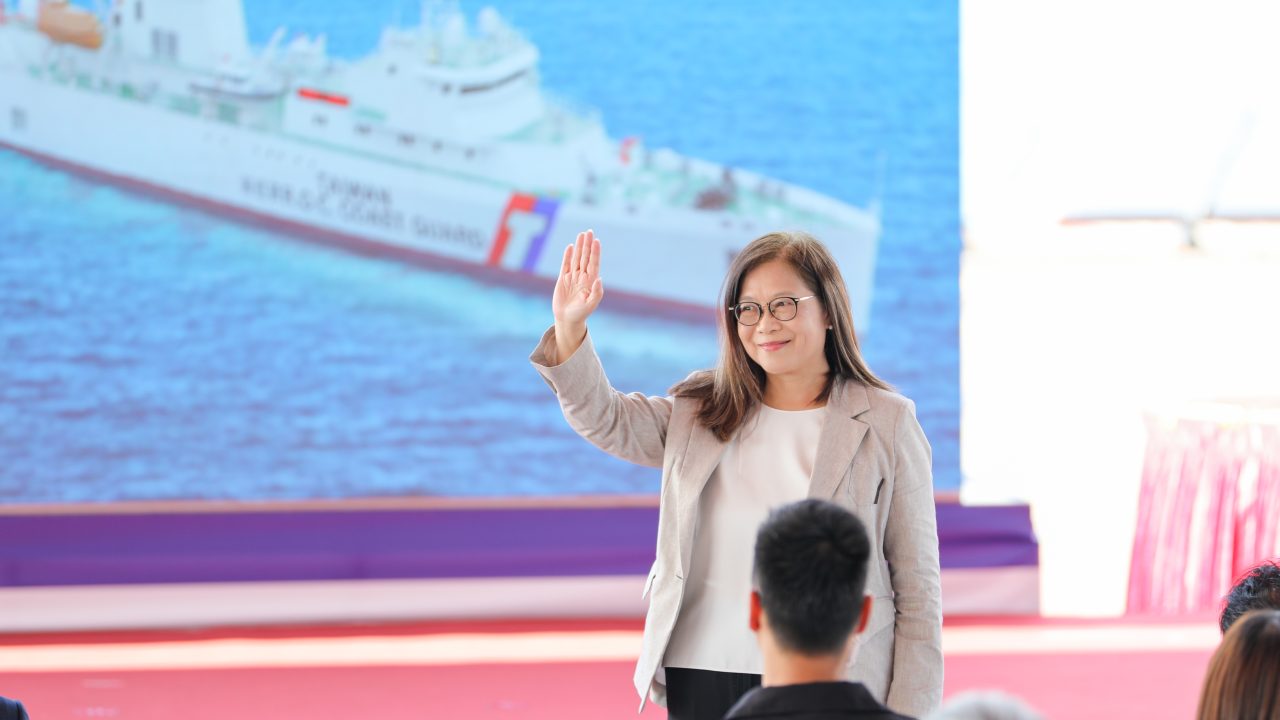
Taiwan launched and named a new coast guard cutter on November 1. The Siraya is the first in a new six ship class of “high-latitude ocean patrol vessels” primarily intended for long-duration fishery patrols in the Pacific, but with the size and versatility to handle a wide variety of other missions.
The Siraya is also the first coast guard ship to be named after one of Taiwan’s Indigenous groups. Other ships in the class will follow the same pattern. The choice was linked to the recent passing on a new Indigenous identity law.
The Siraya will have a range of over 15,000 nautical miles, or approximately 27,780 kilometers. It is substantially larger than existing fisheries patrol vessels, which currently perform cruises of one to three months. It is intended to operate in rough seas, featuring a visually distinctive wave-piercing “axe bow.” Although it is intended to operate in cold waters in the north Pacific, it does not appear to have any ice-breaking capabilities.
The six ships in the class will come in two variants, the maritime patrol type and a transport and supply type that can support Taiwan’s outlying islands. A coast guard spokesperson said that there will be three of each variant, although the difference is limited to the equipment loadout rather than structural changes. The aft deck has space for two 20-foot containers, allowing modular loads.
The Siraya features three water cannons and a single 20-millimeter autocannon. It has a medical bay for humanitarian needs. Kuan Bi-ling (管碧玲), the Ocean Affairs Council Minister who oversees the coast guard, said in March during the Siraya’s keel-laying ceremony that the ship will also have a very significant “tugboat capacity,” meaning it can be used to tow stricken vessels.
Although the Siraya is the first of six “3,000-ton class” high-latitude ocean patrol vessels, it will have a total displacement under load of approximately 5,000 tons. This follows a pattern by Taiwan’s coast guard for class descriptions significantly undercounting the tonnage of its vessels. For simplicity, in the rest of the article when a tonnage is cited it will be according to the naming convention and not the actual weight unless otherwise clarified.
The Siraya is the first coast guard ship to be named after one of Taiwan’s many Indigenous groups. Whereas most Taiwanese are descended from settlers who either arrived hundreds of years ago, mostly from Fujian and Guangdong, or from Chinese refugees who arrived in 1949 at the end of the Chinese Civil War, Taiwanese Indigenous have been here for thousands of years. Taiwanese Indigenous are also culturally distinct, speaking Austronesian languages that are not related to Sinitic languages. Other Austronesian languages include Tagalog, Indonesia, Hawaiian and Malagasy, and it is broadly accepted that Austronesian peoples originated in Taiwan.
What is striking about the choice of Siraya as the first Indigenous name for this class is that the Siraya are not one of the 16 groups that are officially recognized by the central government. The Siraya have been fighting for recognition, and after the passing of a new indigenous identity act last month, seem likely to now achieve that.
Kuan addressed this directly during her speech on Saturday and afterwards on social media. She tied the naming decision to the passing of the new law, which will have implications for many other currently unrecognised groups as well.
The Ocean Affairs Council Minister also name-checked Taiwanese President Lai Ching-te (賴清德), who was at the ceremony, pointing out that as Mayor of Tainan he had previously recognized the Siraya at the local level. “His determination laid the foundation for central reform.”
Uma Talavan (萬淑娟), the director of the Tainan Siraya Culture Association who filed a court case that led to the new act, attended Saturday’s ceremony and broke the bottle to officially launch the ship.
Taiwan embarked on a program of renewal and expansion of the coast guard under former President Tsai Ing-wen (蔡英文) in 2018. Four 4,000-ton class cutters tons, six 1,000-ton class cutters and twelve 600-ton class catamarans were scheduled, almost all of which have already been delivered. The program also included 119 smaller boats.
In September of this year, Lai’s government proposed a resilience budget including an additional 12 new 2,000-ton class cutters and 28 new smaller boats. In a media briefing on the budget, Ocean Affairs Council Administrative Deputy Minister Chang Chung-Lung (張忠龍) noted that China’s coast guard has 1,000 ships, nearly 200 of which are over 1,000 tons.
The Siraya started construction in September of 2024, meaning it was completed in under 14 months, although it won’t be commissioned until next year. It is not constructed to navy standards as it is not intended for high-intensity combat and is thus lighter and less protected.
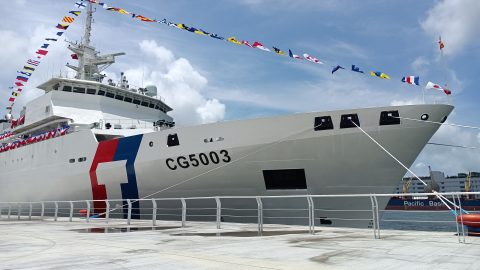
At Saturday’s event, the coast guard cutter Taipei (台北) was also commissioned. The Taipei is the fourth and last member of the 4,000-ton Chiayi class, currently the largest ships in the coast guard with a real tonnage of 5,000 tons. Domino Theory covered the commissioning of the Yunlin (雲林), the third in the Chiayi class, last year. The Yunlin has a medical suite able to handle most emergencies, including an operating theater and qualified doctor.
Although the Taipei was commissioned last weekend, it has already seen important service. The ship was part of a “fleet of friendship” that visited Palau in September, one of the 12 remaining countries that recognize the Republic of China (Taiwan) and not the People’s Republic of China, and geographically the closest to Taiwan. The Yunlin made a similar voyage to Palau last December, and the Hsinchu (新竹), the second in the class, has been even further afield, making a stop in Honolulu in June 2024.



Leave a Reply