
Before Donald Trump became president, he criticized America’s “one China” policy, telling Fox News in a November 2016 interview: “I don’t know why we have to be bound by a one China policy unless we make a deal with China having to do with other things, including trade.” But following a call with Chinese President Xi Jinping (習近平) a few weeks after taking office, he changed his mind, announcing his administration would honor the principle after all.
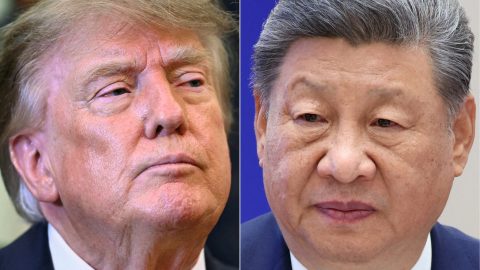
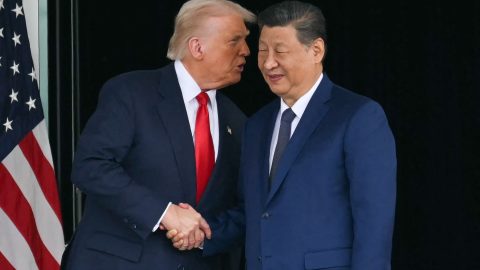
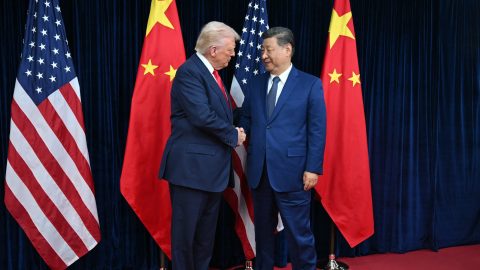
The switch-up was illustrative of a dynamic between the two leaders that will be closely watched as they meet in Washington later this week: Xi’s ability to influence Trump’s public statements on Taiwan.
Experts say the summit in Washington is unlikely to yield any major breakthroughs in the U.S.-China relationship, which has remained in a period of relative calm since the two sides agreed to a trade truce in Busan, South Korea last November.
Xi wants to keep China’s external environment stable while he works to shore up domestic economic vulnerabilities. Trump has shown little appetite to return to his drastic tariff measures ever since China hit the U.S. with an aggressive round of rare earth export controls last October. On Taiwan, Trump continues to be surrounded by enough China hawks — most notably Secretary of State Marco Rubio — to make an official change in U.S. policy unlikely.
But when it comes to Trump’s off-hand comments, Xi still has room to maneuver.
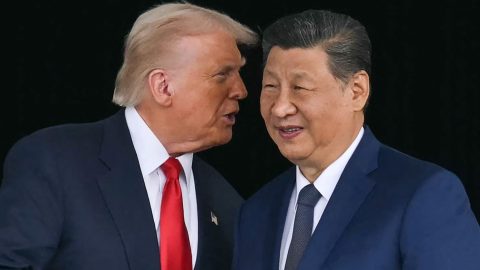
“They’re going to come to Washington hoping that they can fill his head with talking points about Taiwan, which they know he’ll then repeat in the press,” said Stephen Hartnett, a communications professor at the University of Colorado Denver who studies the history of U.S.-China relations.
Xi has reasons for optimism on that front. After Trump visited Beijing earlier this year, he told reporters he considers Taiwan a great bargaining chip in his negotiations with Xi, and that America was not looking “to travel 9,500 miles to fight a war.” The remarks — which alarmed many in Taipei — sounded like something Xi might hand Trump on a cue card.
“In Beijing, Xi made this claim that, ‘We don’t want Taiwan to go independent because it’s been ours for thousands of years,’” Hartnett said. “Trump is too ignorant to turn around and say, ‘Well, actually you’ve only been a country since 1949. So let’s not talk about thousands of years.’”
Trump is still surrounded by advisors with substantial expertise on China and Taiwan. But they appear to be placing less and less of a check on his lack of diplomatic discipline.
“In the first term, Trump often listened to his more experienced advisors when it came to China,” said Zack Cooper, a senior fellow at the American Enterprise Institute. “In the second term, Trump is getting what he wants and few advisors seem willing to run the risk of trying to push back against his instincts. I expect this will continue, and maybe even worsen, over the next couple years.”
Trump has already gotten Trump to publicly discourage Taiwan from pursuing independence and half off on a planned $14 billion arms sale for months.
What will Xi get Trump to say this time around? Only the post-summit press conference will tell.

Leave a Reply