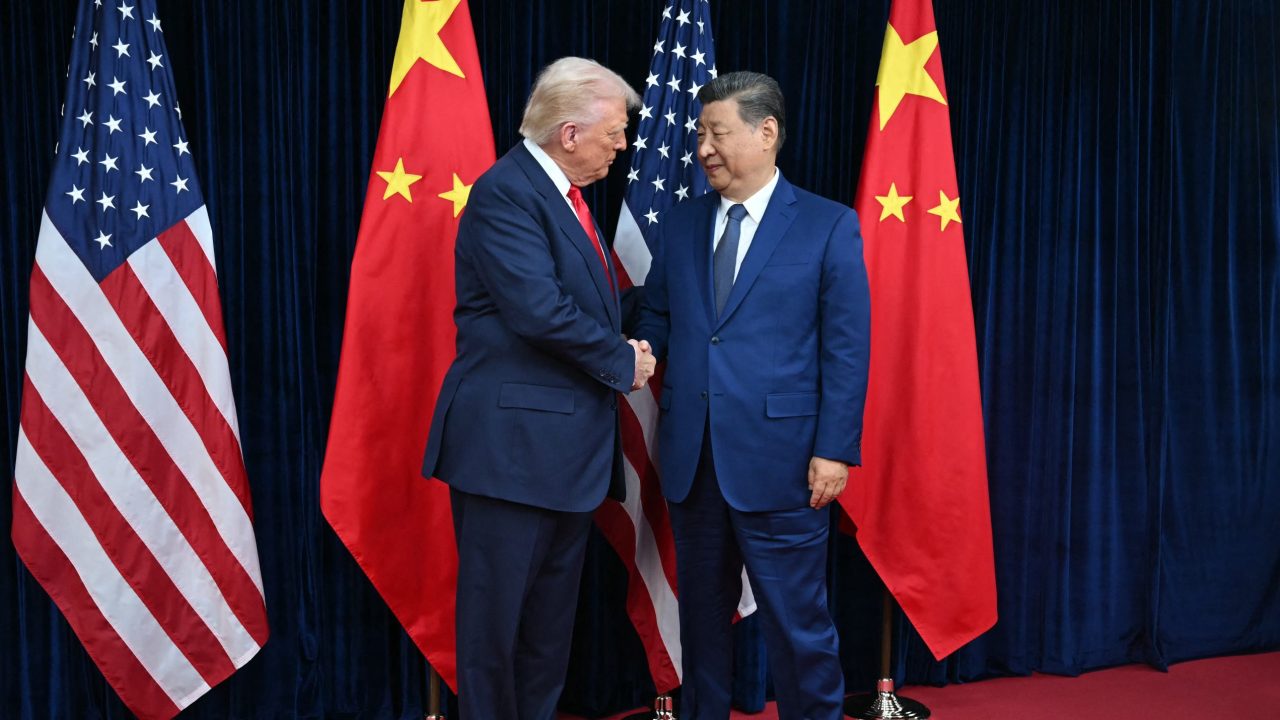
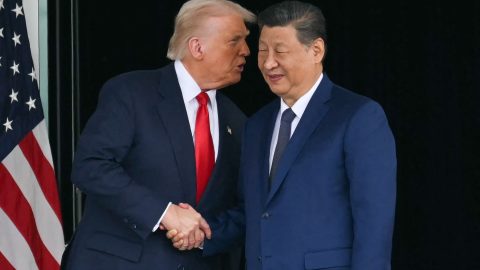
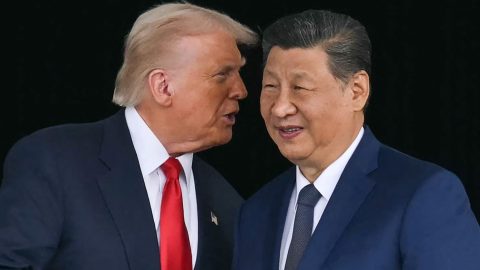
After Donald Trump and Xi Jinping (習近平) agreed to ratchet down trade tensions at a meeting in South Korea last Thursday, both sides touted a list of commitments as evidence of progress. A fact sheet released by the White House called it “a massive victory that safeguards U.S. economic strength and national security while putting American workers, farmers and families first.” Chinese state media outlet Xinhua declared: “China is willing to work with the United States to jointly safeguard and implement the important consensus reached at the meeting between the two heads of state.”
Let’s recap what each side has said they will do, and what these actions could mean.
Tariff Rates
The U.S. said that it will lower the total tariff rate on Chinese goods from roughly 57% to 47% and set aside threats for further escalation. Compared with the peak rate of 135% that U.S. tariffs on Chinese imports reached in the aftermath of “Liberation Day” this spring, 47% seems decidedly modest. But it is still more than twice as high as the U.S. tariff rate on China at the end of Trump’s first term in 2021. That the Busan agreement is being seen as a restabilization of U.S.-China relations is proof of how much Trump has succeeded in changing what is considered normal in international trade.
Rare Earths
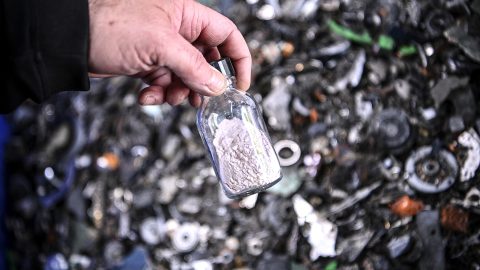
Beijing agreed to suspend the implementation of its rare earth metal export control regime, which it had announced on October 9. It also agreed to grant licenses for rare earths whose export had been restricted under controls imposed in April 2025 and October 2022. The White House said the move amounted to a “de facto removal of controls” on rare earths.
What can’t be undone, however, is the shift in balance of power that China’s aggressiveness on rare earths has caused in the relationship. That’s according to Zichen Wang (王子辰), the author of the popular China-focused newsletter Pekingnology and a Research Fellow at the Center for China and Globalization, a think tank in Beijing.
“By demonstrating that China is willing to use its dominant position in rare earth mining and processing for strategic defense, Beijing signaled that the era of one-way pressure is over,” Wang said in an email. “If Washington can weaponize chips and semiconductors and others, China can do the same with its unique advantage. That creates a form of mutual deterrence neither side can ignore.”
Fentanyl
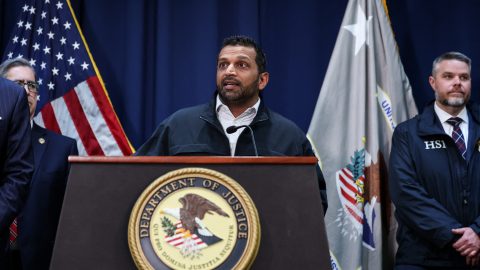
Beijing also agreed to restrict the flow of chemicals used in the production of fentanyl to the United States. The White House said that, “China will take significant measures to end the flow of fentanyl to the United States.” But Amanda Hsiao (蕭嫣然), a director in Eurasia Group’s China practice, says that much remains unclear about what these measures will be, and how they will be enforced. “Beijing is likely to adopt actions that are quite visible to demonstrate follow-through — scheduling additional precursors for instance — and to return to and strengthen the cooperation that it was already pursuing under the Biden administration,” Hsiao wrote in an email. “It is unclear what, if any, metrics were agreed between the two sides to measure progress on this issue.”
Wang says that controlling the flow of fentanyl precursors is not as simple for China as many in the U.S. imagine. “The companies that produce and sell them are mostly private, scattered across different provinces, and challenging to supervise,” he said. “Strictly monitoring every batch’s end-use and export destination is feasible only at considerable cost and administrative burden.” That’s a point that many in Beijing have made before.
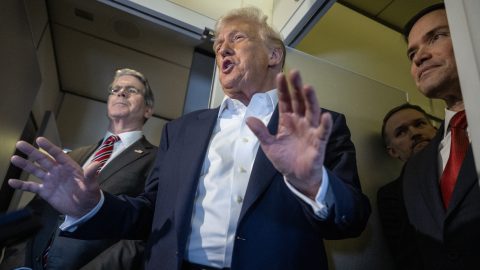
Now even Trump seems to be coming around to the idea that China should be given a bit of grace on this issue. Speaking to reporters on his flight out of South Korea, Trump said: “We also discussed fentanyl. We agreed that he’s going to work very hard to stop the flow. It’s a complex subject, because fentanyl is used for different reasons — including medical anesthetics — but he’s committed to cracking down on the precursor chemicals.”
Agriculture
Under the agreement, China has agreed to buy 12 million metric tons of soybeans before the end of this year, and 25 million metric tons per year until 2028. Soy beans were near the top of Trump’s wishlist going into the meeting, hoping to secure a win for American farmers who helped get him elected. Hsiao says the Chinese commitment isn’t overly ambitious. “The amount of soybeans China is committing to buy is about how much they were purchasing from the U.S. before, meaning it is a realistic target and I expect they would fulfill those purchases barring a major deterioration in bilateral relations,” she said.
China also agreed to remove restrictions on the import of other agricultural products including chicken, wheat and corn, among others, which it had imposed in retaliation for U.S. tariff hikes on “Liberation Day.”
Microchips
Despite the widespread expectation that the topic of Nvidia AI chips would be raised, Trump said afterward that the two sides had not discussed semiconductors. “It is unclear if the U.S. promised to not pursue actions that would further restrict U.S. tech exports to China,” Hsiao said, adding that if the U.S. does so, Beijing would not be happy. For now, semiconductors remain an X factor.

Leave a Reply