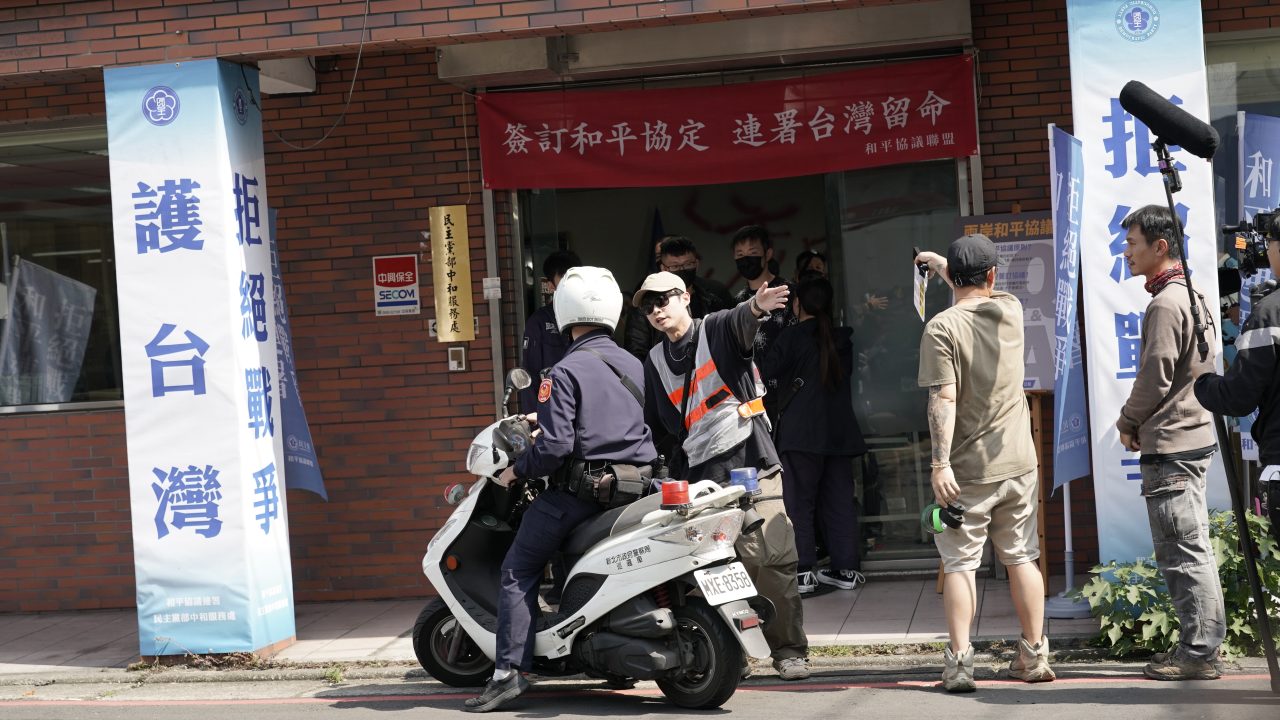
In episode two of “Zero Day Attack,” the new Taiwanese series about a Chinese invasion, viewers saw people desperately flee Taiwan, mass protests erupt and radical groups carry out violent acts.
Amid the chaos, pro-China elements seize the opportunity to incite violence and undermine societal unity, tactics reminiscent of the 2019 Yuen Long incident in Hong Kong.
In real life, China has continued to employ diverse channels and tactics to infiltrate various sectors in Taiwan, recruit Taiwanese nationals to friendly civil society organizations, or obtain sensitive intelligence from the Taiwanese government, according to the National Security Bureau.
China’s main targets include military personnel, according to the National Security Bureau, are government agencies and local groups such as gangs and religious organizations, with troops on active duty and veterans comprising the largest proportion. In the 15 cases prosecuted in 2024, a total of 64 individuals were involved, of whom 15 were veterans and 28 were active service members.
Most recently, four former Taiwanese military personnel were convicted of leaking sensitive military information to Chinese intelligence for bribes between 2022 and 2024, receiving payments of 260,000 New Taiwan dollars ($8,654) to NTD 664,100.
“There are Chinese agents and intelligence personnel in Taiwan, monitoring you regularly to determine the locations of key positions or targets. Then, in the final stage, they will help mark the ground for the attack with military weapons,” Chieh Chung (揭仲), a defense analyst who teaches at Taiwan’s Tamkang University, told Taiwanese news channel SETN in a 2017 interview.
There are also concerns that organized crime groups like the Bamboo Union (竹聯幫) and Chinese Unification Promotion Party (中華統一促進黨) could cause chaos during wartime.
Last November, in an interview with Liberty Times, Zhin-Sheng Wang (王智勝), a professor at the Central Police University, accused Chang An-lo (張安樂), the former Bamboo Union leader and founder of the pro-Beijing Chinese Unification Promotion Party who is also known as “White Wolf (白狼), of acting as a fifth column in Taiwan.
In a previous story we covered on organized crime and politics in Taiwan, Chin Ko-lin (陳國霖), author of the book “Heijin: Organized Crime, Business, and Politics in Taiwan,” said that despite being less violent and visible than it was in the past, organized crime remains a force in Taiwanese business and politics. “Gangsters now stay behind the scenes and let their family members and relatives represent them on the [political] stage,” he said.
Information Operations Research Group (台灣資訊環境研究中心) looked at the 20 Taiwanese media figures most frequently cited by Douyin channels affiliated with the Chinese Communist Party and its official media around last year’s U.S. election and found three recurring themes:
- War (51.69%): Over half of the content emphasized China’s military rise. For instance, former navy captain Lu Li-shih (呂禮詩) praised China’s strength at the Zhuhai airshow last November.
- Anti-American Sentiment (24.83%): After last year’s U.S. presidential election, Chinese social media promoted a clip of former KMT lawmaker and retired army lieutenant-general Shuai Hua-Ming (帥化民) calling Trump a “robber and liar” on Taiwanese TV.
- “One Family Across the Strait” (兩岸一家親) (13.77%): Triggered by Taiwanese President Lai Ching-te’s (賴清德) remarks on national identity, commentators criticized him for provoking China and could escalate war risks.
One group especially vulnerable to Chinese influence is Taiwanese professionals who travel to China for business. “Individuals engaging in business with China are not automatically considered targets for ‘united front’ operations, but their interactions naturally expose them to higher risks of being approached,” said Marco Ho (何澄輝), co-founder of Kuma Academy, a non-profit civil defense organization.





Leave a Reply