Note: This is a follow-up on our previous article on the impact of organized crime in Taiwanese business. Read the first article here.
After speaking to Shen Su-cheng (沈夙崢) on the subject of organized crime for an hour two weeks ago, the Democratic Progressive Party (DPP) councilor for Nantou stood up and introduced a photograph of Nantou County councilors hanging on the wall of her public office. Pointing to them, one by one, she noted those who have purported connections to organized crime. And there were a lot.
To someone from the U.K., where the parliament won’t even allow lying MPs to be called “liars,” a sitting politician talking openly about organized crime in politics can only be seen as shocking. But the gesture is illustrative of a broader view. “Heidao” or “black way/underworld” (黑道) figures may be less high profile than they were in the 1990s, but they still have significant influence in Taiwanese politics.
Chin Ko-lin (陳國霖), author of the book “Heijin: Organized Crime, Business, and Politics in Taiwan,” (黑金) put it like this in an email to Domino Theory: “Gangsters now stay behind the scenes and let their family members and relatives represent them on the [political] stage. Organized crime in Taiwan is still a formidable force in Taiwan’s business and politics, but violence is less frequent and visible nowadays, both in the business and political sectors.”
History of Organized Crime in Politics
The idea of a pivot to less “visible” involvement comes from a comparison with the 1990s, when perceptions of organized crime in Taiwanese politics peaked. Back then, a series of high-profile political assassinations made headlines, including that of Liu Pang-yo (劉邦友), the commissioner of Taoyuan County, and Peng Wan-ru (彭婉如), a high-ranking DPP member, both murdered in November 1996.
At the same time, accusations of vote rigging were rife. Chin’s book contains village leaders directly admitting to helping the Chinese National Party (KMT) buy votes for 1,000 New Taiwan dollars each. “Before martial law was lifted, elections in Taiwan were relatively quiet and limited to local offices,” one unnamed village leader told Chin. “After martial law was lifted in 1987, the KMT realized that if it wanted to stay in power, it had to have the support of local factions. To win elections, the KMT candidates needed the support of heidao people.”
The Situation in 2024
Since that period, a wide variety of reforms have looked to reduce organized crime influence on politics, as Kharis Templeman, research fellow at the Hoover Institution, has detailed. Township elections have been eliminated across much of Taiwan, “removing the most common route for exploiting public resources for private gain at the local level.” Elections at the local level are now held on the same day as national elections, raising turnouts and diluting the effect of vote buying. And an amendment to the Local Government Act forced speakers and deputy speakers of local councils to be elected by open ballot.
And yet, high profile accusations of both heidao links and links to illegal practises such as vote buying still persist. In recent years, Yen Kuan-heng (顏寬恆) of the KMT was accused of buying votes via money placed in cabbages at campaign events, and Pingtung County Council Speaker Chou Tien-lun (周典論) was indicted on charges of vote buying related to Terry Gou’s (郭台銘) run for the KMT’s presidential nomination.
The popular imprint of such cases is such that when I asked around a dozen Taiwanese friends — from a wide variety of backgrounds — about the involvement of organized crime in Taiwanese politics, they were all absolutely matter-of-fact in suggesting it was only less obvious now. Meanwhile, the construction project manager we interviewed for our previous article on organized crime within Taiwanese business told us simply that organized crime figures “are capital providers for politicians now.”
The Practicalities
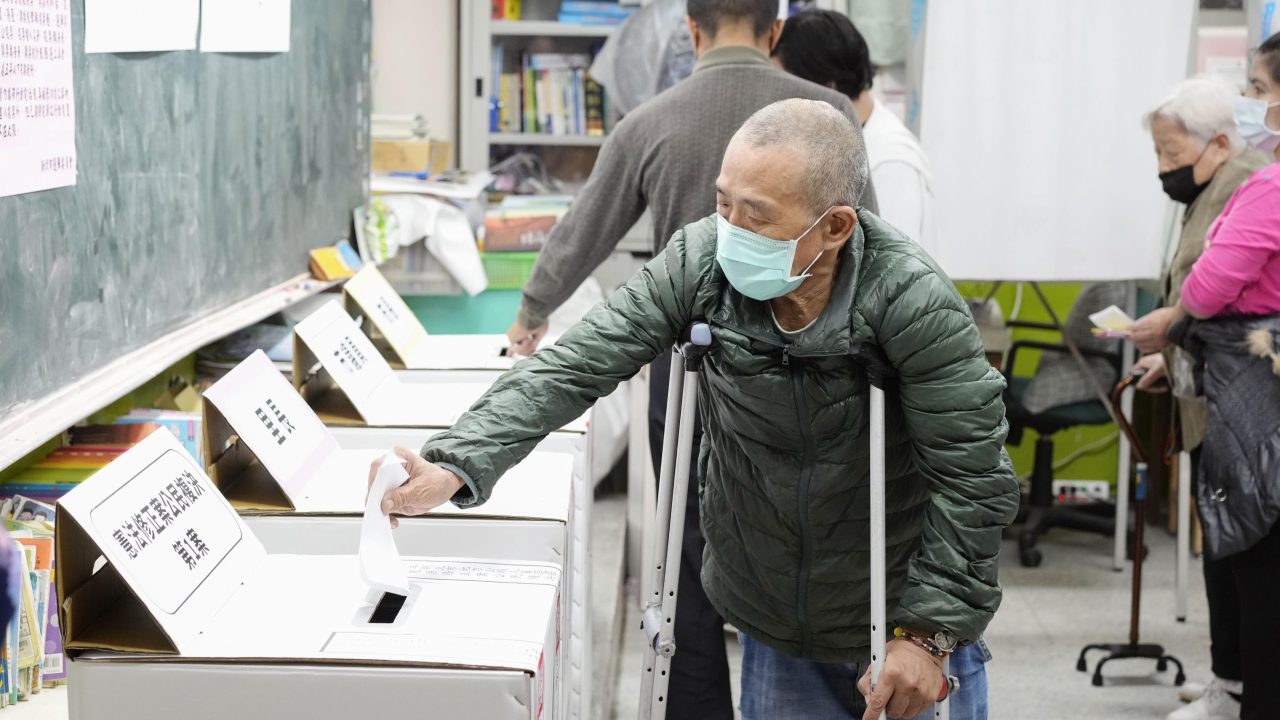
As that quote alludes to, the practicalities of how organized crime figures interact with politics are wide ranging, but vote buying is a consistent thread. Shen Su-cheng, who chose to highlight the issue ahead of her election in 2022, told us that, these days, in smaller areas such as Nantou, “middlemen,” (樁腳) such as the children or spouses of organized crime figures, provide “firewalls” between the crime bosses, the candidates and the vote buying activities. And these involve cash or events rather than traceable bank transactions.
“A middleman will bring money to your home, depending on the number of people in your household, so if a package deal costs 1,500 NTD or 2,000 NTD the middleman will give you 6,000 NTD,” Shen said, adding that the middlemen would take responsibility for vote buying should police end up investigating it.

On top of this, Shen also said organized crime groups work with “foreign forces” (境外勢力) in China to spread disinformation and money through Taiwan, ultimately helping to determine which candidates should be supported in elections. Adding to Chinese influence brought in by heavily subsidized trips to China for village leaders and other politicians, Shen said the ultimate effect was that candidates will be “controlled” by China and produce a view of Taiwan that suits China. “That’s why there are loopholes in our defense and foreign policies, as well as at the legislative level,” she said.
To be sure, not everyone is so forthright in summing up these dealings. Over the phone, Yang Li-chuan (楊麗川), director of the KMT’s Nantou branch office, said he believed bribery was less prevalent nowadays, and although he said he wouldn’t deny the influence of gangs in politics, he said it was ultimately “hard to define” vote buying — alluding to the fact that lines can be “blurred” between community service and vote buying. Yang did, however, emphasize that he himself was against all forms of bribery, as it impacts a country’s future and politicians’ careers.
The Future
The fact that there is not necessarily agreement on what exactly constitutes vote buying may be one reason why, in the end, Shen is actually somewhat accepting of the current situation. Asked why organized crime presence in Taiwanese politics was so persistent, she said “I think it’s a force that will always exist” and added that “In my view, I believe they are able to control things in certain corners of this society that law and order can’t get to.”
For Shen, this view translates into a working approach whereby “even if that person comes from a large organized crime background, we will still talk to them.” Ultimately, she says that in “every vote counts” elections, even a candidate not buying votes needs to work with all sections of Taiwanese society.
Of course, this is not to say that nothing further is being done to defang organized crime groups in Taiwan. Shen mentions the “drain black act” (排黑條款), an amendment in the Civil Servants Election And Recall Act that precludes anyone charged with activities related to organized crime running for office, and notes attempts to close down other related forms of crime, such as fraud. The Organized Crime Prevention Act is also regularly amended. But rightly or wrongly there is a belief that these groups can always hide behind middlemen, simply moving behind a new layer of representatives and continuing business as usual.




Leave a Reply