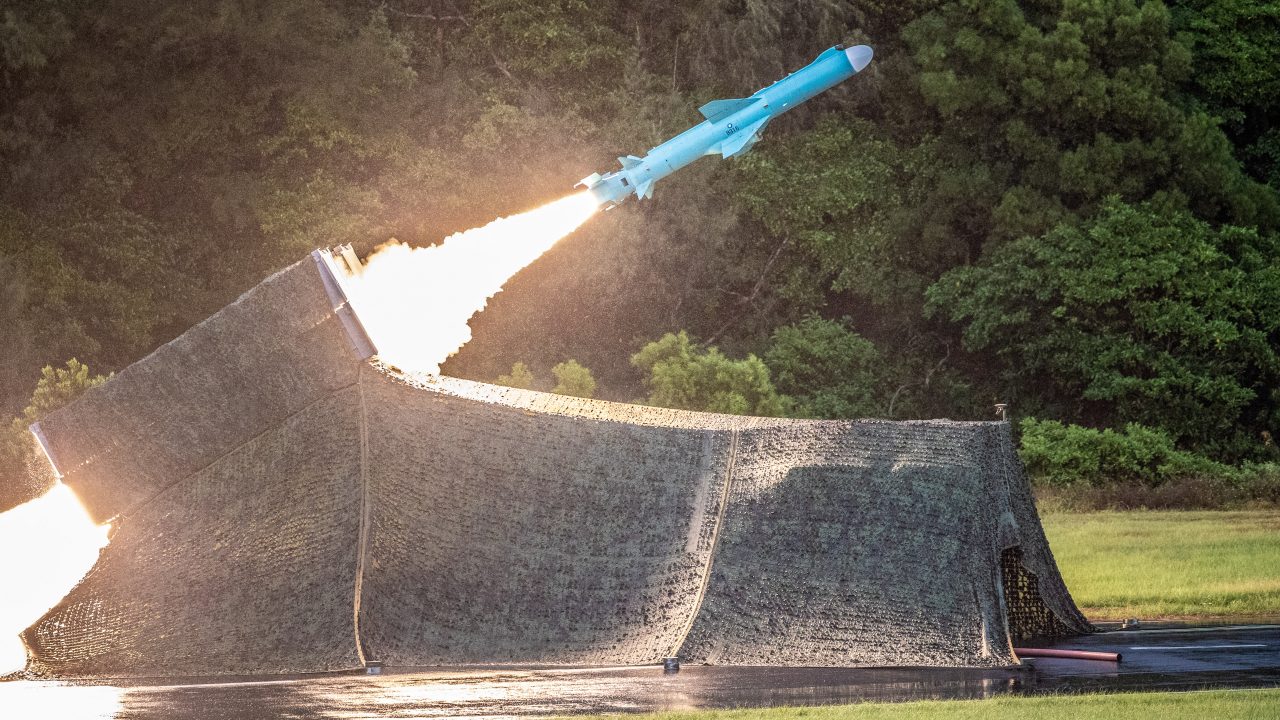
The Taiwanese navy stood up its new Littoral Combat Command on Wednesday, to almost no fanfare.
The Littoral Combat Command brings together the navy’s existing land-based anti-ship missile batteries, radars and uncrewed systems. It will be responsible for defending the seas near Taiwan, as well as its outer islands.
It unites under one command most of the land-based systems that could detect and target Chinese navy ships that attempted to approach Taiwan in the event of war. However, strike and reconnaissance drones that would be expected to form part of the new command’s firepower have yet to be ordered.
The commander of the Littoral Combat Command is Chien Shih-yuan (簡士淵), who was promoted to vice admiral by Taiwanese President Lai Ching-te (賴清德) on June 24.
On June 1, Defense Minister Wellington Koo (顧立雄) confirmed in a hearing at Taiwan’s legislature that the new command had been formed that day. But there was no publicly acknowledged event to inaugurate the new command, no press announcements by the navy, and surprisingly little domestic media coverage.
When asked for comment, or even confirmation that the new command had actually formed, Taiwan’s Ministry of National Defense said it had no plans to issue any statement.
All of this for a new military entity whose primary responsibility would be to sink a Chinese invasion fleet.
“The new command is operationally significant because it appears to be taking into consideration the Hellscape strategy that was proposed several years ago,” Bryce Barros, an associate fellow at the GLOBSEC thinktank who is based in Taipei, said in a written message. The Hellscape strategy would use drones and other uncrewed systems to target and degrade a Chinese invasion fleet as it approached Taiwan’s coast. It was popularized by Admiral Samuel Paparo, commander of the U.S. military’s Pacific Command.
The Taiwanese navy currently operates two indigenous anti-ship missile systems: the subsonic Hsiung Feng II (雄風二型) and the more advanced supersonic Hsiung Feng III (雄風三型). The basic variants of both missiles have a range of 150 kilometers, but Taiwan also operates the Hsiung Feng IIB with a range of 250 kilometers, and the Hsiung Feng III-ER with a range of 400 kilometers, creating a layered defense.
Taiwan made a large order of 400 U.S. Harpoon Block II anti-ship missiles and 100 launchers in 2020. The first launchers were delivered in 2025. A delivery of 128 missiles was projected for 2026, but it’s unclear whether these have arrived yet. There’s no public reporting that new units have been stood up to operate them yet. In April, Michael Miller, director of the Defense Security Cooperation Agency, denied reports that Saudi Arabia would take priority over Taiwan for deliveries of Harpoon batteries.
The subsonic Harpoon is a less advanced missile than the Hsiung Feng III, with a range of 124 kilometers, but the combination of all three systems, once the Harpoons are delivered, will give Taiwan a total of more than 1,400 anti-ship missiles.
Reportedly, the Harpoons and Hsiung Fengs can’t be operated from one unified radar system. But Barros said that arguably one of the reasons for the new command could be to “metaphorically iron out those kinks between those platforms.”
The command will not integrate the navy’s missile attack boats, as had previously been announced. They will remain as part of the Naval Fleet Command, with the rest of the navy’s crewed ships. However, the missile attack boats will still cooperate with the new command.
In the defense special budget that was initially announced in November, there were 208,200 coastal attack aerial drones of four kinds, including FPV drones with a range of 7 kilometers, small suicide drones with a range of 30 kilometers, medium suicide drones with a range of 90 kilometers, and bomb-dropping drones with a range of 25 kilometers.
There were also 1,320 suicide drone boats with a control range of 40 kilometers and an endurance of 460 kilometers, and 1,758 coastal and maritime surveillance drones of three kinds, including 32 large units with a range of 300 kilometers and an endurance of 16 hours, 280 vertical take-off and landing units with a 130-kilometer control range and an endurance of 13 hours, and 1,446 units with a control range of 100 kilometers and an endurance of 120 minutes, intended for detection, identification, and strike assessment of amphibious fleets.
It’s likely that many of these were intended to be integrated into the new command, Barros said, especially given “how many of those drones are short and medium range,” aligning with the command’s focus. He added that this matches some of the potential testing drills the defense ministry has put out notifications for over the last several months, specifically live-fire exercises mixing reconnaissance drones with missiles.
However, those drones were not funded. Taiwan’s opposition parties, which control the legislature but not the presidency, cut funding for domestic drone production and passed a different reduced version of the special budget.
Now the opposition parties have put forward their own proposals to fund domestic drone production. But the substance of these focuses on retaining legislative control over spending on drones, rather than what kind and how many to order. As a result of this domestic wrangling, what new drones, if any, the new command will eventually have is unclear.
The Littoral Combat Command has stood up. But so far, it appears to have been stood up in the more unfortunate sense of the phrase, by the dance partners responsible for arming it.





Leave a Reply