
DeepSeek’s release last month puts into question American leadership in artificial intelligence, with many claiming that it was a “Sputnik moment” for China. The question of the day is, what is the Trump administration going to do about it?
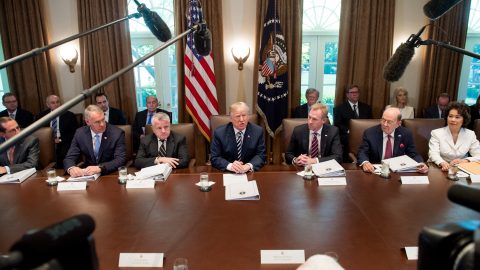
By some accounts, Trump promises pragmatic leadership. Former national security advisor Robert O’Brien argued in an op-ed for Foreign Policy that the merit in Trump’s approach lies in his nonallegiance to any particular ideology. Perhaps his administration will construct an AI policy that purely benefits innovation — creating the better products so that the U.S. can outcompete China. New players on Trump’s tech team, like venture capitalist David Sacks, support less stringent regulation on innovation. The Trump administration also announced the Stargate Project, which intends to invest up to $500 billion in AI infrastructure.
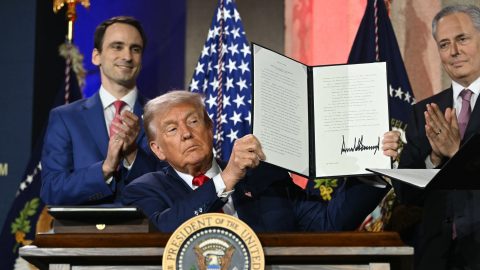
Another hint for Trump’s AI policy is a brief executive order Trump released on January 23, among a slew of others. The order calls for the administration to develop an AI strategy within 180 days that promotes “human flourishing, economic competitiveness, and national security.”
The executive order is seemingly cut and dry. However, I want to call attention to the use of the phrase “human flourishing,” which does not seem to appear in any of Trump’s major AI documents from his first administration. This term can have a neutral and secular connotation in modern parlance, but it also has notable philosophical and theological roots.
“Human flourishing” dates back to Aristotle’s philosophy on how politics can serve the public good. Thomas Aquinas later integrated Aristotelian ethics into Christian theology, framing beatitudo (which means happiness or blessedness) as being ultimately tied to union with God. Aquinas believed that politics should serve the common good, but gave this idea a theological dimension by arguing that just laws and governance should lead people toward virtues (e.g., gratitude and truthfulness) that ultimately reflect the divine order.
Contemporary Christian conservative thought leaders like Adrian Vermeule, an American legal scholar at Harvard University, have extended this tradition. Vermeule believes that “the promotion of morality is a core and legitimate function of authority” that aims to foster the common good and human flourishing.
The idea of “human flourishing” as it relates to Vermeule’s idea of proactive conservatism has appeared in conservative think tanks like the Heritage Foundation and the America First Policy Institute. (Both of these think tanks have played a significant role in staffing and policymaking for Trump’s second administration.) Kevin Roberts, the president of the Heritage Foundation, advocated for a collective endorsement of fundamental conservative principles based on the understanding that “the soil of human flourishing is ordered liberty, not simply freedom from constraints.” The America First Policy Institute put a finer point on what kind of values should underpin American policy in an 80-page document titled, “Biblical Foundations: Ten Pillars for Restoring a Nation Under God.” The institute states that “the gospel of Jesus Christ has been the greatest force for human flourishing the planet has ever seen … Without a Christian worldview and values, Western civilization — and the extraordinary progress, prosperity, freedom, and equality it has produced — does not emerge.”
Exactly how conservative Christian morals could underpin Trump’s technology policy (if they do at all) remains unclear. However, thought leaders in Trumpism like the Heritage Foundation and America First Policy Institute, as well as Trump himself, have articulated a main grievance in the technology space: the perceived bias toward “wokeism” in big tech and the products that come out of big tech. For example, ChatGPT was targeted by some conservatives for providing biased answers that favor the Left. This might indicate that Trump’s ideological drive is largely inward looking — he seeks to rectify a political imbalance in American technology that he believes disadvantages conservatives.
While Trump is focused inwardly, China continues to assert its role in AI governance at the international level. In the Chinese context, this approach is similarly observed through the rhetoric China uses in policy documents and official statements about AI. Specifically, China’s version of “human flourishing” seems to be reflected in the phrase “community of shared destiny.” This is a keystone phrase in Xi Jinping’s (習近平) foreign policy doctrine, and it is used in a variety of contexts — particularly when forging partnerships with countries through programs like the Belt and Road Initiative — to signal an ideological alignment with China. Since 2017, China has increasingly used the term “community with a shared future” over “community of shared destiny” because it is more palatable for global audiences.
The role of the “community of shared destiny” narrative in China’s grand strategy is stated succinctly by Daniel Tobin, faculty member in China Studies at the National Intelligence University: “The premises of Community of Common Destiny … include not only that China’s growing strength presents an opportunity for it to offer other countries the chance to ‘hitch themselves to China’s development train’ as a means of building influence for China’s preferences, but also that China must begin shaping international norms and rules.” The frequent use of “community of shared destiny” (or some variant of the phrase) in China’s AI development and governance plans underscores that China wants to contribute to international norm building in the artificial intelligence space.
There are two ideological clashes taking shape at this moment — a domestic cultural clash between the left and the right and an international clash between American and Chinese models for governing technology. If Trump privileges the first over the second, it could be to the detriment of American global influence.



Leave a Reply