
Semiconductors
Taiwanese semiconductor powerhouse TSMC began mass-producing 2-nanometer chips — its most advanced chips to date — in the fourth quarter of 2025, according to an announcement on the company’s website. Compared to its next most advanced chip, the 2-nanometer process provides a 10% to 15% speed increase at the same level of power consumption, Taiwan’s Central News Agency reported. TSMC maintains a three-to-five year lead over competitors like Intel and Samsung.
Taiwan continued its efforts to protect the chip giant from trade secret theft in December. Prosecutors charged the local subsidiary of Tokyo Electron for failing to prevent the alleged theft of trade secrets from TSMC. This followed news from November that TSMC filed a lawsuit against a former executive for allegedly sharing trade secrets with Intel. The Financial Times reported concerns from experts about the fact that Taiwan is using its newly broadened national security laws to target close friends during a geopolitically sensitive time. The laws were originally designed to prevent technology leakage to China.
But there are other ways TSMC can help Taiwan curry favor with its security partners. U.S. Commerce Secretary Howard Lutnick said in December that he expects TSMC to invest more than $200 billion in semiconductor manufacturing plants in the U.S. TSMC has currently committed $165 billion to build out its U.S.-based production capacity. It’s unclear whether this expansion is actually in discussion.
According to a CEO survey by CommonWealth Magazine published in December, Taiwanese investment into the U.S. is at a 12-year high due to tariffs and pressure from American tech giants like Nvidia. These investments are concentrated in AI and chip-related industries in Texas, which provides low electricity costs, low taxes and abundant power. Drawbacks include high operating costs, labor shortages and uncertainty about short-term returns.
Artificial Intelligence
The Legislative Yuan passed the Artificial Intelligence Basic Act on December 23. The National Science and Technology Council will be the governing authority, ensuring that AI development adheres to seven core principles including sustainability, privacy and cybersecurity. The act also stipulates that the government must allocate funding to AI research and infrastructure.
From the Executive Yuan, the Ministry of Economic Affairs on December 15 announced a plan to invest 2.5 billion New Taiwan dollars (around $80 million) to help 30,000 businesses in Taiwan integrate AI over 2026 and 2027, focusing on the retail and food service industries. Taiwan also opened a new cloud computing center in Tainan to support the country’s sovereign AI development. It features the largest supercomputer in Taiwan, equipped with 1,760 of Nvidia’s H200 chips and 144 Blackwell chips from Nvidia in the GB200 NVL72 configuration. The center is part of Taiwan’s “Ten Major AI Infrastructure Projects” initiative.
Taiwan exports hit an all-time high of $64.05 billion in November, driven by the demand for AI, high-performance computing and cloud service infrastructure. This constitutes a 56% year-on-year increase, the Ministry of Finance reported. Furthermore, Taiwan’s Central Bank raised its 2025 gross domestic product growth rate forecast to 7.31% in December, citing AI growth and a surge in exports of emerging tech. This marks a significant increase from the bank’s previous estimate of 4.55% growth in September.
Defense Technology
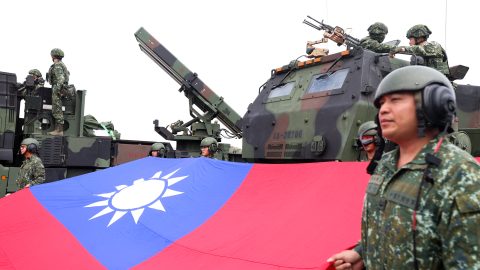
The Chinese navy and air force practiced encircling Taiwan this week as part of a series of military exercises called Justice Mission 2025. In response, Taiwanese President Lai Ching-te (賴清德) said Taiwan needs to defend its sovereignty and continue boosting its defense capabilities.
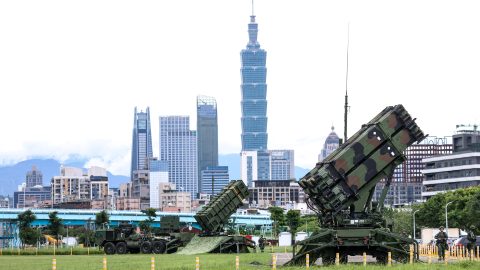
Taiwan certainly gained ground on this goal last month. On December 17, the U.S. announced weapon sales to Taiwan consisting of $11.1 billion worth of howitzers, rocket artillery systems, anti-tank missiles and loitering munitions. Joe O’Connor from Taiwan Security Monitor told Domino Theory that this represents a particularly big and expensive sale of weapons to Taiwan but that “it’s hard to infer a broader trend” about U.S. support for Taiwan from the sale.
In terms of Taiwan’s indigenous defense capabilities, its air force successfully tested a new variant of its Hsiung Feng III anti-ship missile in December. Developed by the state-run Chung-Shan Institute of Science and Technology, the missile will advance to mass production if subsequent tests prove successful.



Leave a Reply