
Semiconductors
Taiwan’s Ministry of Justice’s Investigation Bureau is investigating whether China’s top semiconductor manufacturer, Semiconductor Manufacturing International Corporation, or SMIC, has been illegally recruiting experienced engineers from Taiwan. The bureau raided 34 locations between March 18 and March 28, looking into operations by 11 Chinese companies, including SMIC. They are accused of illegally setting up office without the government’s knowledge.
Taiwan Semiconductor Manufacturing Company could face a fine of over $1 billion from the U.S. Commerce Department for supplying Chinese tech giant Huawei with semiconductors. Last year, a chiplet TSMC sold to Sophgo was used for Huawei’s Ascend 910 series processor.
In its annual report released this month, TSMC appeared to play down its responsibility for the issue, saying “TSMC’s role in the semiconductor supply chain inherently limits its visibility and information available to it regarding the downstream use or user of final products that incorporate semiconductors manufactured by it.”
TSMC’s annual report also revealed that its annual wafer capacity will grow by 4% in 2025, having grown by 6% in both 2023 and 2024.
Earlier this month, Taiwanese chipmaker Vanguard said it would speed up construction of its new plant in Singapore due to geopolitical risks following the U.S.’s new tariff regime.
Military Tech
After an alliance of drone manufacturers from Taiwan signed cooperative agreements with the Czech-Taiwanese Business Chamber and the Polish company Farada Group in February, it revealed this month that it has quadrupled its membership since September last year. Members of the Taiwan Excellence Drone International Business Opportunities Alliance have increased from 50 to over 200, with a focus on decoupling from China-based supply chains a priority concern for the grouping.
Taiwan’s army rejected the latest prototype of the CM-34 “Clouded Leopard II,” a domestically developed light tank, over insufficient firepower. The tank has a 105-millimeter cannon. The army has requested a 120-millimeter cannon.
Computing
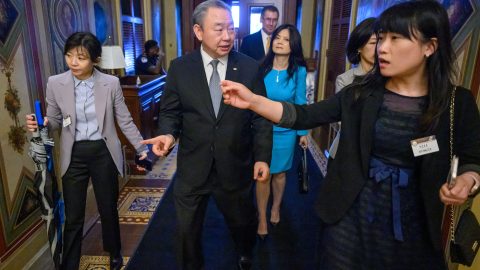
Wyoming Governor Mark Gordon discussed quantum computing with Taiwan’s Ministry of Foreign Affairs during his first visit to Taiwan earlier this week.
Taiwan is set to open a national cybersecurity center in August. The aim of the center is to counter threats from quantum computing, AI and state-sponsored cyberattacks. It will do that by coordinating efforts across four pillars of cybersecurity: societal resilience, protection of the homeland and critical infrastructure, safeguarding vital industries and supply chains, and ensuring the safe use of AI. Talks over the creation of an AI basic law remain ongoing.
Space Industry
The Taiwan Space Agency, or TASA, is planning to launch its own version of SpaceX’s Starlink satellite service by 2029. The plans involve spending $75.54 million to develop four low-Earth orbit communication satellites in collaboration with a number of private companies.
As part of looking at a range of different low-Earth orbit satellite providers for its own internet coverage, Taiwan’s Minister of Digital Affairs Huang Yen-nun (黃彥男) said at the end of February that Canadian companies and Amazon’s Project Kuiper are developing systems like those produced by OneWeb, which Taiwan currently has an arrangement with.
AI
A new report by Greenpeace has accused chipmakers in Taiwan and South Korea of driving up fossil fuel use as they expand capacity to produce more chips meant for AI-based end uses.
“AI chipmaking is being leveraged to justify new fossil fuel capacity in Taiwan and South Korea — demand that could, and should, be met by renewable energy sources,” the report said. “Across East Asia, there are many opportunities for companies to invest directly in wind and solar energy, yet chipmakers have failed to do so on a meaningful scale,” it added.
Last week, Taiwan’s Legislative Yuan passed an amendment to allow tax credits for businesses that invest in AI and carbon emissions reduction technologies.
In the same week, Hon Hai Precision Industry Chairman Young Liu (劉揚偉) said that Taiwan is a key AI hub. Speaking at a Chinese National Federation of Industries event, Liu noted that Taiwanese contract manufacturers make up 90% of the global AI server market, while his company — also known as Foxconn — alone supplies 40% of demand for AI computing.
Green Transition
Taiwan’s electricity prices will remain unchanged in the first half of 2025 after the government’s Electricity Price Review Committee unanimously voted to hold them at the same rate. Taiwan’s Ministry of Economic Affairs said it had “cautiously looked at the impact of electricity bills on prices, and resolved that electricity prices would not be adjusted this time around,” after speculation that an increase was planned.





Leave a Reply