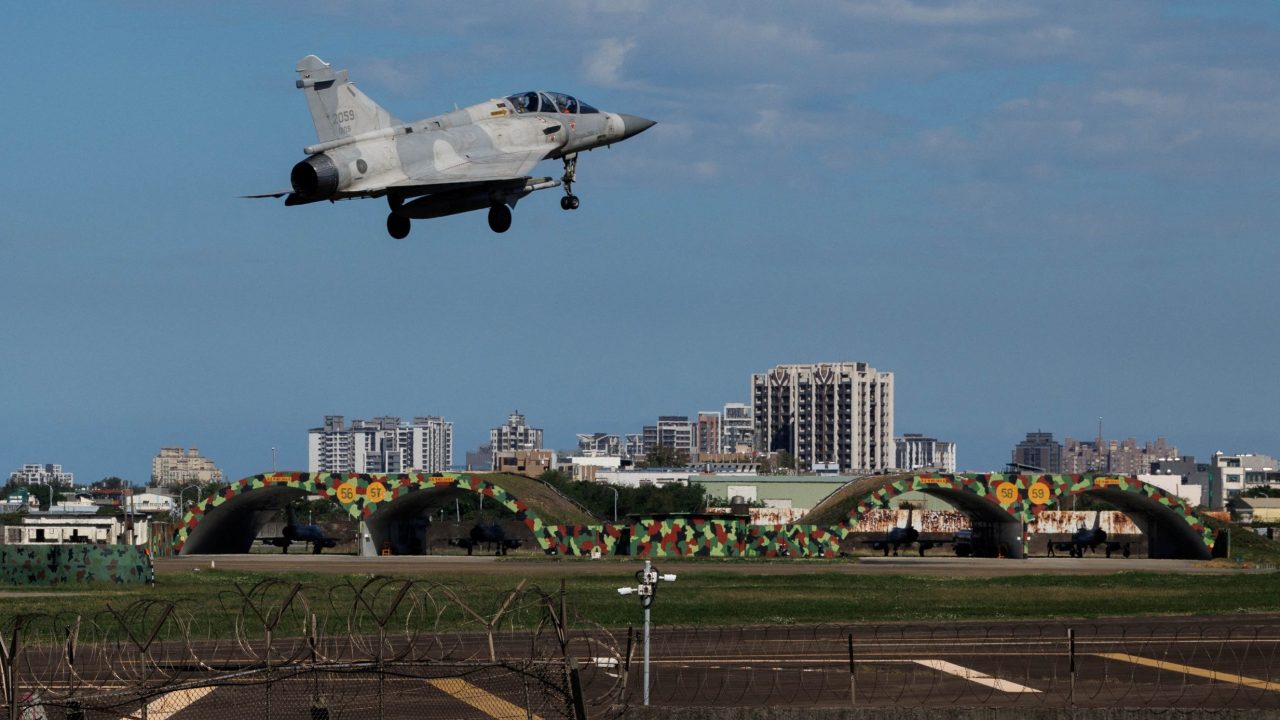
The Chinese military announced Monday that it would conduct a series of Justice Mission 2025 live-fire drills around Taiwan. China’s army, navy, air force and rocket force troops will focus on gaining naval and air superiority while blockading key ports around Taiwan, a spokesperson from the People’s Liberation Army said.
The exercises are China’s second major show of force this year around Taiwan, after the Strait Thunder-2025A drills in April. The Taiwanese defense ministry responded on Monday by saying that it would mobilize troops to rehearse repelling a Chinese attack.
Here are seven things Domino Theory will be watching for as the drills unfold:
The Scope
It won’t be clear until this evening, at the earliest, how many Chinese military aircraft and navy and coast guard ships have been active around Taiwan. Under usual circumstances, that information would be released the following morning, but on days of heightened activity, Taiwan’s defense ministry typically makes a preliminary announcement. The amount of activity is one of the key measurements that observers use to interpret the magnitude of Chinese drills.
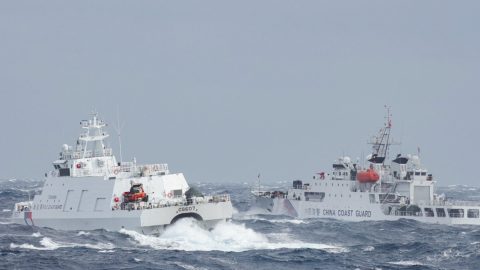
Another detail to watch for will be the variety of ships involved in the exercises. Analysts increasingly expect that in an attempted blockade of Taiwan, China’s pseudo-civilian forces — including the China Coast Guard and the China Maritime Safety Administration — would play a major role alongside the navy. In its press release this morning, the People’s Liberation Army Eastern Theater Command, which covers Taiwan, said that the drills will include practice for a “blockade on key ports and areas” around Taiwan.
The Duration
The Eastern Theater Command announced this morning that the drills were starting immediately, and that there are live-fire exercises scheduled for tomorrow, December 30.
In previous drills, China has sometimes left the ending unscheduled and then abruptly announced they have been successfully concluded. Alternatively, China has sometimes announced a scheduled ending time and then extended it at the last minute with further days of exercises. It can be inferred in both cases that the aim is to put operational and psychological pressure on the Taiwanese military, who must prepare for multiple contingencies.
These major Chinese drills already strain the Taiwanese military because it has to account for the possibility they are the cover for a genuine attack on Taiwan. The unknown duration exacerbates this.
The Zones
China’s military announced five live-fire exercise zones around Taiwan. The Maritime Safety Administration and the Civil Aviation Authority issued navigation warnings and flight restrictions for an additional two zones, which are situated north and west of Taiwan.
While the zones appear broadly similar to those from previous drills, there are two important things to note. First, the zones are substantially larger. Second, like the drills after U.S. Congresswoman Nancy Pelosi’s 2022 visit, but unlike the ones in following years, some of this week’s zones intrude into the territorial sea and airspace around the main island of Taiwan. There were no confirmed reports, however, that the Chinese military did actually breach Taiwanese territorial sea or airspace in 2022.
China has announced that it will conduct live firing as part of these drills on December 30. Only one of the seven has been designated by the civil aviation authority for “rocket firing.” That area sits in the middle of the Taiwan Strait, close to Penghu.
Will China fire rockets over Taiwan into zones off the west coast, which it has done before? Or will it fire rockets that land in Taiwan’s territorial sea, which it has not?
The Name
China held large drills in April of this year, called Strait Thunder-2025A. From 2023 to 2024, major drills were named Joint Sword. Like the Joint Sword drills, the first Strait Thunder drills used the suffix “A” to indicate that there would be a second set of “B” drills later in the year.
Why then has China announced what look to be major drills with a different name, instead of calling them the Strait Thunder-2025B?
The name Justice Mission 2025 appears intended to build legitimacy for China’s aggression to Taiwan, by invoking the two ideas that China both already owns Taiwan, and is simultaneously owed it back.
This name also feels connected to the ongoing tensions with Japan, which arose from the Japanese prime minister’s comments on Taiwan. China’s recent propaganda messaging has focused on historical narratives, including Japan’s past military aggression, and the idea that Japan has no right to operate a normal military today.
It is likely that Chinese state media will run articles in the coming days attempting to justify this name change.
The General
The drills are the first live-fire exercise conducted under the leadership of Yang Zhibin (楊志斌), the commander of the Eastern Theater Command. The exercises come only one week after Yang’s appointment was announced on December 22. Whether the decision to stage the drills this week was taken before Yang took his position is probably unknowable.
Yang is a former air force commander who most recently served as deputy commander of the PLA’s Western Theater Command, which covers Tibet and Xinjiang. In October, Yang’s predecessor Lin Xiangyang (林向陽) was expelled from the Communist Party as part of China’s largest military purge in more than a decade. Speculation is rife among China watchers as to whether these purges are weakening or strengthening operational command within the Chinese military.
The Propaganda
China has already released propaganda posters for the Justice Mission 2025 exercises. One such poster shows Chinese arrows striking green maggots all over Taiwan. This is a call-back to the propaganda from Strait Thunder-2025A earlier this year, when China depicted Taiwanese President Lai Ching-te (賴清德) as one of the maggots.
Another poster appears to show a Chinese shield blocking cargo ships carrying U.S.-made HIMARS rocket launchers to Taiwan. Chinese state media has already tied the drills to the recently announced massive U.S. arms sale to Taiwan, which includes 82 new HIMARS systems.
China will likely continue to release more propaganda throughout the duration of the exercises.
The KMT
Taipei Mayor Chiang Wan-an (蔣萬安) was in China yesterday for the Taipei-Shanghai Twin-City Forum. Chiang comes from the Chinese Nationalist Party (KMT), Taiwan’s main opposition party which currently controls the legislature. He returned to Taiwan in the evening, saying on social media that he looked down from the plane and saw fishing boats and merchant ships. He missed the Chinese navy by a matter of hours.
For China to stage these drills so soon after Chiang’s visit puts Beijing’s sincerity about engaging with Taiwan into question. At an unrelated press conference this morning, Chiang said that he strongly condemned any behavior that escalates regional conflict, but didn’t mention China or the Chinese Communist Party directly. He also said that those in positions of power should exercise restraint and prioritize the peoples’ well-being. UDN, the pro-KMT Taiwanese media who reported his remarks, interpreted this as being aimed at President Lai.
Addressing today’s drills, Presidential Office Spokesperson Karen Kuo (郭雅慧) called on China to “exercise rational restraint, immediately cease irresponsible provocative actions, and avoid misjudging the situation or becoming a troublemaker disrupting regional peace.”
KMT Chairperson Cheng Li-wun’s (鄭麗文) statement, in contrast, did not call for China to stop the exercises. “The KMT has never harbored the naive fantasy that mainland China would immediately halt all military preparations and actions simply because the opposition party called for it,” it read, continuing: “the KMT is the opposition and does not hold ruling power.”
For Cheng, the real blame lies elsewhere: “President Lai Ching-te continues to provoke and cross red lines.” She accused Lai of “implicating Taiwan’s 23 million people” in his own political problems where his solution is to stoke cross-strait tensions. Cheng said that the Taiwanese people do not want to be “used as cannon fodder.”
Cheng has said she plans to meet Chinese President Xi Jinping (習近平) early in 2026. The timing of such a meeting would likely follow soon after Taiwan’s parliament deliberates on Taiwan’s budget for 2026 in January. Cheng and the KMT are going to come under pressure from China to block the planned rise in defense spending, as well as pressure from the U.S. and other international partners to support it. They will then have to defend those decisions to the Taiwanese electorate in the November 2026 local elections.
Once again, the audience of three rears its head in Taiwan.


Leave a Reply