When Hong Kong’s journalists could still operate with only the occasional machete attack on their editors back in 2019, the Centre for Communication and Public Opinion Survey at the Chinese University of Hong Kong conducted a poll on the credibility of digital news outlets in the eyes of the public.
Top of the pack was achieved by Stand News, an upstart nonprofit with pro-democracy leanings and a click-count in the millions, while bottom of the barrel came Speak Out HK, a news website associated with Leung Chun-ying (梁振英), Hong Kong’s former chief executive and vice chair of the National Committee of the Chinese People’s Political Consultative Conference, part of the Chinese Communist Party’s cobweb of control.
Leung argues that Western politicians deflect attention from their own failures by setting malicious media agendas in precisely the same breath as he does likewise. He also once took legal action against Stand News after it published allegations that linked him to triad gangsters. On its side, Speak Out HK is the kind of media that prefers to write about the deliciousness of berries from Xinjiang rather than the cumulative 4.4 million years of jailtime to which Turkic peoples are estimated to have been sentenced there.
By virtue of its trustworthiness, its willingness to dare where others fear to tread and the praise it earned even from the other side of Hong Kong’s political chasm, Stand News ought now to be attracting brand-conscious advertisers and truth-loving readers as it trounces its less reliable competitor from the media-sphere. That is supposedly what happens on a level playing field and within the free market for expression and capital that Hong Kong’s leaders feign to maintain.
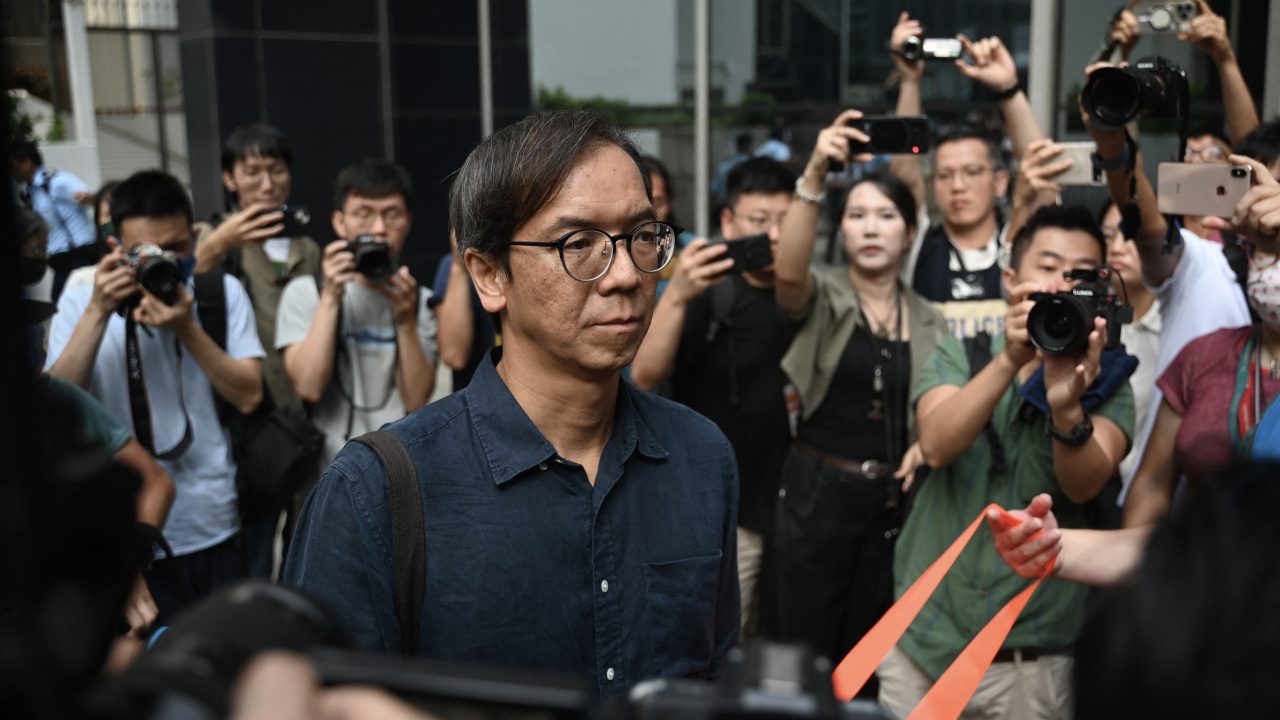
But the city has wandered so far from the image it promotes that perceptible honesty is now the frame through which one can be convicted of a crime: Not only has Stand News been forcibly shuttered and its editors Chung Pui-kuen (鍾沛權) and Patrick Lam (林紹桐) convicted in late August on sedition charges for publishing opinion pieces disliked by authorities, but, in an explanation of the verdict, judge Kwok Wai-kin (郭偉健) turned the positive reputation of their news outlet against them.
Characterizing Chung’s acknowledgement of the abovementioned Chinese University of Hong Kong poll as a confession, Kwok seems to have found Stand News’ credibility and popularity among youth to be aggravating factors in its dissemination of undesirable articles. In other words, while much of the world grapples with fake news, flat-earthism and political despondency, Hong Kong considers its youth’s discovery of media that reports on their own city in a way they believe to be generally accurate as a threat to stability.
And, as the central figures behind Stand News face lengthy jail terms merely for allowing opinions to be written on their pages, the far less reputable Speak Out HK sails on without a care in the world, positively slanting China President Xi Jinping’s (習近平) thoughts and policies as standard.
Described in depth by Ryan Ho Kilpatrick of China Media Project, Speak Out HK emanates from a parent organization named Looop Media, which itself is a subsidiary of a nominally non-government organization called the Hong Kong United Foundation (香港齊心基金會) that was established over a decade ago to back Leung’s successful bid to become chief executive.
Looop self-identifies as government-approved, and, according to Ho Kilpatrick, serves to further the business interests of Leung and other politically connected individuals, where they correlate with the Chinese Communist Party’s, via coverage in a suite of websites including Speak Out HK. Its directorship plays switcheroo with Hong Kong authorities’ inner PR and communications teams, too.
None of this makes its content any more believable, which ought to impact its bottom line. However, unlike Hong Kong’s financial secretary-instigated investigation of Next Digital, the company which produced Apple Daily, another of the city’s compulsorily closed pro-democracy media, nobody in power appears to be probing too deeply how Looop and the Hong Kong United Foundation are supported and what people may receive in exchange.
Thus, Hong Kong has dissolved into an Orwellian morass where first is last, law is lop-sided and credibility is criminal. It cannot maintain relevance as a top-tier global business haven under such conditions.
Incidentally, another point to emerge from Judge Kwok’s verdict explanation in the case against the Stand News editors was a change in his interpretation of the law.
As reported by Hong Kong Free Press, Kwok overturned one of his previous judgements in which he had stated that a defendant’s intention to incite must be demonstrated in order to convict somebody of sedition, instead ruling that convictions can be grounded upon recklessness to the consequences of publishing seditious materials.
Reading between the lines, the coverage of the law was stretched so as to ensure the result that the Hong Kong government and Beijing behind it wished to see. How many similar cases will we witness over the coming years?




Leave a Reply