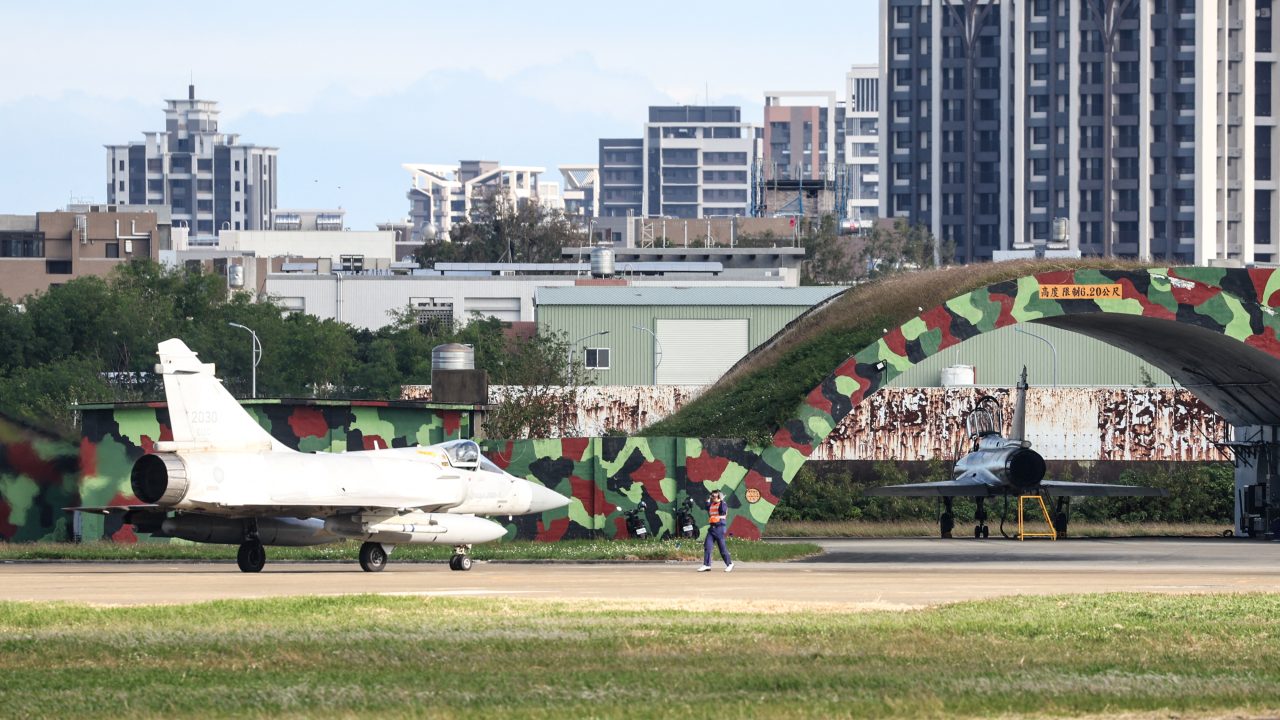
When Taiwan’s defense ministry reports the largest ever Chinese fleet has been deployed to the region, but then that fleet is absent from the ministry’s daily updates, you know the math ain’t mathing.
Last week the headlines were full of talk of major drills around Taiwan, but something was different: China had not announced any exercises. This left reporters who had already mobilized in Taipei to cover “Joint Sword 2025C” at somewhat of a loss about how to characterize what actually happened. Taiwanese and American officials also seemed split on what had taken place.
As a result, two rather different pictures of the week’s events have emerged. One is a maximalist, largest-drills-ever viewpoint. The other is rather more cautious about the level of Chinese activity.
Let’s try to build the two different cases for what happened last week.
On Sunday, December 8, China announced seven reserved airspace zones or restricted navigation areas that would be active between December 9 and December 11. These ranged all the way along the Chinese coast from Shanghai toward Hong Kong, far larger than previous drills.
On Monday December 9, Reuters reported that an unnamed Taiwanese security official said nearly 90 ships were active “near Taiwan, the southern Japanese islands and the East and South China Seas.” This is a far larger number than anything has been seen in previous drills.
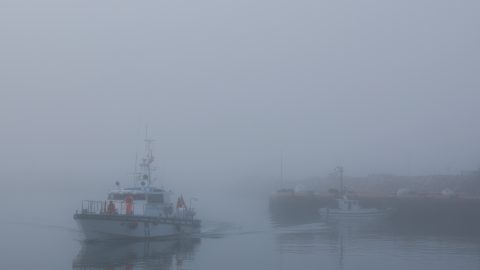
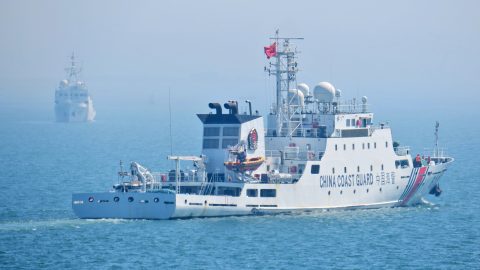
Also on December 9, Taiwan’s Coast Guard Administration released information showing that the China Coast Guard had been active around Taiwan over the weekend, and that this activity was continuing.
Taiwan saw extended PLA activity around the island from Monday through to Wednesday of that week, to a level comparable to previous drills.
On Tuesday, December 10, Taiwan’s Ministry of National Defense told the press China had deployed its largest naval fleet in decades to the region.
On Thursday, December 12, Taiwan’s Coast Guard Administration again released footage of China Coast Guard ships at sea in waters southeast of Hualian. Taiwan’s Ministry of National Defense released a video on December 13 showing encounters between the Taiwanese and Chinese navies in unspecified locations.
At a press conference on Friday, December 13, a spokesperson for China’s defense ministry said, “Whether or not to hold exercises and when to hold them is a matter for us to decide on our own according to our own needs and the situation of the struggle.”
One could be forgiven for reading all of this and believing that these were the largest drills since before then-speaker of the U.S. House of Representatives Nancy Pelosi’s visit that started the current series of periodic exercises in 2022. Domino Theory lacks the information to state clearly whether or not that statement is objectively accurate.
However, there are a series of interrogative questions we can ask that should at least leave some skepticism.
Firstly, how exactly did the numbers announced by the Ministry of National Defense for aircraft in Taiwan’s ADIZ and ships in the waters around Taiwan compare to previous exercises?
For ship numbers the figures are pretty similar per day to both Joint Sword 2024A and 2024B. For aircraft the figures were much lower per day than both 2024A and 2024B, but considering that the period of excessive activity extended for three days instead of two for 2024A and one for 2024B the total numbers are more comparable, albeit still lower.
In other words, in the region around Taiwan alone these exercises were not larger.
| Exercise | Aircraft in ADIZ per day | Aircraft-days in ADIZ | Ships in waters around Taiwan per day | Ship-days in waters around Taiwan |
| Joint Sword 2024A | 35, 47 | 82 | 26, 27 | 53 |
| Joint Sword 2024B | 111 | 111 | 26 | 26 |
| Unnamed December exercise | 16, 23, 22 | 61 | 21, 19, 16 | 56 |
Note that the defense ministry reports both incursions and a separate larger figure for aircraft “around” Taiwan. I prefer the ADIZ figure simply because it is clearer what is being measured.
Second, if there were only 20 or so ships around Taiwan, where was the fleet of nearly 90?
That figure needs to be treated with some caution because Taiwan’s defense ministry disowned it as a specific number but then still noted the “largest deployment.” Some others of those putative 90 ships can be identified roughly using Japanese defense ministry public reporting. For most, lacking any similar sources we simply can’t say.
Nonetheless, given that this figure covers waters near Taiwan, the southern Japanese islands and the East and South China Seas, the major issues are the vast amount of sea that is included, as well as the location of that area and the proximity of it to the Chinese coast. Thus, a substantial amount of that number could have simply deployed briefly from ports in China without needing to venture too far, and another fraction of it could simply be ships that were already “out” on deployments, especially in the South China Sea. Reporting from the Financial Times offers another version of this, citing Taiwanese national security officials who said that ships were left “offshore” after previous deployments.
Third, why didn’t China actually announce any exercises? It’s clear they were held, whatever the scale. In many ways this is the most interesting question, but answering it is a different article. We might ponder though that if China had held drills that were the largest in decades it would have been a waste not to publicize them, and to call them Joint Sword 2024C.
Without access to better information than has yet been released, it is hard to truly assess the scale of the drills instead of assessing the comments made about them by officials of various nationalities. However, at the very least the language of “largest fleet to the region” used last week is misleading. If China surges ships out of ports all along its coastline and out of contested South China Sea islands as well, this is not a fleet, at least not in the sense that readers and listeners will mostly understand. And it is certainly not a fleet off of or surrounding Taiwan.
None of this diminishes the fact that major exercises were held yet again and that the extended geographic distribution is a source of its own concern. Nor does it alleviate the pressure such drills put on Taiwanese personnel and equipment. But information is a weapon of its own, and the more people believe that what they read or hear about these drills is correct, the sharper that weapon becomes. More precision here would not be a bad thing.




Leave a Reply