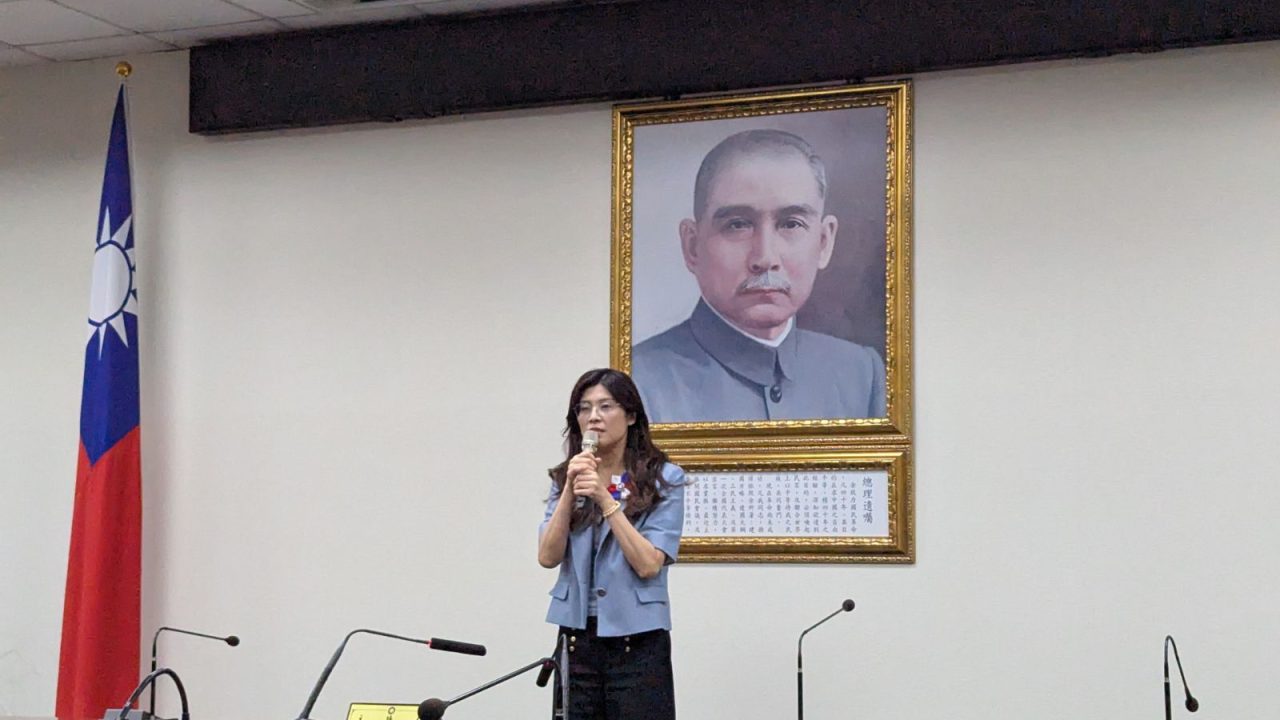
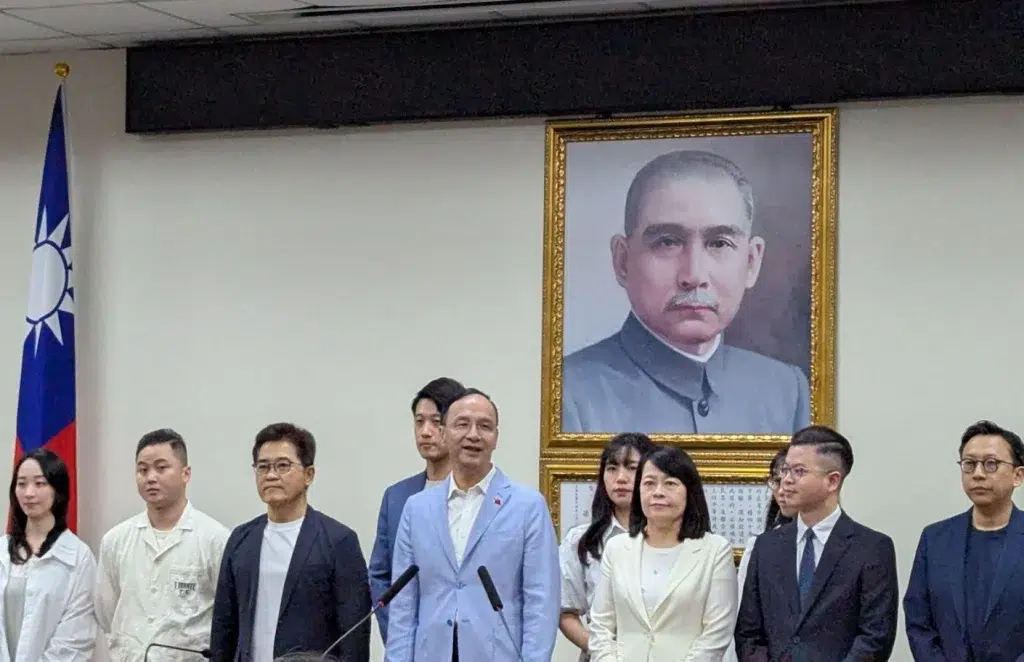
In a sweeping victory, outsider Cheng Li-wun (鄭麗文) has won the leadership election of the Chinese Nationalist Party (KMT). In a speech at the KMT party headquarters before vote counting had finished on Saturday night, outgoing Chairman Eric Chu (朱立倫) congratulated Cheng.
“I firmly believe that this election reflects our party’s commitment to democracy and unity. Under the leadership of our new party chair, I am confident that the KMT will grow stronger and more united,” Chu said.
Cheng triumphed over Hau Lung-bin (郝龍斌) and four other candidates in the contest to lead Taiwan’s main opposition party, which has lost the last three presidential elections. In a televised debate earlier this month, Cheng said that, “Taiwan and the mainland should join forces to reach new heights in human civilization.”
During the campaign, former KMT vice presidential candidate Jaw Shau-kong (趙少康) accused China of interfering in the party’s leadership election, suggesting that it was responsible for the spread of disinformation about Hau. Earlier this week, China’s Taiwan Affairs Office spokesperson Chen Binhua (陳斌華) said that “comments from some mainland netizens do not represent the officials stance” of China.
Cheng defeated her closest rival former Taipei Mayor Hau by a margin of more than 10% with 65,122 votes from KMT supporters, out of 129,867 cast across 383 polling stations across the country and overseas. The KMT has 331,135 members who were eligible to vote.
“The KMT will shoulder Taiwan’s most important responsibilities. We share the same island and the same destiny. The ruling and opposition parties must not forget their aspirations in entering politics, nor should they betray Taiwan’s future for personal gain,” Cheng said in her victory speech at party headquarters on Saturday night.
Cheng will take office on November 1 during the party’s 22nd National Congress.
At a recent Taiwan Foreign Correspondents’ Club event, Cheng outlined some of her party governance policies. She plans to push for fair nominations, encourage younger people to take over roles in the 2026 local elections, set up a “shadow cabinet,” and adopt collective party leadership.
Cheng, 55, was the youngest and only female candidate in the race. She brings the combative style she was known for as a legislator. Cheng has said she is willing to challenge Taiwan’s President Lai Ching-te (賴清德) and his Democratic Progressive Party (DPP).
Before joining the KMT in 2005, Cheng was a member of the DPP, a transition not common in Taiwanese politics. In the leadership race this fall, she enjoyed strong support from young party members, local councils and military veterans.
A Friend of China
Cheng’s victory is a win for KMT members who are skeptical of ties with the U.S. and who are eager to see a more “China friendly” approach to cross-strait relations. She is likely to advocate for more business exchanges between Taiwan and China, as well as diplomatic meetings with Chinese President Xi Jinping (習近平).
Cheng supports the 1992 Consensus, which describes the cross-strait situation as “one China under the ROC Constitution.” At the Taiwan Foreign Correspondents’ Club event, Cheng said that Taiwan “should not resort to military conflict or war. It cannot solve the problems across the Taiwan Strait, it will only create more problems.”
“We don’t want to be sacrificed, and we hope to play an active role as peace builders,” Cheng added.
Cheng opposes Lai’s proposed goal of spending 5% of Taiwan’s GDP on defense by 2030. Throughout the election campaign, Cheng argued that, in an arms race, Taiwan would be the “biggest loser.”
In the near term, Cheng will have to take a stance on whether Taiwan should raise defense spending to 3.5% of GDP. Eric Chu committed to this figure in June as part of the KMT’s campaign to convince Washington that it wasn’t trying to sabotage defense spending. Chu’s commitment came after criticism from U.S. Senator Dan Sullivan, who said in March that the KMT was “playing a dangerous game on their defense budget.”
The KMT has suffered defeats in three consecutive presidential elections, with the most recent loss coming last year. Cheng has made clear that reversing the party’s fortunes in the 2028 presidential election will be one of her top goals. But before she can take on the DPP, Cheng will first have to consolidate support among her own ranks, half of whom voted for somebody else.
In combination with its smaller ally, the Taiwan People’s Party (TPP), the KMT holds a majority in Taiwan’s parliament. The party got a boost this summer when voters chose to return all its legislators in a mass recall attempt by the green side.
The DPP posted a congratulatory message on the party’s website on Saturday night, saying it has two expectations and one reminder for the newly elected KMT chair. It hopes that the KMT can return to rational politics, prioritize national interests over party interests and work together to face Taiwan’s growing security challenges.




Leave a Reply