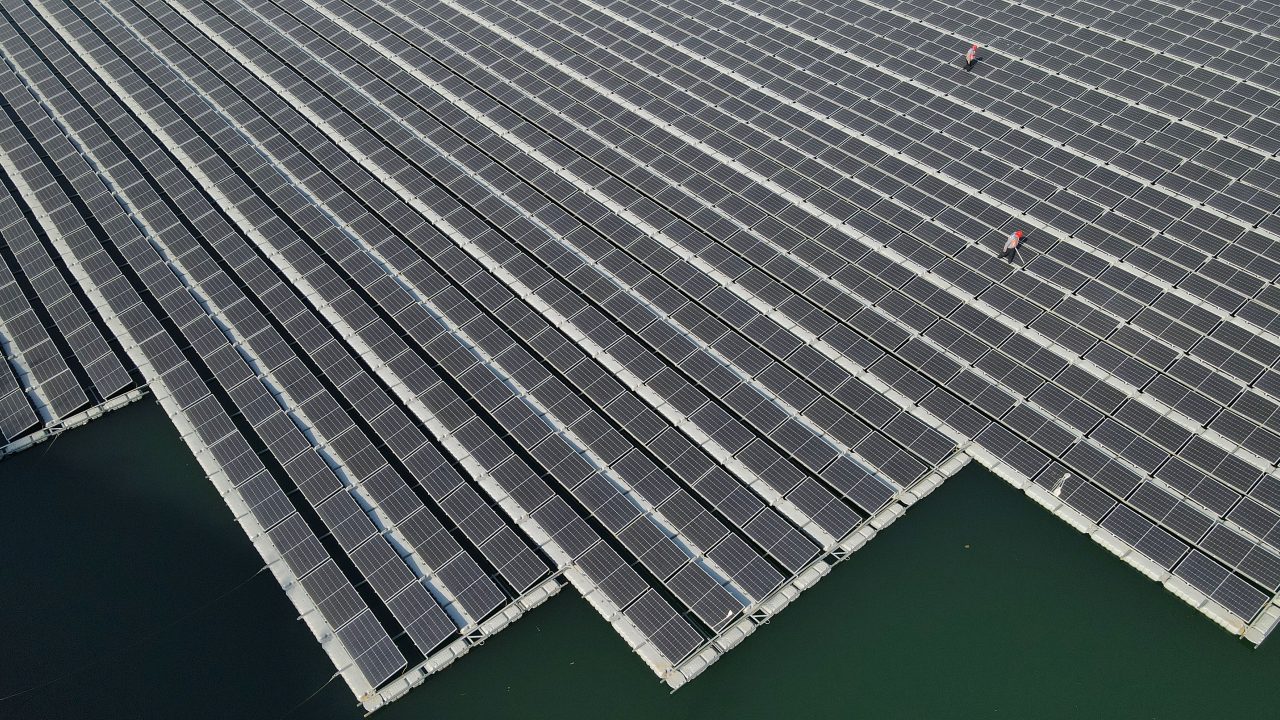
As the petrostate-presided United Nations Framework Convention on Climate Change’s 28th Conference of Parties (COP28) quarrels its way to a close for another year, on December 7, 2023, China’s state propaganda apparatus, in the guise of Xinhua News Agency, cued up its Foreign Ministry spokesperson Wang Wenbin (汪文斌) to talk about a pledge between 118 countries to triple the installed capacity of renewable energy before 2030, already one of COP28’s most optimistic headlines.
Xinhua cited comments from unspecified foreign media, some of which Beijing may well itself have planted through its extensive global web of news contacts, that China is the only major nation expected to achieve the goal, and Wang took up the thread to expound on how the Middle Kingdom has “turned from ‘followers’ to ‘forerunners’ and even ‘pacesetters’” for renewables and is “lighting up the dreams of green and low-carbon development of more countries.”
Aside from illuminating how China nurtures its domestic and global narratives, the set-piece question and answer contained subtle hints and threats, epitomizing how Beijing will wrap itself in the glory of supposed climate leadership without ever exposing itself to the parched truth that its reprehensible climate actions are returning the world towards slavery and hastening the sixth mass extinction.
Indeed, having decimated certain renewable industries of other countries to establish green tech monopolies more concentrated than OPEC for itself, China has a vested interest to push the tripling goal and can now decide who will achieve the 2030 target and who will not. On the other hand, the emphasis on capacity is telling: For all its sweeping social media panoramas of solar and wind farms, China’s actual delivery of green energy lags the installation of equipment, sometimes because it is not connected to the local grid.
For context, 95% of the globe’s new coal capacity in 2023 has also formed in the Middle Kingdom, where, in contrast to the rest of the world, the construction of coal plants is actually accelerating. Moreover, because coal is cheap, it enables China to reduce the production costs for renewables, which perversely means it can push cleaner competitors from other countries out of the market, especially when inexpensive materials for the manufacturing process are secured through unscrupulous mining practices at home and abroad. This has already happened with the solar industry and is increasingly true for batteries as well.
But that is not the only tactic Beijing has employed to achieve a stranglehold over the green transition. The low cost of the equipment for sustainable energy that it sells across the world is also guaranteed by subsidies that the Chinese government gifts to companies for so-called labor transfers.
In regions like East Turkestan (Xinjiang), a supply-chain hotspot for renewables, there is strong reason to believe that many of the people involved in these transfers are coerced or forced into work, some instances of which “may amount to enslavement as a crime against humanity,” according to Tomoya Obokata, the U.N. Special Rapporteur on Contemporary Forms of Slavery. Even when this is not the case, evidence is compelling that higher level workplace roles are reserved for Han citizens, while the local Uyghur population is routed into more menial or risky tasks.
Thus, for as long as China is permitted to dominate renewable energy and electric vehicle markets, it is holding the existential fate of many of Earth’s species, including, possibly, humankind, as hostages against its determination to perpetuate a social organization with features that are not nearly distinguishable enough from either slavery or apartheid. In a race against time to limit rising temperatures, with alternatives unable to compete, the world must purchase from its polluted and tainted supply chains or unleash climate carnage, in not such a different manner to how we have all been forced to tolerate the mania and abuses of North Korea in case it launches a nuclear bomb.
Such a situation cloaks Beijing with enormous geopolitical power, and it is not frightened to use it in ways that do not befit a benign climate partner. In reaction to U.S. restrictions on exports of chip technology that risks being put to use for the territorially covetous People’s Liberation Army, China has responded by choosing to screen the distribution of graphite, a key ingredient for the batteries that furnish greenification of energy supply and transport. According to The Economist, it is suspected of having test-run this policy with a silent attempt to hobble Sweden’s vibrant green tech industry following a diplomatic spat with the country.
Further betraying that it is more interested in political leverage than limiting warming to 1.5 degrees, Beijing has also launched verbal attacks on the European Union’s Carbon Border Adjustment Mechanism, which looks to levy a fee on imports from countries that emit large amounts of carbon during their production and thereby level the playing field for manufacturers in those that do not.
These fees will be introduced from 2026, so China’s opposition suggests that its industries such as steal plan to continue emitting significant volumes of greenhouse gasses for a while yet, which is consistent with the country’s delay in releasing key targets for reductions in carbon emissions and reports that it is seeking to prevent a fossil fuel phase-out at COP28.
Since many states and their citizens do not want to be placed in a geopolitical vice by Beijing and balk at the idea of blending forced labor with the economy of the future, they are looking to establish their own supply chains with the consequence that a mining and processing boom is unleashing. This will inevitably bring habitat destruction and water pollution to new localities, risking the survival of certain flora and fauna populations that make up the fabric of our ecosystems, an outcome that might have been partially mitigated if resource extraction responsibilities could be concentrated and organized between countries that do not behave criminally and abusively towards their own and other peoples.
And when China is not indirectly driving these assaults on our planet and its inhabitants, it is doing so far more directly. Its economy is predicated to a large degree, not on green development, but on massive over-construction of real estate and infrastructure that contributed more climate change-inducing cement to the planet between 2011 and 2013 than the U.S. did in the entire 20th century, while simultaneously consuming or fragmenting habitat, which makes it harder for other species to adapt to rising global temperatures.
Examples abound, from the colossal highway expansion currently planned through the home of rare fireflies in Guangzhou to the 11 airports constructed in Guizhou, China’s poorest province. Not uncommonly, these developments, which take place against the backdrop of a decreasing population, appear to serve political ends such as the wetland-encroaching plans to subsume Hong Kong in a Guangdong metropolis and the so-called sponge city at Xiong’an, a pet project of Xi Jinping.
The approach entwines with geopolitics and Beijing’s stability delusions, too. Running out of things to build and, perhaps, money to build them with at home, it has pumped its excess production capacity into the Belt and Road Initiative, which is generating quite a carbon footprint around the world, often with unnecessary or environmentally destructive projects. Meanwhile, dams like the proposed largest in the world, on the Yarlung Tsangbo in Tibet, offer political power over those downstream as well as electricity from broken rivers.
These projects and others that China facilitates logistically and financially are sometimes directly related to future greenhouse gas release, such as the 7-million-passenger airport just opened in Cambodia, the oil pipeline that will run from East Turkestan (Xinjiang) to the port of Gwadar in Pakistan, a petrochemical complex in Brunei and the East Africa Crude Oil Pipeline that has threatened the Albertine Graben region of Uganda, where half of Africa’s bird species can be found, and displaced thousands of people, according to over 260 NGOs, including Greenpeace and Human Rights Watch.
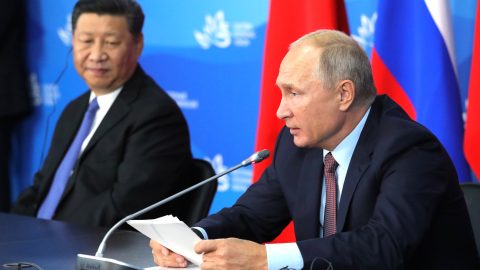
As if that was not bad enough, several of its renewable energy developments, notably with hydropower in locations like Indonesia’s Batang Toru ecosystem, risk substituting a climate crisis for a biodiversity one. And its $200 billion war-backing brotherhood with Russia is based, not a little, on imports of Moscow’s discounted oil, which again contributes to Chinese companies undercutting their more ethical counterparts from elsewhere in the world.
Indeed, as reported by The Diplomat, there is even talk of China and Russia working together to develop yet more of the latter’s oilfields on top of existing Chinese investment in the country’s fossil fuels, money that it can afford to put to use due to its continuing reticence, as the world’s highest emitter, to compensate poorer states for extreme weather damage.
Therefore, when world leaders justify their decisions to continue doing all kinds of business with the Chinese Communist Party on the grounds that it is a reliable climate partner, they are both misleading their audiences and hopelessly missing the point. Yes, the world does need to engage with Beijing on climate issues, but only with the aim of reversing and ending its climate tyranny, not perpetuating or deepening it.





Leave a Reply